INSIDE:
NEWS/STORIES/ARTICLES
Book Reviews
Columns/Opinion/Cartoon
Films
International
National
NW/Local
Recipes
Special A.C.E. Stories
Sports
Online Paper (PDF)
CLASSIFIED SECTION
Bids & Public Notices
NW Job Market
NW RESOURCE GUIDE
Archives
Consulates
Organizations
Scholarships
Special Sections
Upcoming
The Asian Reporter 19th Annual
Scholarship & Awards Banquet -
Thursday, April 20, 2017
Asian Reporter Info
Contact Us
Subscription Info. & Back
Issues
ASIA LINKS
Currency Exchange
Time Zones
More Asian Links
Copyright © 1990 - 2016
AR Home

Where EAST meets the Northwest
|
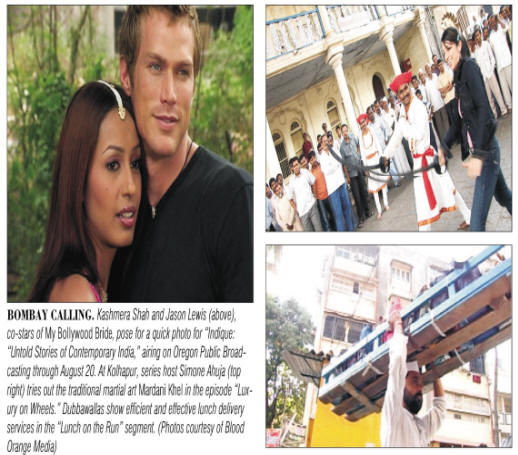
BOMBAY CALLING. Kashmera Shah and Jason Lewis (above), co-stars of My Bollywood Bride, pose for a quick photo for "Indique: "Untold Stories of Contemporary India," airing on Oregon Public Broadcasting through August 20. At Kolhapur, series host Simone Ahuja (top right) tries out the traditional martial art Mardani Khel in the episode "Luxury on Wheels." Dubbawallas show efficient and effective lunch delivery services in the "Lunch on the Run" segment. (Photos courtesy of Blood Orange Media) From The Asian Reporter, V17, #30 (July 24, 2007), page 10. Modern Indian culture takes center stage in new series By Maileen Hamto The tagline for "Indique: "Untold Stories of Contemporary India" set me to imagine a raw, honest, and introspective look at how globalization and the rapid rise of India’s young, professional middle class are changing the fabric of Indian society. Instead, the new series airing on Oregon Public Broadcasting (OPB) takes a semi-travelogue approach to what Westerners — Indian or otherwise — might find comforting when they explore Indian culture, or should they decide to go for a visit. If you’re curious about India’s offerings in terms of popular culture, the series delivers quick, easily digestible overviews — of Bollywood in particular. Author Suketi Mehta, interviewed by series host Simone Ahuja, asserts that one cannot fully understand contemporary India without exploring Bollywood. Two of the six episodes are devoted to Bollywood, the world’s largest film industry, which produces hundreds of films each year. Even episodes that are not devoted to Bollywood also tangentially discuss India’s film industry, such as the segment "Scene but not Heard," featured in the episode "Bombay’s Finest." The segment explores the practice of "playback" singing for Bollywood films. Music is a central aspect of Indian culture, and Bollywood films are reminiscent of musicals produced in Hollywood during the 1950s — complete with flawless choreography and elaborate sets and costumes. The episode "Hollywood Meets Bollywood: The Making of My Bollywood Bride" feels like it should be on the E! cable network or featured in People magazine, rather than in a documentary on OPB. The emphasis on Bollywood also gives the series a Bombay bent. One of the more memorable segments is "Lunch on the Run," which focuses on the efficient and effective lunch delivery services offered by "dubbawallas." Every day, dubbawallas deliver more than 400,000 home-cooked meals to thousands of workers all over the city. An error rate of less than one in 6 million has earned the organized group a Six Sigma designation from Forbes magazine. Every now and then, insights into the cultural divide between generations in India are expressed in the interviews. The episode "Indian Style" discusses how younger palates are favoring wines over whiskey, which has long been the most popular alcoholic beverage in India. An interesting development is the movement toward locally produced vintages, with Indian entrepreneurs perfecting the craft of producing white wines. A cultural magazine series on India needs to be Indo-centric, but insularity is not a requirement. Some of the interviews with noted Indian personalities fail to recognize that no matter how popular these personalities are in India, they may not be as easily recognizable to a mainstream audience in the U.S. and elsewhere. The segments on artist M.F. Hussain and filmmaker Mira Nair come to mind. Hardly any introduction was provided about the importance of their works. I had to consult the brochure that accompanied the screeners to read up on M.F. Hussain, known as the Father of Contemporary Indian Art. I’m familiar with the works of Mira Nair because I admire her portrayal of complex women’s issues, but mainstream U.S. audiences may not know the magnitude of her contributions to cinema. Many of the episodes emphasize how contemporary India is adopting elements from the West to produce a hybrid culture that is uniquely Indian. We learn that Indian designers are making their mark on the international fashion scene, with styles and fabrics from the Indian subcontinent. We learn rugby is becoming more popular in India, which has long been known for its allegiance to cricket. But the series is at its best when it focuses on aspects of Indian culture that are neither borrowed from the West nor mere holdovers from the country’s colonial history. My personal favorite? The episode "Oh Kerala!" focuses on the many contributions of southern India to the world, such as the healing arts of Ayurveda and the spice trade. Portlanders who fancy the annual dragon boat races along the Willamette River will appreciate the segment on snakeboat races in Allepey. Large, ornately decorated vessels carry as many as 150 rowers in the annual race through the tropical backwater canals that have given the state the title "Venice of the East." Blood Orange Media, the production company distributing the series in the U.S., touts its programming as an "insider’s perspectives into the cultural, social, and economic evolution of India." "Indique" excels in entertainment value — its heavy emphasis on Bollywood is a case in point. However it offers little in-depth commentary on social and economic trends in the subcontinent. "Indique" airs weekly on OPB through August 20. For more information, or to verify show times, call (503) 293-1982 or visit <www.opb.org>. To learn more about "Indique" and Blood Orange Media, visit <www.blood-orange.com>.
|