INSIDE:
NEWS/STORIES/ARTICLES
Book Reviews
Columns/Opinion/Cartoon
Films
International
National
NW/Local
Recipes
Special A.C.E. Stories
Sports
Online Paper (PDF)
CLASSIFIED SECTION
Bids & Public Notices
NW Job Market
NW RESOURCE GUIDE
Archives
Consulates
Organizations
Scholarships
Special Sections
Upcoming
The Asian Reporter 19th Annual
Scholarship & Awards Banquet -
Thursday, April 20, 2017
Asian Reporter Info
Contact Us
Subscription Info. & Back
Issues
ASIA LINKS
Currency Exchange
Time Zones
More Asian Links
Copyright © 1990 - 2016
AR Home

Where EAST meets the Northwest
|
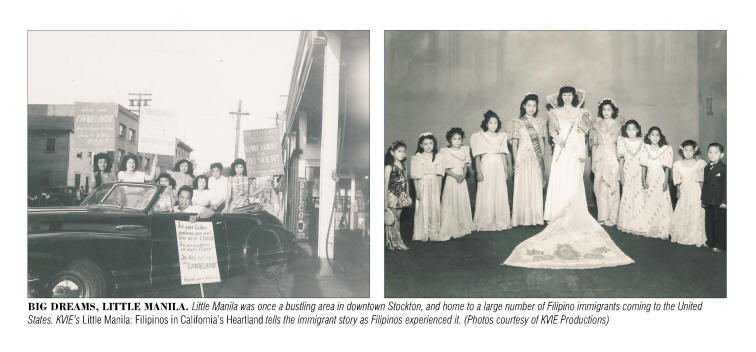
BIG DREAMS, LITTLE MANILA. Little Manila was once a bustling area in downtown Stockton, and home to a large number of Filipino immigrants coming to the United States. KVIE’s Little Manila: Filipinos in California’s Heartland tells the immigrant story as Filipinos experienced it. (Photos courtesy of KVIE Productions) From The Asian Reporter, V18, #19 (May 6, 2008), page 18. Familiar themes, ugly and redemptive Little Manila: Filipinos in California’s Heartland Directed by Marissa Aroy Produced by the KVIE Public Television ViewFinder series By Ronault L.S. Catalani Marissa Aroy’s Little Manila: Filipinos in California’s Heartland is so many things packed into less than half an hour of fine documentary, not the least of them is a knowing nudge among American immigrants, particularly those welcomed when U.S. labor was short, those no longer welcome when their laboring became shrill politics. Little Manila is harsh American history. The mission of Sacramento broadcaster and public television producer KVIE, located in California’s Central Valley, is inspiring audiences and enriching their lives through engaging programs and educational services. Little Manila does both. Of course it documents bad behavior by America’s mainstream and our disappointing leadership. Past and present. But the film’s also full of Pinoy exuberance, full of our immigrant families’ irrepressible ambition and resilience. Filipina-American filmmaker Marissa Aroy gives voice to all that. The scene is that section of most 19th- and 20th-century East Coast and West Coast cities, where fresh-off-the-boat bachelor societies have settled in. And rise to work. Little Manila’s set is old downtown Stockton. The packed hotels, the vigorous hiring, gambling, and dance halls off El Dorado (City of Gold) Street. "I’ve never seen so many Filipinos in my life," says Filipino pioneer Mr. Jimmy Ente Jr., recalling his awe when he and the elder Manong Jimmy Ente arrived in Stockton in the region’s energetic 1930s. Mr. Ente and his father joined legions of other sojourning men — Filipinos, Japanese, Chinese, Punjabis, and Mexicans among them — harvesting Pacific Coast foods, forests, and fisheries. In those early decades, as American colonial subjects, Filipinos briefly had the competitive labor advantage of something close to U.S. citizenship. It gave hardworking boys and men a certain security about crossing borders, but in the end it was no barrier against the blatant racism of American nativists — in the streets, in the press, in local, state, and federal government. At the end of long-long workweeks, cash in hand, dressed to kill, Pinoy men dating and renting white women fermented a familiar American fear, which legalized just as familiar systems of overt bigotry. Segregated movie seating. "No Filipinos Allowed" signs. As America’s economy tumbled into the Great Depression, these antecedents predictably led to mob violence, mass deportation, and ugly exclusion from U.S. immigration. As old as this awful story is, as much as its telling resonates with red hot themes of our unkind times, director Ms. Aroy and broadcaster KVIE give their viewers more. Much more. The younger and the elder Jimmy Ente; those armies of stubborn Pinoy farm workers; those battalions of loyal Filipino infantrymen; those college classes of that cool Pinay professor leading her bright next generation down the abandoned street of boarded-up buildings where Little Manila used to hum — all of them: inspire and enrich and educate. To learn more, or to purchase a copy of Little Manila, visit <www.kvie.org/programs/kvie/viewfinder/little_manila>.
|