INSIDE:
NEWS/STORIES/ARTICLES
Book Reviews
Columns/Opinion/Cartoon
Films
International
National
NW/Local
Recipes
Special A.C.E. Stories
Sports
Online Paper (PDF)
CLASSIFIED SECTION
Bids & Public Notices
NW Job Market
NW RESOURCE GUIDE
Archives
Consulates
Organizations
Scholarships
Special Sections
Upcoming
The Asian Reporter 19th Annual
Scholarship & Awards Banquet -
Thursday, April 20, 2017
Asian Reporter Info
Contact Us
Subscription Info. & Back
Issues
ASIA LINKS
Currency Exchange
Time Zones
More Asian Links
Copyright © 1990 - 2016
AR Home
The Asian Reporter's
BOOK REVIEWS
|
|
||||
|
From The Asian Reporter, V14, #49 (November 30, 2004), page 12. Memoir recalls the wisdom of barefoot doctors
"My father looked into the boy’s eyes and said, ‘I have come to talk to you. I am asking you to leave and to give me back this boy. I help people so I ask you to do the same. I try to do good. Please … Let’s work together.’" — Author Nguyen Van Quang, on Master Nguyen Van Thau talking to a bad ghost
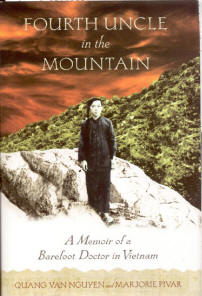
Fourth Uncle in the Mountain: A Memoir of a Barefoot Doctor in Vietnam By Quang Van Nguyen (Nguyen Van Quang) and Marjorie Pivar St. Martin’s Press, 2004 Hardcover, 352 pages, $25.95 By Polo I’ve worked with a lot of communal elders, spiritual and medicinal elders. Often these gentle men are way outside languages I can navigate. Almost always when I’m without a clue, very cool younger men interpret between us, between our worlds. Interpreters intend well, and I mean them no harm, but all three of us know that he and I construct a third world out of our elder uncle’s spoken word. An interpreter absorbs both words and meaning, knowing each aspect lugs around immeasurable mass and nuance. A good interpreter does his or her darnedest to approximate English words and phrases that denote or connote the substance of what he or she was asked to deliver. A great interpreter — that is, an intelligent and generous one — is rare. Just as rare as understanding between our distant worlds. I apologize for this, my prolonged preface in what promised to be a review of Nguyen Van Quang’s new memoir Fourth Uncle in the Mountain. A quick note, if not a more deserved acknowledgement of the difficulty of cross-cultural writing, is important, indeed necessary to credit the doubtless dogged work done between Master Quang and Fourth Uncle co-author Marjorie Pivar. Fourth Uncle reads in the direct and confident phrasing and tone true to a "barefoot doctor." That is to say, there is no National-Geographic-like emotional distancing ("these noble, if quaint, peoples believe that …"). There are no well-meaning interpreter’s estimates of what hip American readers are likely to understand. Fourth Uncle is a matter-of-fact account of stressed-out medical students playing stupid pranks, unhappy ghosts terrifying townsfolk, and so much in between. The Fourth Uncle in the title Fourth Uncle in the Mountain is the name of the author’s most esteemed teacher out of several successive priests and masters entrusted by Nguyen Van Quang’s father to discipline and school him during his youth in Viet Nam. Master Quang’s grandfather found Fourth Uncle during the 1860s, meditating at the far end of a cave complex deep inside The Forbidden Mountain (Nui Cam) of the Meking Delta in the southernmost corner of the Republic of South Viet Nam. The author’s father, the Honorable Nguyen Van Thau, studied under Fourth Uncle for nearly two decades during the troubled end of French colonial times. The author was his student in his dark, dank, and silent cave for four years during Viet Nam’s most bitter civil war years. Fourth Uncle is about father and son healers. They are organic pharmacologists and accomplished acupuncturists; they are diagnosticians in the Chinese chi system of body energy and they are practitioners of native shamanic arts. It is a memoir of two barefoot doctors’ remarkable lives — lives of stubborn devotion to discipline, to learning and tending to the suffering of literally thousands of children, adults, and perished people’s lingering spirits. The barefoot part of the profession refers to the unfortunate distinction persisting since European colonial times when urbanized elites benefited from Western-trained physicians. Doctors and institutions in developing capital economies expect cash. Conforming to their spiritual sect’s strict ethics, both father and son’s lives are committed to serving and healing without regard to reward; both remained barefoot. Fourth Uncle in the Mountain is a great story about two simply good men. It is told simply, but simplicity should never be mistaken for a lack of emotional complexity, intellectual refinement, or overwhelming humanity. It is all that.
|
||||
|
|
||||