
INSIDE:
NEWS/STORIES/ARTICLES
Book Reviews
Columns/Opinion/Cartoon
Films
International
National
NW/Local
Recipes
Special A.C.E. Stories
Sports
Online Paper (PDF)
CLASSIFIED SECTION
Bids & Public Notices
NW Job Market
NW RESOURCE GUIDE
Consulates
Organizations
Scholarships
Special Sections
Asian Reporter Info
Contact Us
Subscription Info. & Back
Issues
FOLLOW US
Facebook
ASIA LINKS
Currency Exchange
Time Zones
More Asian Links
Copyright © 1990 - 2025
AR Home
International News

TRADITION THREATENED. Fishers retrieve a net on Nguyen Tat Thanh beach in Da Nang, Vietnam. Warming oceans threaten the ocean ecology and the marine life that inhabits it. It may result in the proliferation of smaller, less nutritious fish and increase costs of fishing and consequently food. Anchovies, for instance, have an outsized role on marine ecology. They’re food for other fish that people eat, like mackerel. They are also vital to make fish meal, which is used to feed farmed fish. (AP Photo/Yannick Peterhans)
From The Asian Reporter, V35, #4 (April 7, 2025), pages 2 & 4.
Climate change and overfishing threaten Vietnam’s ancient tradition of making fish sauce
By Aniruddha Ghosal
The Associated Press
DA NANG, Vietnam — Bui Van Phong faced a choice when the Vietnam War ended 50 years ago: Stay in his small village, helping his parents carry on the family’s centuries-old tradition of making fish sauce, or join the hundreds of thousands of people fleeing his country for a better life.
Phong chose to stay behind and nurtured a business making the beloved condiment, known as nuoc mam in Vietnam, that is now in its fourth generation with his son, Bui Van Phu, 41, at the helm. Fish sauce from the village has been recognized by Vietnam as an indelible part of the country’s heritage and the younger Bui is acutely aware of what that means.
"It isn’t just the quality of fish sauce. It is also the historical value," he said.
But that heritage is under threat, and not only from giant conglomerates that mass- produce fish sauce in factories. Climate change and overfishing are making it harder to catch the anchovies essential to the condiment that underlies so much of Vietnam and southeast Asia’s food.
Anchovies thrive in large schools in nutrient-rich waters near the shore. But climate change is warming the oceans, depleting oxygen levels in the water. Scientists have long feared that this would lead to smaller fish, as large fish that need more oxygen may migrate or adapt over time by shrinking. Renato Salvatteci, who studies fisheries at the Christian-Albrecht University of Kiel in Germany, said his research into warmer periods millenia ago found support for this in the fossil record.
"If we continue with this trend of deoxygenation, anchovies will not be OK with that," he said. "Every species has a limit."
Breaching that limit will have global consequences.
Warming oceans threaten the ocean ecology and the marine life that inhabits it. It may result in the proliferation of smaller, less nutritious fish and increase costs of fishing and consequently food. Anchovies, for instance, have an outsized role on marine ecology. They’re food for other fish that people eat, like mackerel. They are also vital to make fish meal, which is used to feed farmed fish.
Overfishing compounds the problem, and geopolitical tensions in the contested waters of the South China Sea — responsible for about 12% of the global fish catch — make management difficult. The destructive industrial fishing practice of dragging large nets along the seabed, scooping up everything in a net’s path, has prevailed since the 1980s. But despite increased fishing, the amount of fish being caught has stagnated, according to a 2020 analysis of fishing trends.
Even if the world can limit long-term global warming to 2.7º Fahrenheit (1.5º Celsius) above pre-industrial levels and halve fishing intensity, the South China Sea will still lose more than a fifth of its fish stocks, warned a 2021 assessment by scientists from the University of British Columbia in Canada. In the most pessimistic scenario — temperatures rising by 7.7º F (4.3º C) — nearly all the fish disappear.
Phu, who teaches information technology by day, also works hard to perfect the fish sauce art handed down by his ancestors.
The anchovies are usually caught between January to March when they congregate off the coast of Da Nang. If they are the right species and size, they get mixed gently with sea salt and put in special terra cotta barrels. Sometimes worms or other ingredients are added to bring in different flavors. Phu ferments this for up to 18 months — stirring the mix several times a week — before it can be strained, bottled, and sold to customers.
The sea salt imparts different flavor depending on where it comes from. So does the amount of salt used, and makers have their own recipes; the Bui family uses three parts fish to one part salt. The time allowed for fermentation, and the potential addition of other fish, also affect the flavor of the final product.
But it is harder to get the perfect anchovies. The fish catch has decreased — fishermen in markets across Vietnam rue the fact that much of the fish they sell now was considered bait-size in previous decades — and it’s only the good relationships he has with anchovy fishermen that allow him to get the fish directly, avoiding high market prices. The unmistakeable aroma of fermenting fish cloaks the homes of families that still make traditional fish sauce. But Phu said that many families are thinking of getting out of the business because of high anchovy prices.
That may affect Vietnamese plans for a bigger share of the global fish sauce market — projected to increase in value from $18.5 billion in 2023 to nearly $29 billion by 2032, according to a report by Introspective Market Research. Vietnam, along with Thailand, is the world’s largest exporter of fish sauce and is hoping improvements in food safety to satisfy standards in lucrative markets like the U.S., Europe, and Japan will help cement a national brand that helps advertise Vietnamese culture to the world.
It’s hard to overemphasize how deeply the condiment is enmeshed in Vietnamese culture. Students living abroad speak of how its taste transports them back home and a top chef says it’s the foundation for flavor in the country’s cuisine. The varying taste of different brews also means everyone — from top businessmen to daily wage workers — has their own opinions about which is the best.
Phu said that each family has their own secrets about making fish sauce. And, nearly fifty years since his father chose to stay back and take care of the family business, he’d like to pass those on to his own son. But he knows that it’ll depend on whether enough anchovies thrive in the sea for the craft to be viable.
"Fish sauce to me is not just a condiment for cooking. But it is our craft, our culture, our tradition that need to be preserved, safeguarded, and inherited," he said.
Associated Press journalist Hau Dinh contributed to this report. The Associated Press’ climate and environmental coverage receives financial support from multiple private foundations. AP is solely responsible for content.
* * *
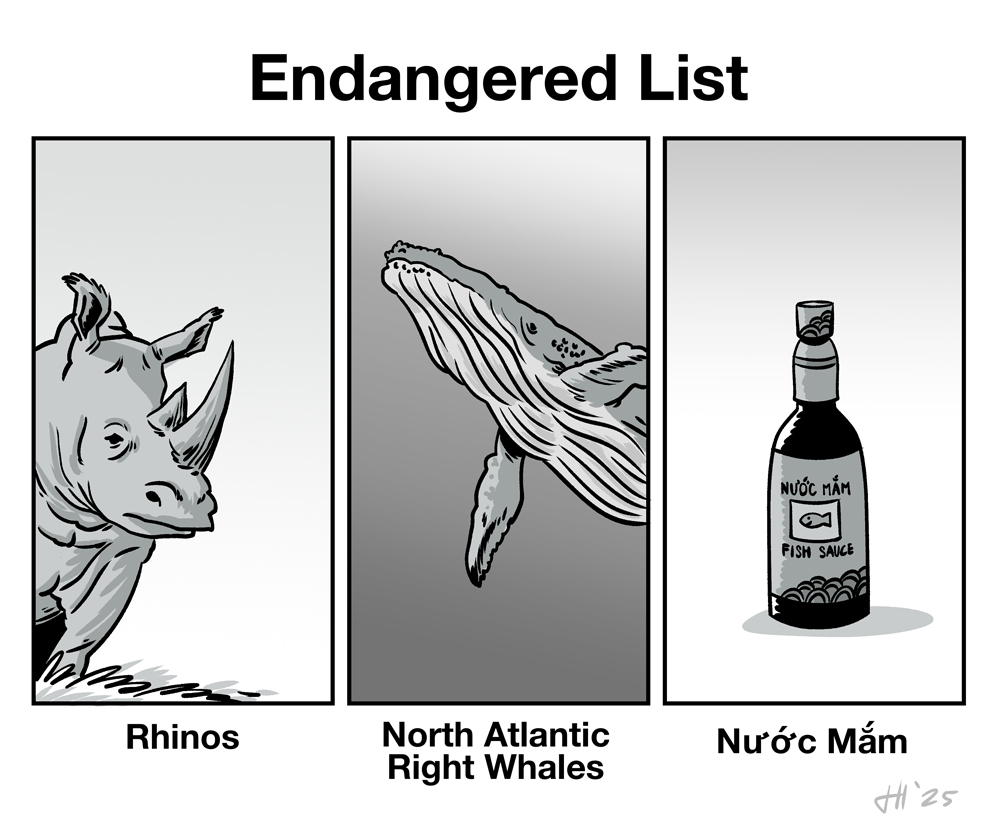
Cartoon by Jonathan Hill
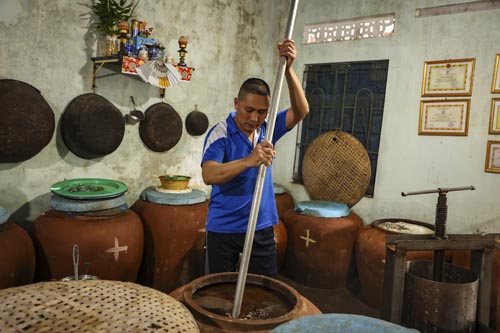
FLAVORFUL ADDITION. Phan Cong Quang makes fish sauce in his home in Nam O fishing village in Da Nang, Vietnam. (AP Photos/Yannick Peterhans)
Dishes made with fish sauce are prepared at Chapter Dining, a fine dining restaurant, including a water bug, left, in Hanoi, Vietnam. (AP Photos/Yannick Peterhans)

Phan Cong Quang makes fish sauce in his home in Nam O fishing village in Da Nang, Vietnam. (AP Photos/Yannick Peterhans)
From The Asian Reporter, V35, #4 (April 7, 2025), page 4.
How one chef in Vietnam uses fish sauce as the foundation for flavor
By Aniruddha Ghosal
The Associated Press
Cartoon by Jonathan Hill
HANOI, Vietnam — The taste of banh te — a steamed rice cake with an enticing filling of mushrooms and minced pork — captures the quintessence of northern Vietnamese cuisine: Humble ingredients, prepared perfectly and often enjoyed with a funky fish sauce dip.
This balance of flavors is what Quang Dung, the chef and owner of Chapter Dining in Hanoi, sought in his modern take on the dish. His version of banh te is unapologetically fancy. The steamed rice cake is enriched with pork stock and served with a raw scallop and pickled daikon shavings. Freshness comes from coriander used several ways, sweetness from fried shallot oil, and a delicate floral essence extracted from a giant water bug used in northern Vietnamese cooking.
And then, a splash of fish sauce — or nuoc mam — brings it all together in a savory broth that suffuses the dish.
"Fish sauce is one of the foundations for flavor," he said.
It’s also the basis for Vietnam’s diverse and vibrant cuisine. Just a drop of the amber liquid can transform a dish by boosting umami and savory notes. Made by fermenting fish — often anchovies that are getting harder to catch because of climate change — in salt for many months, the taste of each bottle varies depending on factors like the ratio of salt to fish or the length of fermentation.
Fish sauce is a staple across Vietnam, used in a variety of dishes. As a dipping sauce for spring rolls or savory crepes called banh xeo. In marinades for grilled meat dishes like Hanoi’s pork and noodle classic called bun cha. In salad dressings and in braised meat dishes like the southern classic where pork is cooked in bittersweet caramel and fish sauce. Much of Vietnam’s cuisine is shaped by the decades of hardship during and after the Vietnam War, but today its economy and its cities are booming. And fish sauce is finding its way into unusual applications.
In Hanoi, fish sauce is used in some cocktails to add umami, and Dung has used it to add a Vietnamese twist to French hollandaise sauce and even flavor ice cream.
"It is very versatile," he said. "A lot of fun to use and to explore."
Dung’s culinary explorations began early. His mother taught him to cook at 10 so he could feed himself while his banker parents worked long hours. He learned how to make rice, fry eggs, and boil vegetables. Soon after, he was braising pork and making spicy fried rice. Growing up, he assumed everyone could cook — after all, his friends in Hanoi could. But it wasn’t until he moved to the United Kingdom as a teenager to finish high school that he realized this wasn’t the case.
He eventually studied finance in coastal Devon, but while working part-time in restaurants, he fell in love with all things food: learning from his peers, consuming cookbooks by top chefs, and spending all his savings to eat out at restaurants. "When you’re 18, you’re a sponge. You absorb everything," he said.
He came back to Vietnam in 2013 and got a job working in a bank. But every evening, he worked a second job — as a junior chef for a five-star hotel in Hanoi at night. He eventually quit both jobs in 2015 and started a gastropub in Hanoi. That didn’t go according to plan as he "managed to do everything wrong." More failures followed — he calls them "lessons in my dictionary" — but in 2021 he opened Chapter Dining, a fine dining restaurant in the heart of Hanoi’s Old Quarter that celebrates local, seasonal produce and the cooking traditions of Vietnam’s mountainous north.
The restaurant, with its facade of steel slats, leads to an open kitchen where Dung and his team regularly create a 14-course tasting menu that won it a spot in the coveted Michelin Guide Hanoi in 2023 and 2024.
"I can finally call it ... my restaurant, my food, my philosophy," he said.
Central to that philosophy is sustainability. Each menu is seasonal — warm, comforting dishes for the cold months and fresh, lighter dishes in the summer — and the ingredients are locally sourced. Given the erratic weather in the climate-vulnerable country, this means that he can’t always be sure of what produce will be available. So the menu adapts, letting nature decide, and the bottle of fish sauce is never too far away.
"Fish sauce isn’t just about saltiness. It is as much about umaminess. It is magic," he said, adding that he hoped more people would cook with fish sauce.
A good starting point, he suggested, is to use it to add a bit of that magic to the humble omelet. Three eggs, two teaspoons of fish sauce, a heap of finely diced spring onions all beaten together. Add pork fat to a hot pan and roll the eggs around.
"And then you’ve got a very nice fish sauce omelet. That goes down really well with rice," he said.
The Associated Press’ climate and environmental coverage receives financial support from multiple private foundations. AP is solely responsible for content.
* * *
Read the current issue of The Asian Reporter in its entirety!
Go to <www.asianreporter.com/completepaper.htm>!