
INSIDE:
NEWS/STORIES/ARTICLES
Book Reviews
Columns/Opinion/Cartoon
Films
International
National
NW/Local
Recipes
Special A.C.E. Stories
Sports
Online Paper (PDF)
CLASSIFIED SECTION
Bids & Public Notices
NW Job Market
NW RESOURCE GUIDE
Consulates
Organizations
Scholarships
Special Sections
Asian Reporter Info
Contact Us
Subscription Info. & Back
Issues
FOLLOW US
Facebook
ASIA LINKS
Currency Exchange
Time Zones
More Asian Links
Copyright © 1990 - 2026
AR Home
International News
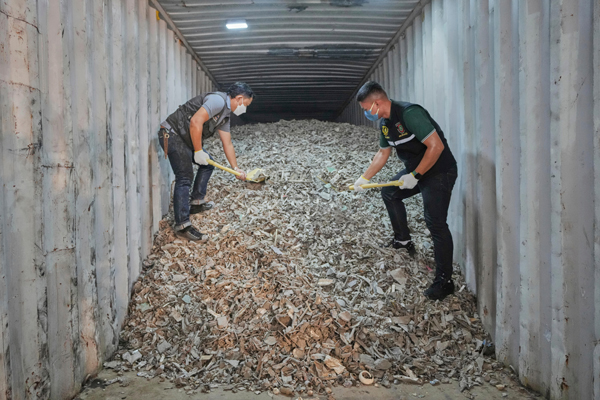
WASTE WOES. Thai officials show samples of illegally imported electronic waste from the United States, which they say they seized at a Bangkok port, during a press conference in Bangkok, Thailand, in this May 14, 2025 file photo. (AP Photo/Sakchai Lalit, File)
From The Asian Reporter, V36, #3 (March 2, 2026), page 4.
Malaysia bans e-waste imports, vows to end illegal dumping
KUALA LUMPUR, Malaysia (AP) — Malaysia has announced an immediate and full ban on the importation of electronic waste, as the government vowed the country would not be a "dumping ground" for the world’s waste.
The Malaysian Anti-Corruption Commission (MACC) said in a statement that all electronic waste, commonly known as e-waste, would be reclassified under the "absolute prohibition" category effective immediately. This removes the discretionary power previously given to the Department of Environment to grant exemptions for the importation of certain e-waste.
Environmental advocates have long urged stronger action. E-waste — discarded electronic products such as computers, phones, and appliances — can contain toxic substances and heavy metals including lead, mercury, and cadmium that pollute soil and water resources if improperly processed or dumped.
"E-waste is no longer permitted," MACC chief Azam Baki said in the statement, vowing "firm and integrated enforcement action" to prevent illegal imports.
Malaysia has previously grappled with large volumes of imported e-waste, much of it suspected to be illegal and hazardous to human health and the environment. Authorities have seized hundreds of containers of suspected e-waste at ports in recent years and issued notices for return to exporters.
The ban comes as authorities widen a corruption inquiry tied to e-waste management. Last month, MACC detained and remanded the director-general of the environment department and his deputy over alleged abuse of power and corruption involving e-waste oversight. The probe has also seen authorities freeze bank accounts and seize cash linked to the case.
The Home Ministry in a social media post vowed the government would bolster efforts to combat the smuggling of e-waste into the country.
"Malaysia is not a dumping ground for the world’s waste," it said. "E-waste is not just garbage but a serious threat to the environment, people’s health, and national security."
Neighboring Indonesia has also pushed back against attempts to ship toxic electronic waste into the country.
Late last year, the government said it seized more than 70 containers of hazardous e-waste, primarily from the United States, at a port on Batam Island. In January, four of the containers — carrying used computers, hard drives, audio-video devices, modems, power boards, and printed circuit boards — were shipped back to the U.S.
Southeast Asia has become a frequent destination for such shipments after China moved to ban most foreign waste imports beginning in 2018, prompting exporters to seek alternative sites with lower recycling costs and weaker enforcement, though governments in the region have increasingly tightened controls.
* * *
Read the current issue of The Asian Reporter in its entirety!
Go to <www.asianreporter.com/completepaper.htm>!