
INSIDE:
NEWS/STORIES/ARTICLES
Book Reviews
Columns/Opinion/Cartoon
Films
International
National
NW/Local
Recipes
Special A.C.E. Stories
Sports
Online Paper (PDF)
CLASSIFIED SECTION
Bids & Public Notices
NW Job Market
NW RESOURCE GUIDE
Consulates
Organizations
Scholarships
Special Sections
Asian Reporter Info
Contact Us
Subscription Info. & Back
Issues
FOLLOW US
Facebook
ASIA LINKS
Currency Exchange
Time Zones
More Asian Links
Copyright © 1990 - 2026
AR Home
International News
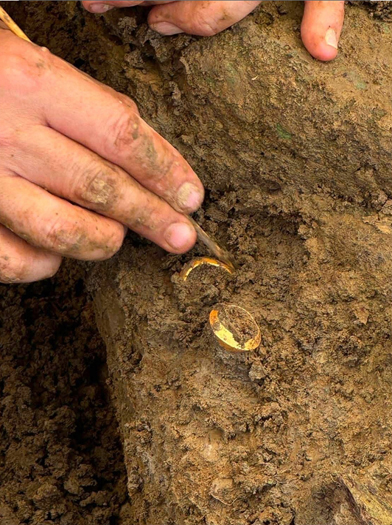
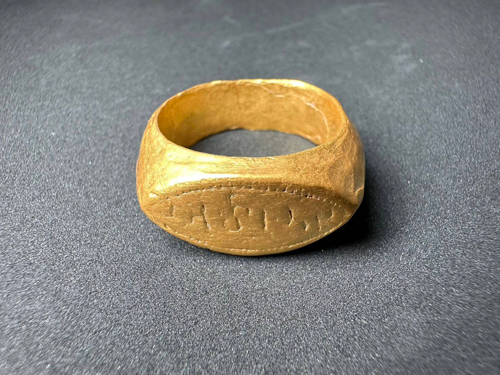
ANCIENT ADORNMENTS. An archaeologist shows two rings with human bones during an ongoing dig at the Don Yai Thong archeological site in Phetchaburi province, Thailand, on July 2, 2026. One ring was engraved with characters believed to be Bhrami script, an ancient Indian writing system, and the other ring was a plain gold ring without any pattern. The Don Yai Thong archaeological site was discovered early this year after residents found pieces of ancient bronze drums in a rice field, leading to further excavation. (The Fine Arts Department via AP)
From The Asian Reporter, V36, #8 (August 3, 2026), page 3.
Gold rings around 2,000 years old found during dig at Thailand archaeological site
BANGKOK (AP) — Two gold rings aged around 2,000 years old were discovered during an excavation at a new archaeological site in western Thailand, officials said.
The rings were found with human bones during an ongoing dig at the Don Yai Thong archaeological site in Phetchaburi province in July, the Thai government’s Fine Arts Department said in a statement.
One ring was engraved with characters believed to be Bhrami script, an ancient Indian writing system. An initial assessment by experts identified the script reading as "pusarakhitasa," meaning "the one protected by Pushya," said to be one of the most auspicious zodiac signs in Indian astronomy, the department said.
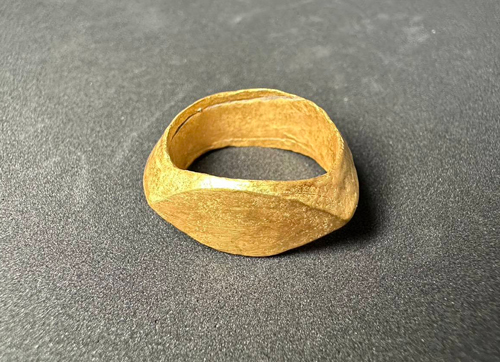
The other ring found with the same skeletal remains is a plain gold ring without any pattern. Experts believe the rings’ owner may have been a merchant of the Indian ancient caste system Vaishyas, the department said.
The Don Yai Thong archaeological site, about 80 miles southwest of the capital of Bangkok, was discovered early this year after residents found pieces of ancient bronze drums in a rice field, leading to further excavation.
The site was dated to a late prehistoric era in Thailand, a period of human settlement also known as the Iron Age, established to be around 1,500 to 2,500 years ago.
Since February, archaeologists have discovered eight human skeletons, bronze and gold jewelry, pottery, and other artifacts indicating a ceremonial burial of wealthy people or members of the society’s upper classes.
The excavation is expected to be complete in late August, with plans to showcase the archaeological finds to the public, the Fine Arts Department said.
* * *
Read the current issue of The Asian Reporter in its entirety!
Go to <www.asianreporter.com/completepaper.htm>!