
INSIDE:
NEWS/STORIES/ARTICLES
Book Reviews
Columns/Opinion/Cartoon
Films
International
National
NW/Local
Recipes
Special A.C.E. Stories
Sports
Online Paper (PDF)
CLASSIFIED SECTION
Bids & Public Notices
NW Job Market
NW RESOURCE GUIDE
Consulates
Organizations
Scholarships
Special Sections
Asian Reporter Info
Contact Us
Subscription Info. & Back
Issues
FOLLOW US
Facebook
ASIA LINKS
Currency Exchange
Time Zones
More Asian Links
Copyright © 1990 - 2026
AR Home
My Turn
|
 |
From The Asian Reporter, V36, #7 (July 6, 2026), pages 6 & 12.
5 simple rules to find a great Chinese restaurant
As a Chinese American, a common question I’m asked by my friends who aren’t Chinese is, "Wayne, what Chinese restaurant would you recommend?" Having lived in the U.S. all my life, as well as spending a lot of time in China, Hong Kong, and Taiwan, I’m pretty confident in my Chinese culinary critical skills, or CCCS for short. People can usually count on me to provide a handful of great Chinese restaurants, at least in my area of town.
Having sampled a multitude of Chinese restaurants in my life, I’ve experienced a wide variety of Chinese cuisines across the scale, from the absolutely sublime to food that requires one to put quotation marks around the word "Chinese" in order to specify that what is being presented as Chinese food is really just an approximation of what someone who doesn’t really know anything thinks Chinese food is supposed to be.
With my experience and critical eye (and tongue) to know what’s what, I thought it might be helpful to create a handy guide anyone can use to help quickly determine whether a Chinese restaurant is, in fact, Chinese, or "Chinese."
Before providing guidelines based on my CCCS, I think it’s important to stipulate that I am not focusing my attention on really high-end Michelin-star rated Chinese restaurants that ultimately cost an arm and a leg. My uncle in Hong Kong is the owner of Lei Garden in China and Hong Kong, which is a very prestigious and luxurious Chinese restaurant group found throughout the world. When I visit him there, I basically camp out at one of his restaurants morning, noon, and night. I admit it — I’m a Lei Garden groupie.
If you are planning to spend a lavish amount of money on Chinese food, you don’t need my help finding a place. No, what is more satisfying to me is locating the hidden gem — the hole in the wall in the strip mall joint. Finding the diamond in the rough is the name of the game.
So, without further ado, I present, "Wayne’s 5 simple rules to find a great Chinese restaurant."
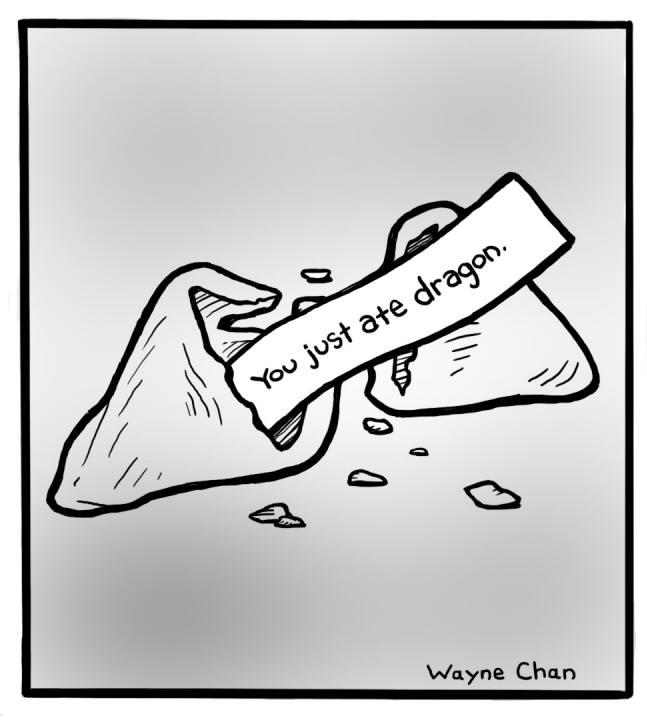
#1 — When you see a Chinese restaurant, pay attention to the restaurant name. If it makes grammatical sense, be wary. Stay away from restaurants where something is golden. "Golden Palace" or "Golden Dragon" are big red flags. You can be sure there’s nothing golden in the establishment, and why a golden dragon would even translate into something tasty is beyond me.
On the other hand, if a restaurant has a name that in English language terms seems non-sensical, you may have hit on something good. If a restaurant has a name like "3 Hen Green Pot" or "China Heen," park the car. This may be a winner.
#2 — While approaching the restaurant, be sure to look for a sign showing the hours of operation. If the sign says the restaurant should be currently open, but the doors are locked, that’s a good indication it’s a place worth trying. Always remember, a good Chinese restaurant uses the hours of operations sign as more or less an approximation, not something to strictly follow.
#3 — If the restaurant name is non-sensical enough and it happens to be open when it’s supposed to be, proceed to the lobby. Then the next thing to watch for is how attentive the staff is when you walk in. If they approach you with a smile and a warm greeting and quickly have menus ready to seat you, be very cautious. Prompt and friendly service is often a warning sign. If you don’t feel inclined to leave immediately, you’ll need to look for other cues before taking a seat at a table.
If, on the other hand, you wait for a good 5 minutes as harried food servers are walking in and out of the kitchen carrying hot platters of food to patrons, that is a good sign. Add two points if the serving staff actually sees you and still keeps you waiting for another 10 minutes.
#4 — While walking to your table, pay attention to the floor. If it’s vinyl tiles or linoleum and slick with so much grease that you could oil skate to your table, slide over as safely as you can and take a seat. More than likely, you’re in for a treat.
#5 — After perusing the menu and considering some preliminary choices, once the server arrives and is ready to take your order, a good test is to ask if the kitchen is able to make a substitution, such as switching chicken to shrimp in a dish. If the server readily agrees to make the change, it’s still not too late for you to get up and grab a quick bite at the McDonald’s across the street.
On the other hand, if the server replies with, "the dish is no good that way," or even starts arguing with you about your request, you’ve hit nirvana.
We once went to a Chinese restaurant and specifically asked the server if they could not put monosodium glutamate (MSG) in any of the food, as it gives my wife a headache. Chinese restaurants often use MSG as a flavor enhancer. Ten minutes after digging into the food we ordered, my wife Maya started to feel a dull ache at the back of her neck.
We immediately checked with our server. I said, "Excuse me — we specifically asked you not to put any MSG in, right?" She replied, "Yes, that’s why I told the cook to put less in for your dishes. If we don’t put any in, it won’t taste right."
I’ve put these guidelines together with tongue planted firmly in cheek, but I do believe there’s a glimmer of truth running through them.
That truth is, there’s a time and place for everything. An amazing meal with top-notch service and a glitzy setting? You bet, but there’s something to be said for a small restaurant that focuses on one thing and one thing only — serving great food and nothing but that.
More often than not, that’s just fine with me.
Humor writer Wayne Chan lives in the San Diego area; cartoonist Wayne Chan is based in the Bay Area.
Read the current issue of The Asian Reporter in its
entirety!
Go to <www.asianreporter.com/completepaper.htm>!
Opinions expressed in this newspaper are those of the
authors and not necessarily those of this publication.