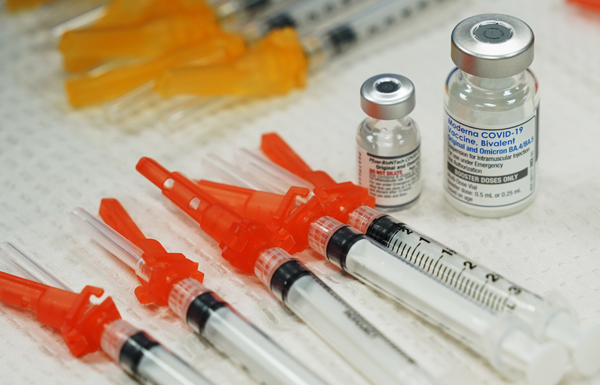
OMICRON HOLDING ON. Pfizer, left, and Moderna bivalent
COVID-19 vaccines are readied for use at a clinic in Richmond.
Virginia. (AP Photo/Steve Helber)
From The Asian Reporter, V32, #12 (December 5, 2022),
page 10.
After a year, omicron still driving COVID
surges and worries
By Laura Ungar
The Associated Press
A year after omicron began its assault on humanity, the
ever-morphing coronavirus mutant drove COVID-19 case counts
higher in many places just as Americans gathered for
Thanksgiving. It was a prelude to a wave that experts expect to
soon wash over the U.S.
Phoenix-area emergency physician Dr. Nicholas Vasquez said
his hospital admitted a growing number of chronically ill people
and nursing home residents with severe COVID-19 in November.
"It’s been quite a while since we needed to have COVID
wards," he said. "It’s making a clear comeback."
Nationally, new COVID cases averaged around 39,300 a day as
of November 22 — far lower than last winter but a vast
undercount because of reduced testing and reporting. About
28,000 people with COVID were hospitalized daily and about 340
died.
Cases and deaths were up from two weeks earlier. Yet a fifth
of the U.S. population hasn’t been vaccinated, most Americans
haven’t gotten the latest boosters, and many have stopped
wearing masks.
Meanwhile, the virus keeps finding ways to avoid defeat.
The omicron variant arrived in the U.S. just after
Thanksgiving last year and caused the pandemic’s biggest wave of
cases. Since then, it has spawned a large extended family of
sub-variants, such as those most common in the U.S. now: BQ.1,
BQ.1.1, and BA.5. They edged out competitors by getting better
at evading immunity from vaccines and previous illness — and
sickening millions.
Carey Johnson’s family got hit twice. She came down with
COVID-19 in January during the first omicron wave, suffering
flu-like symptoms and terrible pain that kept her down for a
week. Her son Fabian Swain, 16, suffered much milder symptoms in
September when the BA.5 variant was dominant.
Fabian recovered quickly, but Johnson had a headache for
weeks. Other problems lingered longer.
"I was like, ‘I cannot get it together.’ I could not get my
thoughts together. I couldn’t get my energy together," said
Johnson, 42, of Germantown, Maryland. "And it went on for months
like that."
Hot spots emerge
Some communities are being particularly hard hit right now.
Tracking by the Mayo Clinic shows cases trending up in states
such as Florida, Arizona, Colorado, and New Mexico.
In Arizona’s Navajo County, the average daily case rate is
more than double the state average. Dr. James McAuley said 25 to
50 people a day were testing positive for the coronavirus at the
Indian Health Service facility where he works. Before, they saw
just a few cases daily.
McAuley, clinical director of the Whiteriver Indian Hospital,
which serves the White Mountain Apache Tribe, said they are
"essentially back to where we were with our last big peak" in
February.
COVID-19 is part of a triple threat that also includes flu
and the virus known as RSV (respiratory syncytial virus).
Dr. Vincent Hsu, who oversees infection control for
AdventHealth, said the system’s pediatric hospital in Orlando is
nearly full with kids sickened by these viruses. Dr. Greg
Martin, past president of the Society of Critical Care Medicine,
sees a similar trend elsewhere.
Pediatric hospitals’ emergency departments and urgent care
clinics are busier than ever, said Martin, who practices mostly
at Grady Memorial Hospital in Atlanta. "This is a record
compared to any month, any week, any day in the past," he said.
Looking to the future, experts see the seeds of a widespread
U.S. wave. They point to what’s happening internationally — a
BA.5 surge in Japan, a combination of variants pushing up cases
in South Korea, the start of a new wave in Norway.
Some experts said the U.S. wave could begin during the
holidays as people gathered indoors. Trevor Bedford, a biologist
and genetics expert at the Fred Hutchinson Cancer Research
Center, said it could peak at around 150,000 new cases a day,
about what the nation saw in July.
A new wave would be rough, said Dr. Mark Griffiths, medical
director of the emergency department of Children’s Health Care
of Atlanta-Spalding Hospital. "So many systems are on the brink
of just being totally overburdened that if we get another COVID
surge on top of this, it’s going to make some systems crack."
One bright spot? Deaths are likely to be much lower than
earlier in the pandemic. About 1 in 2,000 infections lead to
death now, compared with about 1 in 200 in the first half of
2020, Bedford said.
Omicron’s yearlong reign
The same widespread immunity that reduced deaths also pushed
the coronavirus to mutate. By the end of last year, many people
had gotten infected, vaccinated, or both. That "created the
initial niche for omicron to spread," Bedford said, since the
virus had significantly evolved in its ability to escape
existing immunity.
Omicron thrived. Mara Aspinall, who teaches biomedical
diagnostics at Arizona State University, noted that the first
omicron strain represented 7.5% of circulating variants by
mid-December and 80% just two weeks later. U.S. cases at one
point soared to a million a day. Omicron generally caused less
severe disease than previous variants, but hospitalizations and
deaths shot up given the sheer numbers of infected people.
The giant wave ebbed by mid-April. The virus mutated quickly
into a series of sub-variants adept at evading immunity. A
recent study in the journal Science Immunology says this
ability to escape antibodies is due to more than 30 changes in
the spike protein studding the surface of the virus.
Omicron evolved so much in a year, Bedford said, it’s now "a
meaningless term."
That rapid mutation is likely to continue.
"There’s much more pressure for the virus to diversify," said
Shishi Luo, head of infectious diseases for Helix, a company
that supplies viral sequencing information to the U.S. Centers
for Disease Control and Prevention (CDC).
Doctors said the best protection against the bubbling stew of
sub-variants remains vaccination. And officials said Americans
who got the new combination booster targeting omicron and the
original coronavirus are currently better protected than others
against symptomatic infection.
Dr. Peter Hotez, co-director of the Center for Vaccine
Development at Texas Children’s Hospital, said getting the
booster, if you’re eligible, is "the most impactful thing you
could do."
Doctors also urge people to continue testing, keep up
preventive measures such as masking in crowds, and stay home
when sick.
"COVID is still a very significant threat, especially to the
most vulnerable," said Dr. Laolu Fayanju of Oak Street Health in
Cleveland, which specializes in caring for older adults. "People
have to continue to think about one another. We’re not
completely out of the woods on this yet."
Associated Press writer Heather Hollingsworth contributed
from Mission, Kansas.
The Associated Press Health and Science Department receives
support from the Howard Hughes Medical Institute’s Department of
Science Education.
The AP is solely responsible for all content.


