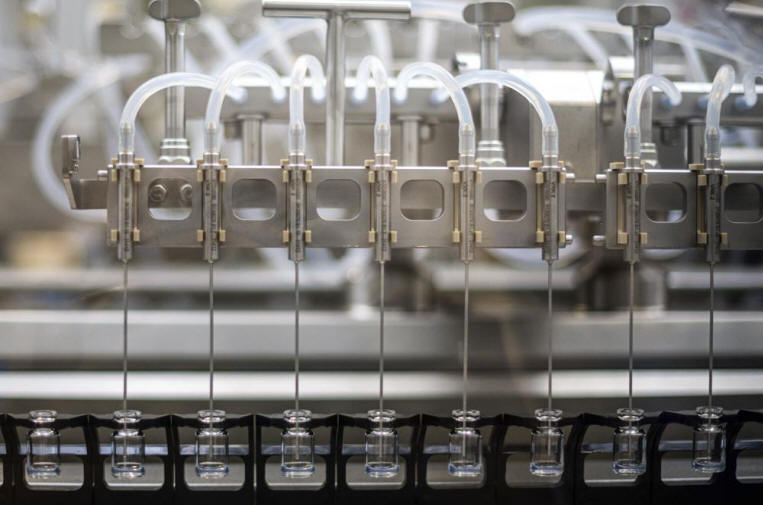
This photo provided by Pfizer shows production of Pfizer’s
COVID-19 vaccine for children under age 5 in Puurs, Belgium, in
May of 2022. U.S. health advisers have recommended COVID-19
vaccines for infants, toddlers, and preschoolers — the last
group without the shots — in mid June. Since the start of the
pandemic, about 480 children under age 5 are counted among the
nation’s more than 1 million COVID-19 deaths, according to
federal data. (Photo courtesy of (Pfizer)
Asian Reporter web extra, June 26, 2022
U.S. opens COVID vaccine to little kids
By Mike Stobbe
The Associated Press
NEW YORK (AP) — The U.S. opened COVID-19 vaccines to infants,
toddlers, and preschoolers on June 18.
The shots finally became available last week, expanding the
nation’s vaccination campaign to children as young as 6 months.
Advisers to the Centers for Disease Control and Prevention
(CDC) recommended the vaccines for the littlest children, and
the final signoff came hours later from Dr. Rochelle Walensky,
the agency’s director.
"We know millions of parents and caregivers are eager to get
their young children vaccinated, and with today’s decision, they
can," Walensky said in a statement.
While the Food and Drug Administration (FDA) approves
vaccines, it’s the CDC that decides who should get them.
The shots offer young children protection from
hospitalization, death, and possible long-term complications
that are still not clearly understood, the CDC’s advisory panel
said.
The government has already been gearing up for the vaccine
expansion, with millions of doses ordered for distribution to
doctors, hospitals, and community health clinics around the
country.
Roughly 18 million kids will be eligible, but it remains to
be seen how many will ultimately get the vaccines. Less than a
third of children ages 5 to 11 have done so since vaccination
opened up to them last November.
Here are some things to know:
WHAT KINDS ARE AVAILABLE?
Two brands — Pfizer and Moderna — got the green light on June
17 from the FDA and June 18 from the CDC. The vaccines use the
same technology but are being offered at different dose sizes
and number of shots for the youngest kids.
Pfizer’s vaccine is for children 6 months to 4 years old. The
dose is one-tenth of the adult dose, and three shots are needed.
The first two are given three weeks apart, and the last at least
two months later.
Moderna’s is two shots, each a quarter of its adult dose,
given about four weeks apart for kids 6 months through 5 years
old. The FDA also approved a third dose, at least a month after
the second shot, for children with immune conditions that make
them more vulnerable to serious illness.
HOW WELL DO THEY WORK?
In studies, vaccinated youngsters developed levels of
virus-fighting antibodies as strong as young adults, suggesting
that the kid-size doses protect against coronavirus infections.
However, exactly how well they work is hard to pin down,
especially when it comes to the Pfizer vaccine.
Two doses of Moderna appeared to be only about 40% effective
at preventing milder infections at a time when the omicron
variant was causing most COVID-19 illnesses. Pfizer presented
study information suggesting the company saw 80% with its three
shots. But the Pfizer data was so limited — and based on such a
small number of cases — that experts and federal officials say
they don’t feel there is a reliable estimate yet.
SHOULD MY LITTLE ONE BE VACCINATED?
Yes, according to the CDC. While COVID-19 has been the most
dangerous for older adults, younger people, including children,
can also get very sick.
Hospitalizations surged during the omicron wave. Since the
start of the pandemic, about 480 children under age 5 are
counted among the nation’s more than 1 million COVID-19 deaths,
according to federal data.
"It is worth vaccinating even though the number of deaths are
relatively rare, because these deaths are preventable through
vaccination," said Dr. Matthew Daley, a Kaiser Permanente
Colorado researcher who sits on the CDC’s advisory committee.
In a statement, President Joe Biden urged parents to get them
for their young children as soon as possible
WHICH VACCINE SHOULD MY CHILD GET?
Either one, said Dr. Peter Marks, the FDA’s vaccine chief.
"Whatever vaccine your healthcare provider, pediatrician has,
that’s what I would give my child," Marks said.
The doses haven’t been tested against each other, so experts
say there’s no way to tell if one is better.
One consideration: It takes roughly three months to complete
the Pfizer three-shot series, but just one month for Moderna’s
two shots. So families eager to get children protected quickly
might want Moderna.
WHO’S GIVING THE SHOTS?
Pediatricians, other primary care physicians, and children’s
hospitals are planning to provide the vaccines. Limited
drugstores will offer them for at least some of the under-5
group.
U.S. officials expect most shots to take place at
pediatricians’ offices. Many parents may be more comfortable
getting the vaccine for their kids at their regular doctor,
White House COVID-19 coordinator Dr. Ashish Jha said. He
predicted the pace of vaccination will be far slower than it was
for older populations.
"We’re going to see vaccinations ramp up over weeks and even
potentially over a couple of months," Jha said.
CAN CHILDREN GET OTHER VACCINES AT THE SAME TIME?
It’s common for little kids to get more than one vaccine
during a doctor’s visit.
In studies of the Moderna and Pfizer shots in infants and
toddlers, other vaccinations were not given at the same time so
there is no data on potential side effects when that happens.
But problems have not been identified in older children or
adults when COVID-19 shots and other vaccinations were given
together, and the CDC is advising that it’s safe for younger
children as well.
WHAT IF MY CHILD RECENTLY HAD COVID-19?
About three-quarters of children of all ages are estimated to
have been infected at some point. For older ages, the CDC has
recommended vaccination anyway to lower the chances of
reinfection.
Experts have noted re-infections among previously infected
people and say the highest levels of protection occur in those
who were both vaccinated and previously infected.
The CDC has said people may consider waiting about three
months after an infection to be vaccinated.
Associated Press writer Zeke Miller in Washington contributed
to this report.
The Associated Press Health and Science Department receives
support from the Howard Hughes Medical Institute’s Department of
Science Education. The AP is solely responsible for all content.
|