
INSIDE:
NEWS/STORIES/ARTICLES
Book Reviews
Columns/Opinion/Cartoon
Films
International
National
NW/Local
Recipes
Special A.C.E. Stories
Sports
Online Paper (PDF)
CLASSIFIED SECTION
Bids & Public Notices
NW Job Market
NW RESOURCE GUIDE
Consulates
Organizations
Scholarships
Special Sections
Asian Reporter Info
Contact Us
Subscription Info. & Back
Issues
FOLLOW US
Facebook
ASIA LINKS
Currency Exchange
Time Zones
More Asian Links
Copyright © 1990 - 2024
AR Home
My Turnby Dmae Lo Roberts |
 |

Shizue: An American Story premieres on October 4 and 5 at Brunish Hall at the Portland Center for the Performing Arts (1111 S.W. Broadway, Portland). (Image courtesy of the Portland Opera)
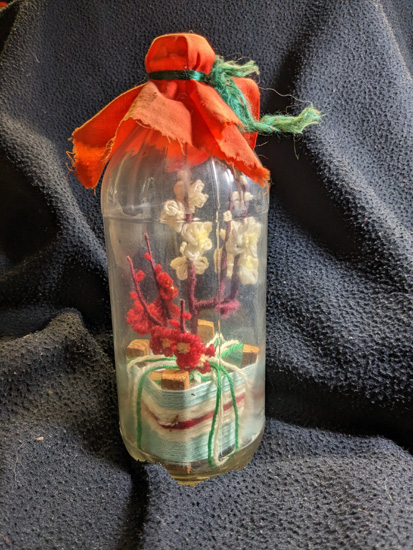
RESOURCEFUL ARTIST. The creative team of Shizue: An American Story met with Harry Iwatsuki, Shizue Iwatsuki’s grandson. Harry showed them a bottle with an ikebana flower arrangement made of yarn, wire, and sticks inside (pictured). Harry said his "granny" had made it at Minidoka with found materials in lieu of flowers. (Photo courtesy of the Portland Opera)
From The Asian Reporter, V34, #9 (September 2, 2024), pages 6 & 7.
Shizue: An American Story
For the last two years, I’ve been working with the Portland Opera to create a youth opera about Shizue Iwatsuki. Alexis Hamilton runs the Portland Opera to Go (POGO) program that produces and tours short operas developed for Oregon students and community audiences. As part of POGO’s initiative, Alexis wanted to create new work highlighting the stories of Black, Indigenous, and People of Color (BIPOC) in Oregon. The first commissioned work, Beatrice, debuted in 2022. Beatrice highlighted the life and accomplishments of community leader Beatrice Morrow Cannady, a Black journalist in Oregon from about 1910 to 1930.
For the next youth POGO opera piece, Alexis wanted to focus on a Japanese American survivor of World War II incarceration camps. I was intrigued with the educational value for young people to not only learn more about opera, but also about history that often isn’t taught much in many schools. And as a playwright, journalist, and theater director, I jumped at the opportunity to write a libretto.
My first call was to Linda Tamura, a scholar and book author who has written about Nisei soldiers and Hood River Issei. We’d worked together on a couple projects, including The Journal of Ben Uchida: Citizen 13559, an Oregon Children’s Theatre show about a family that was imprisoned at Minidoka in Idaho. I mentioned to her that I was interested in featuring a woman’s perspective; she told me about Shizue Iwatsuki’s remarkable life.
Shizue was an Issei woman knowledgeable in Tanka poetry and ikebana. Born in 1896 in Okayama, Japan, she married an Issei orchard owner, Kamegoro Iwatsuki, and in 1916 moved to Hood River, Oregon, where the couple tried to earn a living selling apples and strawberries while raising their children. Amidst growing anti-Japanese sentiment and following the attack on Pearl Harbor, Shizue’s family was forcibly imprisoned in three different locations — the Pinedale Assembly Center in California, where Hood River Japanese residents were incarcerated, in addition to Tule Lake and Minidoka. All the while, she wrote Tanka about her experiences.
Upon returning to Hood River, they found a community that had placed an advertisement in the newspaper asking that they not return, but the family began again and started another orchard. When her husband became paralyzed after falling off a ladder, Shizue and her sons kept the business running.
In 1984, long after her husband had passed away, Shizue, at age 78, won a poetry contest in Japan. Her poem was selected by the emperor, so she finally took a trip back there. That same winning poem is engraved on a monument at the Japanese American Historical Plaza on Portland’s waterfront and at the History Museum of Hood River County on a marble column along the Columbia River. After reading her poetry, I immediately knew her story and poetry would lend a richness to the opera.
The Portland Opera selected composer Kenji Oh to write the music for the libretto. During the first year, I worked on the libretto and crafted it for a workshop reading with four Japanese American actors I had previously collaborated with. I reshaped the libretto following audience comments and reactions as well as input from Kenji, Alexis, and the actors. Kenji spent several months composing the beautiful music. In his new and exciting works, you can hear Kenji’s emotional response to the history as well as his grounded knowledge of traditional Japanese folk music.
The most emotional moment for me was when Linda introduced us to Harry Iwatsuki, Shizue’s grandson. He showed us a bottle with an ikebana flower arrangement made of yarn, wire, and sticks inside. Harry said his "granny" had made it at Minidoka with found materials in lieu of flowers.
Harry described how she taught him that in ikebana you need to have a flower "that is above, that represents heaven, and one below, that’s the earth." Harry went on to tell us that his granny pointed to him and said, "and here in the middle are where we are."
I felt chills when I heard the story and knew it would be included as a motif revisited at the beginning, middle, and end of the opera.
When Alexis asked if I would direct the new opera, I immediately replied "yes!" I invited John Kashiwabara to design the set and Michelle Fujii and Toru Watanabe of Unit Souzou to craft the movement. Working with the opera’s production team has been joyous. I appreciated the discipline and professionalism of the staff and the singers. I especially loved the care and concern displayed by Alexis, who was tasked with commissioning new operas for youth highlighting the experiences of diverse Oregonians. Shizue: An American Story is the first East Asian American opera to be staged by the Portland Opera and I’m honored to be a part of the new creation.
After the world premiere on October 4 and 5 at Brunish Hall at the Portland Center for the Performing Arts (1111 S.W. Broadway, Portland), the show will embark on a two-month, multi-city tour. The four singers will be working on the tour, driving from town to town; unloading the set, the props, and costumes; and then reloading for the next performance. So far, more than three dozen Oregon towns have booked performances. This will be an amazing show and one not to be missed!
To learn more, visit <www.portlandopera.org>.
Read the current issue of The Asian Reporter in its
entirety!
Go to <www.asianreporter.com/completepaper.htm>!
Opinions expressed in this newspaper are those of the
authors and not necessarily those of this publication.