INSIDE:
NEWS/STORIES/ARTICLES
Book Reviews
Columns/Opinion/Cartoon
Films
International
National
NW/Local
Recipes
Special A.C.E. Stories
Sports
Online Paper (PDF)
CLASSIFIED SECTION
Bids & Public Notices
NW Job Market
NW RESOURCE GUIDE
Consulates
Organizations
Scholarships
Special Sections
Asian Reporter Info
Contact Us
Subscription Info. & Back
Issues
FOLLOW US
Facebook
ASIA LINKS
Currency Exchange
Time Zones
More Asian Links
Copyright © 1990 - 2026
AR Home
Where EAST meets the Northwest
|
HONORING AN ICON. Martial arts icon Bruce Lee (1940-1973) was honored and celebrated by the U.S. Postal Service with a new forever stamp earlier this year. The stamp, by artist Kam Mak, features a black-and-white painting of Lee executing his famous flying kick set against a yellow calligraphic brushstroke on a white background.
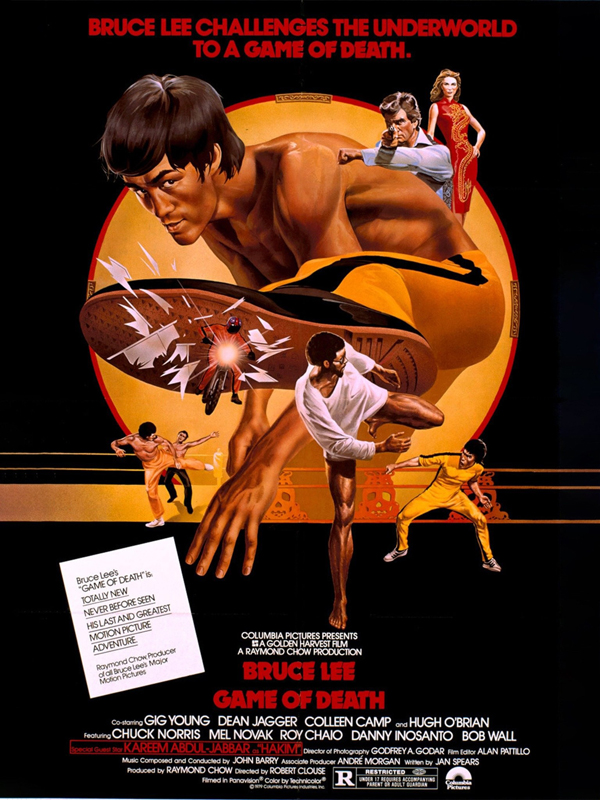
GONE TOO SOON. The Bruce Lee stamp created by the U.S. Postal Service (USPS) has a yellow calligraphic brushstroke on a white background, which, according to USPS, is a reference to Lee’s iconic yellow tracksuit in the film The Game of Death, which was released years after his death. Pictured is a promotional poster for The Game of Death. From The Asian Reporter, V36, #5 (May 4, 2026), pages 10 & 17. U.S. Postal Service celebrates martial arts icon Bruce Lee with a forever stamp By Kathleen Liermann The Asian Reporter At a ceremony at the Nippon Kan Theater in Seattle earlier this year, martial arts icon Bruce Lee (1940-1973) was honored and celebrated by the U.S. Postal Service (USPS) with a new forever stamp. The stamp, by artist Kam Mak, features a black-and-white painting of Lee executing his famous flying kick set against a yellow calligraphic brushstroke on a white background. According to USPS, the brushstroke is a reference to Lee’s iconic yellow tracksuit in the film The Game of Death, which was released years after his death. On the right side of the stamp printed vertically and slightly angled are Lee’s name and the words "USA" and "FOREVER," arranged to appear as if the flying kick is breaking them in half. Known as Hollywood’s first Asian American leading man, Lee was a celebrated box office star in Hong Kong well before he dazzled American moviegoers. Shannon Lee, Bruce’s daughter, said her father’s life was about breaking through barriers and bringing people together along the way. "He was mesmerizing to watch. Unlike the theatrical, acrobatic kung fu that came before, Lee’s movements were economical, explosive, and real," said Ben Kuo of USPS, who spoke at the ceremony. "Bruce Lee has earned this special tribute because he wasn’t just an action film star who could fight — he was a philosopher who could think and a teacher who inspired millions." Others attending the unveiling were Lee’s daughter Shannon; Sue Ann Kay, a former student and friend of Lee; and journalist Jeff Chang. Serving as master of ceremonies was Mimi Gan, representing Seattle’s Wing Luke Museum of the Asian Pacific American Experience. Genelia Lai performed the national anthem and the American Legion Cathay Post 186 served as color guard for the day. Bruce’s "legacy is one of resilience, self-mastery, and flow that resonates and connects people across multiple demographics, which is why this stamp is such a profoundly perfect touchpoint and a true honor, especially at this moment in time," said Shannon, who is CEO of Bruce Lee Enterprises. "Our family is deeply grateful to the USPS for choosing to recognize Bruce Lee, and we are excited to see his kicks flying all across the country on our mail." Lee Jun Fan was born at Jackson Street Hospital in San Francisco on November 27, 1940, while his father, Lee Hoi Chuen, a singer and actor from Hong Kong, and mother, Grace Ho, were in the United States on an extended tour with the Chinese Opera. Their son, who had dual citizenship, received a Cantonese name as well as an American one suggested by a person at the hospital who helped delivered him — Bruce. Bruce had two older sisters, Phoebe and Agnes, an older brother, Peter, and a younger brother, Robert. The family returned to Hong Kong when Bruce was just three months old. With family connections in the Hong Kong film industry, Bruce appeared in more than 20 films as a child, with his first lead role at age 10. His stage name was Li Xiao Long, or "Lee the Little Dragon," because he was born in both the Hour of the Dragon — between 6:00am and 8:00am — and the Year of the Dragon in Chinese astrology. At age 13, he began learning wing chun gung fu under renowned wing chun master, Yip Man, studying diligently for five years. He also became an expert boxer and competitor in cha-cha dancing. Bruce took a steamship back to the United States at age 18. He went to San Francisco then made his way to Seattle, where he worked in the restaurant of a family friend. After earning the equivalent of a high school diploma at Edison Technical School, he majored in philosophy at the University of Washington and taught martial arts on the side, eventually opening his first school, the Jun Fan Gung Fu Institute. Two more schools followed in Oakland and Los Angeles. Bruce opened the Oakland school and also married his wife, Linda Emery, in 1964. The couple would eventually have two children, Brandon in 1965 and Shannon in 1969. At an exhibition at the Long Beach Internationals in the mid-’60s, Bruce demonstrated the "one-inch punch" technique, which enabled him to strike an opponent at close range with extraordinary force. A celebrity hairstylist and martial arts enthusiast, Jay Sebring, happened to be part of the crowd at the competition. Sebring was in awe of Lee’s remarkably chiselled frame, lightning-fast hands and feet, and zen-like composure — quite the combination. A few months later, when a producer-friend was looking for a Chinese actor, Sebring told him about Bruce Lee and his abilities. In Hollywood, this was groundbreaking, as Asian roles usually went to Caucasian actors, with Asian actors rarely given a chance. William Dozier, a producer, gave Lee a screen test in 1965. Lee’s first major American role was in the television version of "The Green Hornet," which aired on ABC from September 1966 through March 1967. Bruce played Kato, the title character’s martial artist partner. After one season, the TV program in the United States was cancelled, but it caught on in Hong Kong, where it became known as "The Kato Show." Bruce tired of the resistance he encountered in Hollywood and headed to Hong Kong. In Hong Kong he made three films, which broke box office records and showcased martial arts in an entirely new way. There, he choreographed movie fight scenes and appeared on television shows. Bruce was developing his own martial art during this time, which he ultimately named Jeet Kune Do, which roughly translates as "the way of the intercepting fist." He used a philosophical foundation instead of rigid traditional martial arts to create a free-flowing approach. At its core were the ideas of simplicity, directness, and personal freedom. "When there is freedom from mechanical conditioning, there is simplicity," he wrote in his posthumously published book Tao of Jeet Kune Do. Several years passed before Lee starred in a Hollywood-Hong Kong movie co-production. Released in 1972, Enter the Dragon became a worldwide phenomenon. It was eventually added to the National Film Registry, which honors "culturally, historically, or aesthetically" significant motion pictures. Sadly, Lee passed away before Enter the Dragon was released to American audiences and became a global success. On July 20, 1973, a month before the film’s premiere, Bruce fell into a coma while asleep. He died at age 32 of cerebral edema. In the following decades, Bruce Lee’s legend grew. In 1999, he was included in TIME magazine’s list of the Top 100 Most Important People of the Century. In 2012, the U.S. House of Representatives paid tribute to him with an official statement calling Lee "a true catalyst for social change and civil rights" and "a cultural and American icon." The statement concluded that Lee "remains a beacon of hope and opportunity for future generations in America." The Bruce Lee USPS stamp is available in panes of 20. It’s a Forever stamp, so it will always be equal in value to the current one-ounce first-class mail price. To learn more about Bruce Lee, readers are encouraged to view "Be Water, My Friend: The Teachings of Bruce Lee," an interactive exhibit currently on view at the Wing Luke Museum of the Asian Pacific American Experience, located at 719 S. King Street in Seattle. The display invites viewers to step into the mind, body, and spirit of Bruce Lee to see how his unquenchable pursuit of knowledge informed his philosophy and life. For more information about "Be Water, My Friend," or to purchase tickets, call (206) 623-5124 or visit <www.wingluke.org>. Read the current issue of The Asian Reporter in
its entirety!
|