INSIDE:
NEWS/STORIES/ARTICLES
Book Reviews
Columns/Opinion/Cartoon
Films
International
National
NW/Local
Recipes
Special A.C.E. Stories
Sports
Online Paper (PDF)
CLASSIFIED SECTION
Bids & Public Notices
NW Job Market
NW RESOURCE GUIDE
Consulates
Organizations
Scholarships
Special Sections
Asian Reporter Info
Contact Us
Subscription Info. & Back
Issues
FOLLOW US
Facebook
ASIA LINKS
Currency Exchange
Time Zones
More Asian Links
Copyright © 1990 - 2026
AR Home
Where EAST meets the Northwest
|
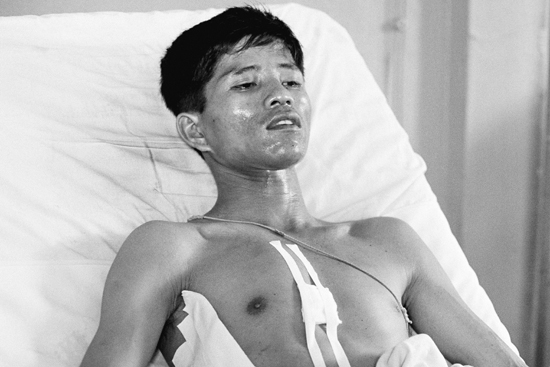
PROLIFIC PHOTOGRAPHER. Dang Van Phuoc, 22, a Vietnamese photographer working with The Associated Press, lies in a bed at the Vietnamese Military Hospital at Can Tho, Vietnam, 80 miles south of Saigon, after he was seriously injured during intense combat, in this March 19, 1969 file photo. Former AP photographer Phuoc, who was wounded multiple times during the Vietnam War and returned to capture the action even after losing an eye in an explosion, has died. (AP Photo/Al Chang, File)
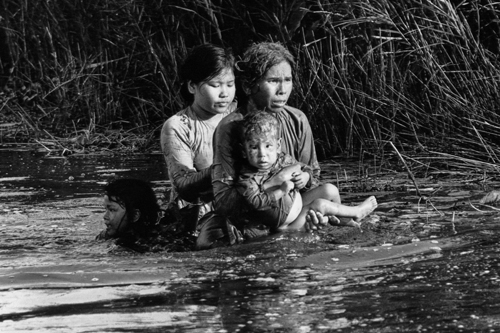
PROLIFIC PHOTOGRAPHER. An image taken by Dang Van Phuoc includes a Vietnamese woman and three children, top right photo, wading through a swamp after government troops fired into their hamlet less than 150 miles southeast of Saigon, on August 30, 1966. (AP Photo/Dang Van Phuoc, File)
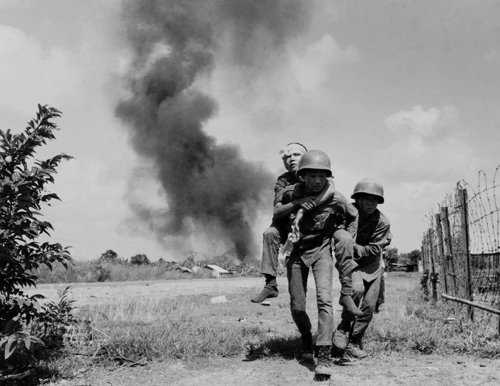
PERSISTENT PHOTOGRAPHER. An image taken by Dang Van Phuoc includes a wounded soldier, bottom right photo, being carried during fighting on Highway 13, north of Saigon, on October 14, 1972. (AP Photo/Dang Van Phuoc, File) From The Asian Reporter, V36, #6 (June 1, 2026), pages 12 & 13. Dang Van Phuoc, AP combat photographer who lost an eye in the Vietnam War, dies at 91 By Gillian Flaccus and Hannah Schoenbaum The Associated Press IRVINE, Calif. — Former Associated Press photographer Dang Van Phuoc, who was wounded multiple times during the Vietnam War and returned to capture the action even after losing an eye in an explosion, has died. He was 91 years old. Phuoc died in Southern California after collapsing suddenly, his nephew, Van Nguyen, said. Phuoc was hired in 1965 by AP’s former photo chief, Horst Faas, to replace another local hire who had been killed on assignment. He quickly gained a reputation among other journalists and the U.S. and South Vietnamese troops for his uncanny ability to find the thick of the action. Phuoc was born in a Vietnamese village near Quang Ngai, south of Da Nang, in 1935 and was the youngest of many siblings. When he was about 10, his father was killed by local members of the Viet Cong insurgency. A few years later, his mother died, leaving him homeless. "He was a really very extraordinary man who grew up from very bad treatment when he was a boy," Nguyen said. As a young man, Phuoc volunteered to help carry equipment at a Saigon film studio where Nguyen’s mother worked as a cook. It was there that Phuoc first picked up a camera and taught himself photography, his nephew said. Phuoc, who was dubbed The AP’s "secret weapon" by his boss, was known for walking with the "point man" on combat patrols, putting him in position to get excellent photographs — but also exposing him to grave danger. He was wounded at least five times during his 10 years with The AP in Vietnam, the first time just five months after he was hired. A grenade explosion left him with shrapnel in his chest and leg, but he was back on duty within a few months covering the drawn-out civil war between the Communist forces of North Vietnam and the U.S.-backed South Vietnamese military. In 1968, he sustained a concussion when he was hit in the head by a rocket while covering street fighting in Saigon. That same year, Phuoc risked sniper fire to carry a wounded U.S. soldier to safety and received a commendation from the Ninth U.S. Army Infantry Division for saving the man’s life. Phuoc lost his right eye in a grenade explosion in 1969 while on patrol with a Ranger battalion south of Da Nang, along Vietnam’s central coast. He learned to shoot with one eye and returned to work. In a 2011 interview for AP’s archives, Phuoc described the difficulty of working with one eye when he had to look through the camera while also watching for silent hand gestures from the soldiers with whom he was patrolling. His colleague in AP’s Saigon bureau, Huynh Cong "Nick" Ut, described Phuoc as fearless and resourceful in the field. Behind the scenes, he was a giving man and loyal friend who treated Ut like a brother. "Everyone loved him so much," Ut said. "When I heard, I cried, ‘My brother, he’s gone.’" Despite his reputation for shooting action, the photos that touched Phuoc were those that evoked the plight of civilians caught in the crossfire. In the 2011 interview, he compared himself to a "small grain of sand" who used his pictures to bring their stories to the world. When Saigon fell in 1975, Phuoc fled with his family with little more than the clothes on their back and a bottle of milk. His family was rescued from a refugee camp in Guam with the help of AP reporter Linda Deutsch, who was covering the tent city, and flown to Camp Pendleton. Phuoc then returned to Asia and worked briefly for The AP in Hong Kong before leaving the company and settling permanently in Southern California with his family. He went on to become a professional portrait photographer in Orange County, which is home to Little Saigon, the largest single community of South Vietnamese refugees in the world. His great-nephew, Kim Nguyen, looked back at the portraits Phuoc shot of him as a baby and reminisced about bringing his own son to see Phuoc’s work on display at a museum in Vietnam. In California, Phuoc was a founding member of The Artistic Photography Association and trained young photographers. He also was a civilian volunteer for the Los Angeles County Sheriff’s Department and in 1994 was named the county’s volunteer of the year. Schoenbaum reported from Salt Lake City Read the current issue of The Asian Reporter in
its entirety!
|