INSIDE:
NEWS/STORIES/ARTICLES
Book Reviews
Columns/Opinion/Cartoon
Films
International
National
NW/Local
Recipes
Special A.C.E. Stories
Sports
Online Paper (PDF)
CLASSIFIED SECTION
Bids & Public Notices
NW Job Market
NW RESOURCE GUIDE
Consulates
Organizations
Scholarships
Special Sections
Asian Reporter Info
Contact Us
Subscription Info. & Back
Issues
FOLLOW US
Facebook
ASIA LINKS
Currency Exchange
Time Zones
More Asian Links
Copyright © 1990 - 2026
AR Home
Where EAST meets the Northwest
|
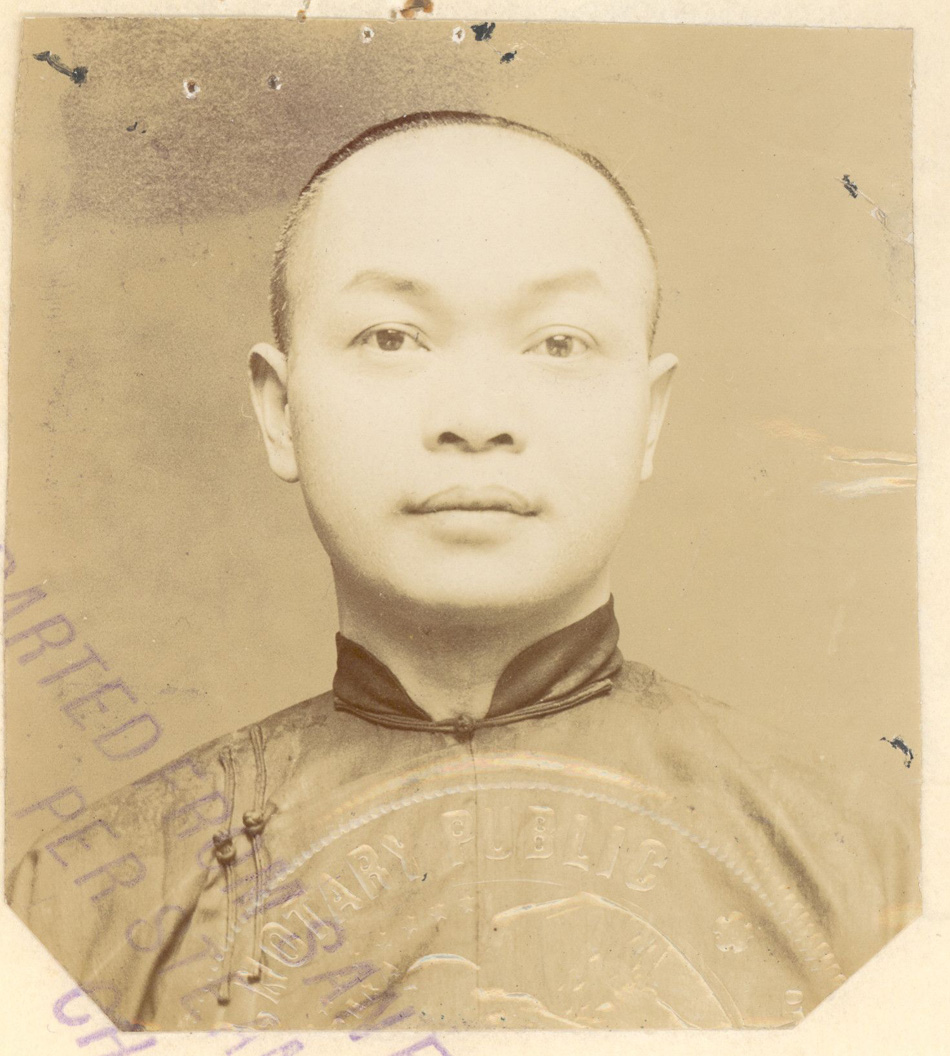
CITIZENSHIP CHAMPION. In the late 1800s, birthright citizenship was legally expanded to the children of immigrants. Wong Kim Ark, who was born in San Francisco in 1873, was returning by steamship from China in 1895 and was denied reentry. He sued and the Supreme Court in 1898 ruled in his favor. The court held that under the Fourteenth Amendment, a child’s citizenship depends on birth in the U.S., not a parent’s citizenship. (Photo/National Archives)
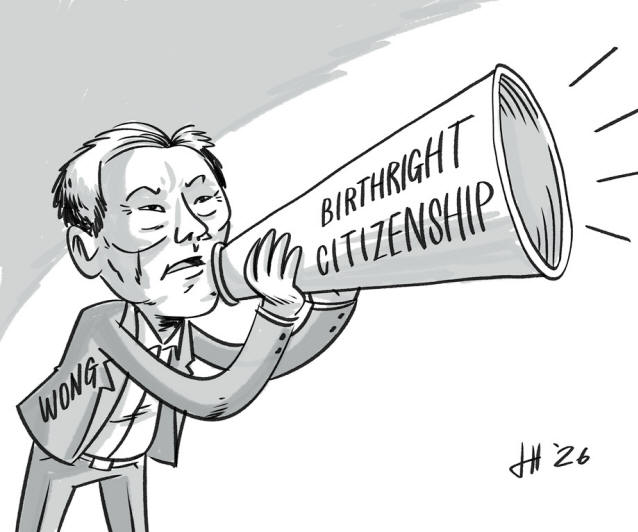
AR Cartoon by Jonathan Hill From The Asian Reporter, V36, #7 (July 6, 2026), page 8. Great-grandson of Wong Kim Ark praises Supreme Court ruling affirming birthright citizenship By Terry Tang The Associated Press AR Cartoon by Jonathan Hill The great-grandson of Wong Kim Ark, the Chinese American at the center of the U.S. Supreme Court case that established the constitutional guarantee of birthright citizenship, called late June’s ruling a victory for all Americans, saying it reaffirmed that precedent. "I don’t consider this stuff a personal victory," Norman Wong told The Associated Press. "It’s an obligation and a duty for every American to care about this because ultimately we’re not fighting for the rights of Chinese or Japanese or whatever. We’re fighting for rights for all Americans because these are fundamental rights." Wong, 76, has become an unexpected public face of the movement to protect birthright citizenship. He began giving speeches and interviews in January 2025 — shortly after President Donald Trump issued his executive order declaring children born to people who are in the United States illegally or temporarily are not American citizens. In a 6-3 decision, a divided Supreme Court upheld a broad interpretation of birthright citizenship, rejecting Trump’s arguments. In an opinion by Chief Justice John Roberts, the court held that the long-settled understanding of the Fourteenth Amendment of the Constitution, adopted after the Civil War, makes anyone born in the U.S. a citizen, with very limited exceptions. Dissenting Justices Samuel Alito, Neil Gorsuch, and Clarence Thomas would have upheld Trump’s proposed restrictions. The Fourteenth Amendment "was designed and understood to secure equal rights for the freed blacks but has instead been repurposed for political projects that the Reconstruction Congress did not support," Thomas wrote. Trump said the decision was "too bad for our Country" and wrongly suggested that congress could "easily" address it with legislation. The majority decision rests on constitutional grounds. It would take an amendment to overcome the decision. Wong called the executive order Trump issued on the first day of his second term an unconstitutional "decree." "If it didn’t fly in the face of the Constitution, the Supreme Court would have ruled differently today," Wong said. "That’s unfortunate that we have a leader that wants the United States to be in his image, but that’s not what we’re supposed to be. He’s supposed to conform to what we the people believe in." Maintaining birthright citizenship as a right and a family legacy In the late 1800s, birthright citizenship was legally expanded to the children of immigrants. Wong Kim Ark, who was born in San Francisco in 1873, was returning by steamship from China in 1895 and was denied reentry. He sued and the Supreme Court in 1898 ruled in his favor. The court held that under the Fourteenth Amendment, a child’s citizenship depends on birth in the U.S., not a parent’s citizenship. Norman Wong has always been social justice-minded. While attending the University of California, Berkeley, in the 1970s, he joined the multiracial student-driven Third World Liberation Front. He saw how the term "Asian American" rallied Asian student groups to join forces. It wasn’t until he was in his 50s that he learned Wong Kim Ark was his great-grandfather. His father had spoken very little about family history. But journalists from Chinese-language newspapers approached his father for an interview after seeing his name in old court records. He never pictured lobbying for another movement in his 70s. But last year, the Chinese Consolidated Benevolent Association, the same organization that funded Wong Kim Ark’s legal fight, invited him to speak at a press conference. Since then, Wong, who lives in the San Francisco Bay Area, has given interviews, speeches, and even travelled to Washington in April to hear the Supreme Court arguments. "I consider myself lucky enough to actually have a meaningful role," Wong said. "All that citizenship grants is the stuff that was the promise of America, which is life, liberty, and the pursuit of happiness." Is birthright citizenship status secure now? In April, the birthright citizenship court proceedings also marked the first time a sitting U.S. president attended Supreme Court oral arguments. California Attorney General Rob Bonta recalled sitting in the same row as Trump. Since Trump’s executive order, Bonta, the first state attorney general of Filipino descent, has heard from "hundreds" of people born in the U.S. who have been worried about being stripped of their citizenship because of a parent’s immigration status. Most of them have been people of color — Black, Latino, Asian, and Pacific Islander. The high court’s decision, while affirming, does not mean they should be less mindful of their rights. "Everyone who believes in the rule of law, believes in the U.S. Constitution — its durability, its strength, its potency — should breathe a little easier today," Bonta said. "But, the attacks on lawful immigration status, on the U.S. Constitution’s protections, rights, and freedoms afforded to people, including birthright citizenship, they will continue." Chinese American daughter of immigrants makes the case The Justice Department said in a statement that it’s "committed to tackling illegal birth tourism schemes by working diligently with U.S. attorneys across the country to uphold the law." "Actors seeking to exploit loopholes to obtain automatic citizenship for their children pose a national security threat and will be brought to justice," the department said in a post on the social platform X. Cecillia Wang, the national director of the American Civil Liberties Union who argued for birthright citizenship in front of the Supreme Court, said in a statement the court "reaffirms a fundamental American promise — if you are born here, you are a citizen." "A president cannot change the Constitution by executive fiat," Wang said. "Our brave clients and our legal team stand with millions of people around our country who spoke up for one of our most cherished rights." Bonta previously worked with Wang at the same San Francisco law firm. He described her as brilliant and said that having immigrant parents "was an added dimension to Cecillia’s incredible advocacy." Wang is American-born with parents who legally came to the U.S. from Taiwan as graduate students. The fact that she was the one who got to argue the case nearly 130 years after his great-grandfather won his case made the decision even better, Wong said. "It’s kind of sweet because — especially for Chinese Americans — they were at the forefront of all this anti-Asian hate," Wong said. "There are certain aspects of my life where I think what happened actually prepared me for what’s happening now." Associated Press reporter Mark Sherman in Washington, D.C., contributed to this report. Read the current issue of The Asian Reporter in
its entirety!
|