INSIDE:
NEWS/STORIES/ARTICLES
Book Reviews
Columns/Opinion/Cartoon
Films
International
National
NW/Local
Recipes
Special A.C.E. Stories
Sports
Online Paper (PDF)
CLASSIFIED SECTION
Bids & Public Notices
NW Job Market
NW RESOURCE GUIDE
Consulates
Organizations
Scholarships
Special Sections
Asian Reporter Info
Contact Us
Subscription Info. & Back
Issues
FOLLOW US
Facebook
ASIA LINKS
Currency Exchange
Time Zones
More Asian Links
Copyright © 1990 - 2026
AR Home
Where EAST meets the Northwest
|
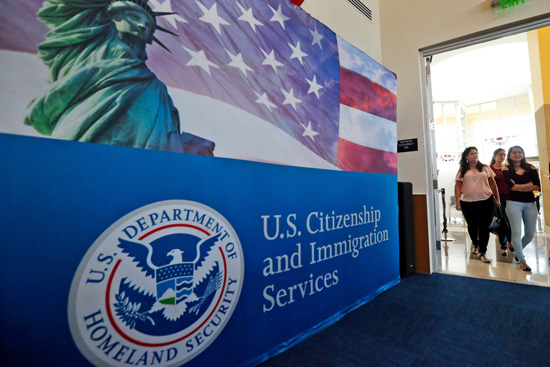
IMMIGRATION UPHEAVAL. People arrive before the start of a naturalization ceremony at the U.S. Citizenship and Immigration Services Miami Field Office in Miami, in this August 17, 2018 file photo. Many Asian American and Pacific Islander adults have experienced or witnessed some degree of upheaval because of the Trump administration’s heightened immigration policies, an AP-NORC/AAPI Data poll finds, while most say the U.S. is no longer the land of opportunity for immigrants. (AP Photo/Wilfredo Lee, File) From The Asian Reporter, V36, #7 (July 6, 2026), pages 7 & 19. Poll: How AAPI adults are being affected by Trump’s immigration crackdown By Terry Tang and Linley Sanders The Associated Press Many Asian American and Pacific Islander adults have experienced or witnessed some degree of upheaval because of the Trump administration’s heightened immigration policies, an AP-NORC/AAPI Data poll finds, while most say the U.S. is no longer the land of opportunity for immigrants. A new poll released in June from AAPI Data and The Associated Press-NORC Center for Public Affairs Research shows about half of AAPI adults say they — or someone they know — have been detained or deported within the last year, started carrying proof of immigration status or U.S. citizenship, upended travel plans, or significantly changed their routines because of immigration status. The findings come after more than a year of immigration crackdowns. The poll indicates that the Trump administration’s aggressive approach, which has resulted in multiple clashes between protesters and enforcement officers and led to the shooting deaths of two U.S. citizens in Minneapolis earlier this year, may be changing the way some people in immigrant-heavy communities see the U.S. itself. AAPI adults are one of the country’s fastest-growing demographic, and most AAPI adults in the U.S. were born outside the country. The survey found a majority of AAPI adults — about 6 in 10 — believe the U.S. used to be a great country for immigrants but is not anymore. Only about 3 in 10 AAPI adults say America is a great place for immigrants, while a few, 5%, say it was never a great place for immigrants. At the same time, AAPI adults are more likely than Americans overall to see the mixing of culture and values from around the world as central to the country’s identity. "America’s success story has depended critically on the role of Asian Americans, but also immigrants in general," said Karthick Ramakrishnan, founder and executive director of AAPI Data. "When you have people who are already in this country, have been here for decades saying, ‘I’m not really sure that this is the best country anymore,’ that’s a warning sign." "Better safe than sorry" approach Even some immigrants with legal status have been affected by the Trump administration’s policies. One policy that would have hiked fees for certain types of visas was shot down in federal court. Another judge struck down a policy that "categorically barred" immigrants from 39 Asian, African, Latin American, and Middle Eastern countries from receiving final decisions on asylum, work permit, green card, and citizenship applications. Khoa Tran, 27, of San Antonio, Texas, came to the U.S. from Vietnam in 2015 at age 15. He gained citizenship four years later. In 2023, he sponsored his wife from Vietnam. Last year, Tran became concerned when his social media feed kept bringing up posts about how essential it was that even legal immigrants carry documentation. It had not occurred to the couple that his wife should have her green card with her at all times. "It seemed like we needed to do it. It’s literally become like a second form of identification in addition to the driver’s license," Tran said. He has also seen how international students in his community have put off trips to visit family in Asia due to concerns about student visas. "They’re just scared. They don’t know the law around that," Tran said. "Better safe than sorry." About half of South Asian adults — compared to about 4 in 10 AAPI adults overall — know someone who started carrying proof of legal status or citizenship over the last year. South Asian adults are much more likely than East Asian or Southeast Asian American adults to have been born outside the U.S., according to the survey. Many of those immigrants may have green cards or be naturalized citizens, Ramakrishnan said, yet feel "like their presence and their status in this country is under question." Cultural identity matters as much as American identity AAPI adults are likelier to say their family’s ancestry or country of origin is "extremely" or "very" important to their personal identity, compared to being an American. Just over half of AAPI adults say their family’s ancestry or country of origin is important to who they are, while 44% say this about their American identity. That extends to AAPI adults who were born in the U.S. About 6 in 10, 59%, U.S.-born AAPI adults say their family’s heritage is important to their personal identity, while 47% say this about being an American. A separate AP-NORC survey conducted in April found that 55% of U.S. adults say being an American is important to who they are, while only 37% said that about their family’s ancestry. Abigail Jeyaraj, 22, of South Hadley, Massachusetts, was born in Texas. Her Indian parents’ decision to build a new life in the U.S. is something she never takes for granted. When she describes her nationality, she identifies herself as not just "American" but South Asian American. "Especially as a South Asian woman, I’m very sensitive to the fact that I have opportunities that my mother and my grandmother, all the women before that didn’t," Jeyaraj said. "I really try to honor that culture. I try to maintain really strong connections to my family in India." Soonho Kwon, 30, of La Mirada, California, was born in Korea. His family settled in New Jersey when he was 8 years old. "I think I still feel more Korean. I came right around the age where I had very solid memories from growing up in Korea. My immediate family’s back there now," Kwon said. "I’m a naturalized citizen. I’m committed to living here, but identity is a different question." Ambivalence around America’s 250th anniversary The vast majority, 73%, of AAPI adults say the mixing of cultures and values from around the world is "extremely" or "very" important to the U.S.’s identity as a nation, compared to only 55% of U.S. adults in the April AP-NORC poll. Jeyaraj grew up around Dallas and Houston — cities where she was "able to interact with people of so many different races and different cultures that weren’t my own." She credits that experience with making her more empathetic. Restrictions on immigration and diversity, equity, and inclusion initiatives left her feeling conflicted about celebrating the country’s 250th anniversary. "I’m proud we made it this far as a country," Jeyaraj said. "You have recent actors who are trying to undo that progress. They maybe view it as restoring an ideal, but it’s removing so much work that powerful and influential people made to bring us toward an ideal of equality and justice." The anniversary feels arbitrary to Tran, a math teacher. "I don’t think this country is ‘founded’ at some point in time. It just changes from one form to another," Tran said. "Even the Native Americans (were) a long time here. I’m pretty sure that was more than 250 years." The poll of 1,075 U.S. adults who are Asian American, Native Hawaiian, and Pacific Islanders was conducted April 20-28, using a sample drawn from NORC’s probability-based Amplify AAPI Panel, designed to be representative of the Asian American, Native Hawaiian, and Pacific Islander population. The margin of sampling error for all respondents is plus or minus 4.4 percentage points. This poll is part of an ongoing project exploring the views of Asian Americans, Native Hawaiians, and Pacific Islanders, which are usually not highlighted in other surveys because of small sample sizes and lack of linguistic representation. Read the current issue of The Asian Reporter in
its entirety!
|