
INSIDE:
NEWS/STORIES/ARTICLES
Book Reviews
Columns/Opinion/Cartoon
Films
International
National
NW/Local
Recipes
Special A.C.E. Stories
Sports
Online Paper (PDF)
CLASSIFIED SECTION
Bids & Public Notices
NW Job Market
NW RESOURCE GUIDE
Consulates
Organizations
Scholarships
Special Sections
Asian Reporter Info
Contact Us
Subscription Info. & Back
Issues
FOLLOW US
Facebook
ASIA LINKS
Currency Exchange
Time Zones
More Asian Links
Copyright © 1990 - 2026
AR Home
Where EAST meets the Northwest
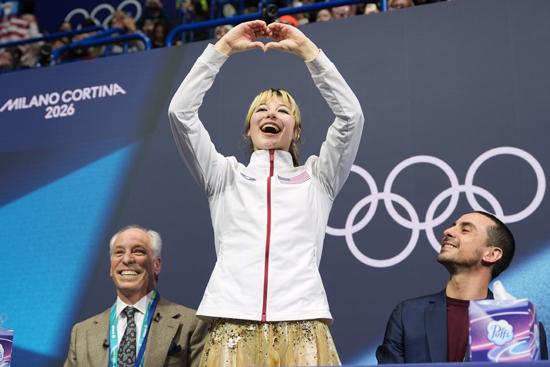
PAUSE PAYOFF. Alysa Liu of the United States reacts to her score after competing in the women’s figure skating free program at the 2026 Winter Olympics, in Milan, Italy. The 20-year-old with the striped hair, prominent frenulum piercing, and carefree attitude never showed any worry or strain when she took the ice for her free skate. (AP Photo/Stephanie Scarbrough)
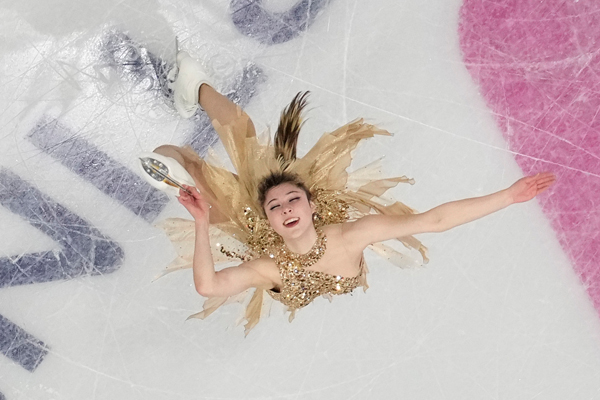
Alysa Liu of the United States competes in the women’s figure skating free program at the 2026 Winter Olympics, in Milan, Italy. (AP Photo/Christophe Ena)
From The Asian Reporter, V36, #3 (March 2, 2026), pages 11, 12 & 14.
Alysa Liu walked away from skating. Her fresh outlook when she returned helped her win Olympic gold.
By Dave Skretta
AP Sports Writer
MILAN — Alysa Liu probably cared the least of all the women in figure skating at the Milan Cortina Olympics about winning the gold medal.
Maybe that is why she won it.
The 20-year-old with the striped hair, prominent frenulum piercing, and carefree attitude never showed any worry or strain when she took the ice for her free skate. Instead, Liu waved up at her friends and family in the stands, grinned throughout her program, and acted as if she was going through just another training session at the Oakland Ice Center back in California.
"My family is out there. My friends are out there. I had to put on a show for them," Liu said afterward. "When I see other people out there smiling, because I see them in the audience, then I have to smile, too. I have no poker face."
It was all smiles for her crew after Donna Summer’s version of "MacArthur Park" came to a conclusion. Liu earned a score of 226.79 points, sending her surging past silver medallist Kaori Sakamoto and Japanese teammate Ami Nakai, who took bronze.
Liu’s coaches, Phillip DiGuglielmo and Massimo Scali, embraced in a hug, content in knowing that a comeback two years in the making had achieved something incredible: The first women’s figure skating gold medal for the U.S. since Sarah Hughes in 2002.
Liu’s family members stood and cheered, as did the rest of the crowd inside the Milano Ice Skating Arena.
No doubt every official at U.S. Figure Skating, and every member of its Olympic team, also felt a surge of joy. Or relief. It had been a frustrating Winter Games on a number of levels, beginning with some controversial ice dance scoring that denied Madison Chock and Evan Bates the gold medal, and continuing right through Ilia Malinin’s struggles in his free skate earlier in the week.
The only golden moment until that night had been the team event, when Liu helped the U.S. defend its Olympic title.
"If I had a nickel for every gold medal I have here," Liu joked, "I would have two!"
That’s the kind of "dad joke" only Liu would crack after triumphing on figure skating’s grandest stage.
Four years ago, the daughter of a Chinese immigrant was in a much different mental state. Liu had just finished sixth at the Beijing Games as a 16-year-old prodigy, but she might as well have finished last. She was so burned out by figure skating that her prevailing thought after that Olympic free skate was relief that it was over, rather than pride in what she had accomplished.
She was the kid who’d get dropped off at the rink in the morning and picked up at night. Her childhood revolved around practice, and not of her own choosing. When she became the youngest U.S. champion at 13, and defended her title the following year, it only upped the ante among those who saw her following in the footsteps of Kristi Yamaguchi, Michelle Kwan, and Tara Lipinski.
Liu was trying to fit the mold that everyone wanted for her.
So, she quit. Walked away. Abruptly decided to retire after the Beijing Games, leaving all of that mental strain behind her.
For two years, Liu did what she wanted, which had little to do with skating. She went on backpacking trips with friends and began studying psychology at UCLA. She got the frenulum piercing that shows across her front teeth when she smiles. In short, she became her own person, one whose individualism has made her a hero to the alt, emo, and punk crowd.
She broke just about every mold for a figure skater.
"I love that Alysa is showing the entire world, and especially our skating world, that there is more than one way to win," said Johnny Weir, the two-time Olympian, who along with Lipinski called her free skate for NBC.
Indeed, when Liu launched a comeback two years ago, she did it her way. She would only spend as much time at the practice rink as she wanted. She would be involved in every decision when it came to designing her programs. She even had a say in her dresses, with her favorite being the glittering gold ensemble that fit the moment so perfectly that night.
"Honestly, it was more than just work, it was experience," Liu said. "The last time I was skating, it was so rough. I genuinely can’t begin to start on it. It took a lot to get to this point, and studying psychology has really helped. I love psychology.
"All I want in my life is human connection and, damn, now I am connected with a hell of a ton of people."
That includes women like Tenley Albright, who won Olympic gold at the 1956 Cortina d’Ampezzo Games, and was watching from the crowd. And other U.S. champions, such as Carol Heiss, Peggy Fleming, and Dorothy Hamill.
But it’s more than that.
It’s a connection to everyone who has walked away from something and found their way back. Who cut ties with something they once loved so that they could learn to love it again. And who had to go searching far and wide to discover who they really are.
"I have no idea how I am going to deal with it. I’ll probably wear some wigs when I go outside," Liu said, when asked how she plans to handle her sudden fame. "I hope with all this attention I can raise awareness about mental health in sports, and mental health more generally. I think my story is very cool. Hopefully, I can inspire some people."
* * *
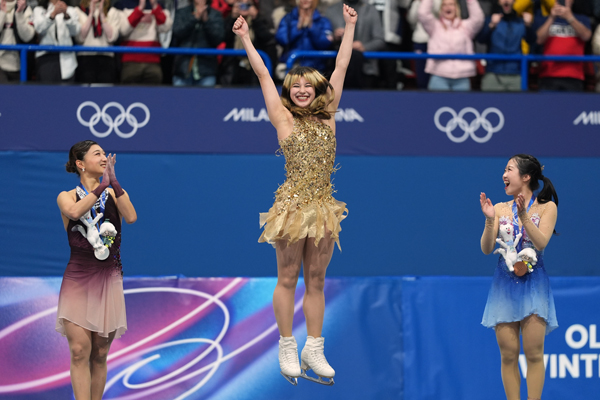
TRIUMPHANT RETURN. Gold medallist Alysa Liu of the United States, center, jumps on the podium to receive her medal after competing in the women’s free skate program in figure skating at the 2026 Winter Olympics, in Milan, Italy. Twenty-year-old Liu, who walked away from the sport before finding her way back again — and finding herself in the process — delivered the U.S. its first women’s figure skating gold medal in 24 years. Pictured on the left is silver medallist Kaori Sakamoto of Japan and on the right is bronze medallist Ami Nakai of Japan. (AP Photo/Stephanie Scarbrough)
From The Asian Reporter, V36, #3 (March 2, 2026), pages 11 & 12.
Alysa Liu dazzles to win figure skating gold, ending a 24-year Olympic drought for U.S. women
By Dave Skretta
AP Sports Writer
MILAN — Alysa Liu had just delivered a near-flawless Olympic free skate, one that left a packed crowd inside the Milano Ice Skating Arena standing and roaring, when a television camera zoomed in on the American star as she was heading off the ice.
"That’s what I’m f––––––– talking about!" Liu shouted into the lens.
Oh, they’ll be talking about her for quite a while.
The 20-year-old from the San Francisco Bay Area, who walked away from the sport before finding her way back again — and finding herself in the process — delivered the U.S. its first women’s figure skating gold medal in 24 years. She finished with 226.79 points to upstage Japanese teammates Kaori Sakamoto and Ami Nakai, who took silver and bronze at the Milan Cortina Games.
"I think my story is more important than anything to me," Liu said, her frenulum piercing glinting in the light as she smiled, "and that’s what I will hold dear, and this journey has been incredible, and my life has just been — I have no complaints."
The moment Nakai’s score was read after the final program of the night, U.S. teammate Amber Glenn jumped into the kiss-and-cry and raised Liu’s hand in triumph. Liu sheepishly turned and applauded the 17-year-old Nakai, who raced over and hugged her.
It was the first individual gold medal for an American woman since 2002, when Sarah Hughes stood atop the podium in Salt Lake City, and it was the second gold for Liu at the Milan Cortina Games. She and Glenn helped the Americans win team gold.
"Her story of taking a step back, mental health, I think it really attests to you never know what the journey to success is going to be," said Glenn, who finished fifth. "I really hope that can reach the skating community, that it’s OK to take time."
It was a bittersweet silver medal for Sakamoto, the three-time world champion, who intends to retire after this season. One of the most popular figure skaters of her generation earned a bronze medal four years ago in Beijing and had her heart set on gold. "I’m really regretful," said Sakamoto, who finished with 224.90 points. "I feel like I’m so disappointed, to be honest."
Liu’s gold medal, meanwhile, blended right into her glittering gold-sequined dress, only the blue ribbon standing out. And it seemed the perfect complement to the golden stripes running through her dark brown hair, which are meant to resemble the growth rings on a tree.
Liu has done a whole lot of growing up over the years.
She was the youngest U.S. champion ever when she won the first of back-to-back titles at 13 years old. But after finishing sixth at the Beijing Games, Liu was so burned out that she abruptly retired. She spent the next two years doing bucket-list things like climbing up to the base camp of Mount Everest and enrolling at UCLA, where she is studying psychology.
It was on a skiing trip a couple of years ago, when Liu felt the same familiar adrenaline rush she once felt while skating, that she began to think about a comeback. But this time, Liu would be skating on her terms, more carefree and self-assured than she’d been as a child prodigy, when her life revolved around the practice rink.
"I mean, it’s just how my life has gone," Liu said, shrugging. "Everything in general has led me to this point."
Even during warmups that night, Liu skated with a grin on her face, never showing any outward signs of pressure. She took the time to wave at friends and family in the stands who had been keeping her out late for dinners, which she called "super fun." "What I was feeling," Liu said, "was happy and confident."
Glenn must have felt the same way a couple of hours earlier. She had to perform long before her friend and teammate following a disappointing short program two nights prior. But Glenn rebounded in spectacular fashion, and her season-best free skate not only gave her a score of 214.91 points but it nearly put her on the podium, too.
Glenn pumped her fist and fought back tears when her score was read, then she took a seat in the new "leader’s chair."
"It was nice to watch some great figure skating up close," Glenn said, "but it’s also conflicting, because you want to stay there but you don’t want to wish mistakes on anybody else."
She wound up staying there for quite a while.
Adeliia Petrosian, an 18-year-old Russian competing as a neutral athlete, tried the only quadruple jump during the women’s competition but fell on the quad toe loop. She was clean the rest of the way, but the points Petrosian lost on that fall ended up leaving her less than a half-point behind Glenn sitting in the leader’s chair.
"I feel a little ashamed," Petrosian said, after taking a few minutes to compose herself, "for myself, for the federation, for my coaches, and for the spectators that it went this way. I understand that it’s my own fault."
It wasn’t until Mone Chiba — the ninth skater to follow Glenn to the ice — that the three-time U.S. champ was bumped from her spot.
Chiba’s stint in the leader’s chair didn’t last nearly as long.
Liu, who last year captured the first world title by an American woman since 2006, was perfect from her opening triple flip to her closing combination sequence. As the last bits of Donna Summer’s version of "MacArthur Park" faded away, and the roar of the fans filled the void, Liu gave a casual flip of her ponytail as if to say, "So what?"
Her coaches, Phillip DiGuglielmo and Massimo Scali, were a little more rambunctious. They punched the air, gave each other a big hug, then headed over to greet their star pupil when she stepped off the ice to await her score.
The score that ultimately would give her an Olympic title and end a long drought for U.S. women.
"I don’t need this," Liu said of the gold medal hanging around her neck, "but what I needed was the stage, and I got that. So it was all good, no matter what happened. I mean, if I fell on every jump, I would still be wearing this dress. So it’s all good."
* * *
Read the current issue of The Asian Reporter in its entirety!
Go to <www.asianreporter.com/completepaper.htm>!