
INSIDE:
NEWS/STORIES/ARTICLES
Book Reviews
Columns/Opinion/Cartoon
Films
International
National
NW/Local
Recipes
Special A.C.E. Stories
Sports
Online Paper (PDF)
CLASSIFIED SECTION
Bids & Public Notices
NW Job Market
NW RESOURCE GUIDE
Consulates
Organizations
Scholarships
Special Sections
Asian Reporter Info
Contact Us
Subscription Info. & Back
Issues
FOLLOW US
Facebook
ASIA LINKS
Currency Exchange
Time Zones
More Asian Links
Copyright © 1990 - 2026
AR Home
Where EAST meets the Northwest
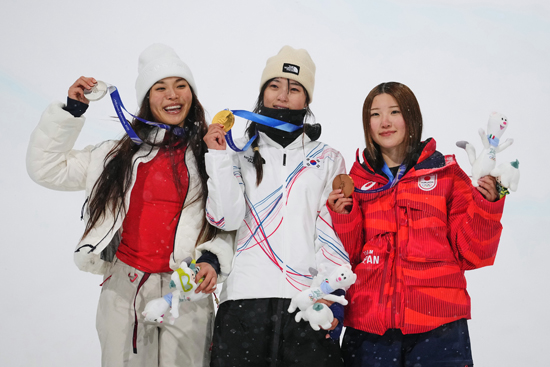
SNOWBOARD SHAKEUP. From left are silver medallist Chloe Kim of the United States, gold medallist Gaon Choi of South Korea, and bronze medallist Mitsuki Ono of Japan celebrating after the women’s snowboarding halfpipe finals at the 2026 Winter Olympics, in Livigno, Italy. Kim was competing for a third gold medal in the event, but was bested by Choi, one of Kim’s favorite kids and protégés. (AP Photo/Lindsey Wasson)
From The Asian Reporter, V36, #3 (March 2, 2026), page 13.
Chloe Kim falls short of Olympic three-peat, but passes the torch to a protégé from South Korea
By Eddie Pells
AP National Writer
LIVIGNO, Italy — Some might say the seeds of an Olympic-sized surprise in snowboarding were planted more than a month ago. That’s when Chloe Kim went skittering down a halfpipe in Switzerland, smashing her shoulder and turning her run for a third straight gold medal into a less-than-perfect scramble.
Kim herself saw it coming years ago. One of her favorite kids and protégés, Gaon Choi of South Korea, kept showing up at halfpipes for practice earlier than anyone else. She kept trying tricks no one else would dare.
Even with Kim at less than 100 percent, and with the halfpipe slowed by a steady light snow that turned that Thursday night into an Italian-Alps postcard, and with the hype, and pressure, of making history hovering over everything — Kim wasn’t going to just give it away. Someone would have to take down the sport’s best rider.
That person was Choi. The 17-year-old overcame a brutal fall at the beginning of the night to post the highest score in the third and final round. Then, in an even bigger surprise, Kim had a chance to top her, but couldn’t.
If the new silver medallist was sad about that, it didn’t show.
"She’s my baby," Kim said of Choi, who is the same age she was when she won her first Olympic title eight years ago in South Korea. "Now I think I know how my mentors felt when I came on the stage."
Choi’s potential sprouted years ago while Kim tried to rediscover her passion
It was never inevitable that Kim, now 25, would win this contest. Since her last Olympic victory four years ago, Choi and a few other riders from Asia in the final have been steadily upping the difficulty on the halfpipe.
Kim, meanwhile, fell out of love with a sport that was growing too repetitive, too predictable.
"Doing the same thing over and over and winning didn’t feel good," she said. "I started to resent snowboarding."
Then, she fell back in love — heartened by the prospect of trying new things. There were double-corks and 1440-degree spins in her repertoire, all ready to be spread out like Christmas presents with the whole world watching when the Olympics came around.
The shoulder injury in Switzerland changed all the math. It cut down on Kim’s practice time. It made her vulnerable, questionable. She wore a brace on the shoulder. She revealed she would need surgery when she returns home.
"It was really scary for me to come back," she said. "I was telling my coach and my therapist, I wished I’d fallen doing a trick, because when I do a trick, I know I can fall. However, when I dislocated my shoulder, I was in the flat bottom, and for some reason, I was so scared of riding through the damn flat bottom."
Snowboarding still looking for an Olympic three-peat
The strain on Kim’s psyche and her limited practice time certainly played a role in all this.
Then, there’s snowboarding itself.
That week at the Livigno Snow Park, two other women had a chance to become the first snowboarders to three-peat for the first time since the sport joined the games back in 1998.
Ester Ledecka, the world’s best in parallel giant slalom, flamed out early in her contest.
Anna Gasser watched a new generation of leapers beat her in big air.
Four years ago, the bad vibes from COVID-19 put a damper on Jamie Anderson’s attempt in slopestyle.
In 2014 in Russia, Shaun White tried for his own three-peat and failed.
He, along with Kim’s boyfriend, Myles Garrett, and Snoop Dogg, wearing a USA jacket with Kim’s face plastered on the front, were at the bottom of the pipe, waiting to watch some history.
An hour after the contest, White, who has seen a lot over the years, was still trying to sort out what happened.
"It’s a wild sport," he said. "You can get injured. Someone can learn a new trick overnight. There’s a lot of variables. It’s never a sure thing."
It did not, in White’s eyes, diminish Kim’s impact on snowboarding.
"She’s a legend. She’s got two golds. She’s no stranger to pressure. It just wasn’t her night, I think," he said.
What seemed like a sure victory turned into a wild surprise
But it sure did start out as her night. Choi, whose "1" on her bib signified her ranking on the points list this season, was widely viewed as the biggest threat to a Kim dynasty.
But on her first run, she lost her bearings on a leap above the halfpipe and her board slammed harshly on the deck. Her knees collapsed and she skidded limply to the bottom. The music stopped and the festive crowd fell silent.
About five minutes passed and a stretcher came out. But suddenly, Choi popped up and rode to the bottom.
"I cried and clenched my teeth and started walking and felt the energy came back into my legs," Choi said. "I thought, I can keep trying and I could get back into these games."
Kim’s first run, meanwhile, was a technical masterpiece that included a Cab double-cork 1080. That’s two flips with a twist, a trick she became the first woman to land in a contest last year and that hardly anyone else can do.
It put her in the lead and when Choi and the rest struggled in Round 2, this looked like it would play out like Kim’s other two Olympic victories: A win secured and a chance to put on a show.
With the lead and nobody pushing her, she tried not one, but two double corks in her second run but fell.
It turned out to be her last, best chance.
Choi’s winning run in Round 3 was a technically precise marvel. It included three 900-degree spins, all approaching the wall from different directions. The landings were smooth. At the bottom, Choi covered her face with her mittens. A gasp rang out when her score was posted: 90.25 — 2.25 more than the champion.
Right about then, the snow picked up.
And then, about 10 minutes later, came something nobody had seen on an Olympic halfpipe: Kim, the last rider to drop, facing an all-or-nothing run that would be the difference between a dynasty and an upset.
"I noticed the wall started to get a little sticky, but that’s part of the competition," Kim said of the intensifying snow. "No excuses here. I should’ve made that mental note when I made my first" jump of the last run.
Kim didn’t make it past her first double cork. She skidded down the halfpipe, bounced back up, dusted herself off, and rode down. She hugged bronze medallist Mitsuki Ono of Japan, then rushed over to Choi to join a swarm of Korean coaches who were hugging the new champion.
"I’m a winner because I was able to persevere and fight through," Kim said.
Even though her protégé got the gold, the former champion said that felt like a win to her, too.
"I’m so damn proud of her," Kim said. "Although we are in an individual sport, it means so much to me to know I’ve inspired a whole new generation. I’m aware that I can’t do this forever."
Associated Press writer Joseph Wilson contributed to this report.
* * *
Read the current issue of The Asian Reporter in its entirety!
Go to <www.asianreporter.com/completepaper.htm>!