
INSIDE:
NEWS/STORIES/ARTICLES
Book Reviews
Columns/Opinion/Cartoon
Films
International
National
NW/Local
Recipes
Special A.C.E. Stories
Sports
Online Paper (PDF)
CLASSIFIED SECTION
Bids & Public Notices
NW Job Market
NW RESOURCE GUIDE
Consulates
Organizations
Scholarships
Special Sections
Asian Reporter Info
Contact Us
Subscription Info. & Back
Issues
FOLLOW US
Facebook
ASIA LINKS
Currency Exchange
Time Zones
More Asian Links
Copyright © 1990 - 2026
AR Home
Where EAST meets the Northwest

YOUTHFUL GAMES. The Asian Games, similar to the Pan Am Games in the Americas, are a proving ground for young athletes. Pictured is Kamus Wong, a 12-year-old skateboarder from Hong Kong. (SNTV via AP)
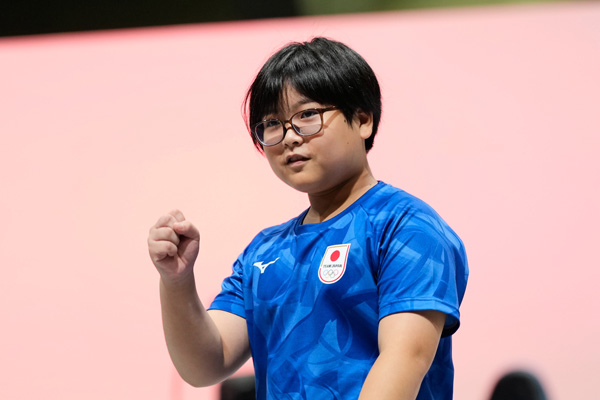
2026 ASIAN GAMES. The Asian Games, similar to the Pan Am Games in the Americas, are a proving ground for young athletes. Pictured is Yuki Kurihara, an esports competitor from Japan. (AP Photo/Dita Alangkara)
From The Asian Reporter, V36, #10 (October 5, 2026), page 11.
Asian Games are a proving ground for young athletes, from skateboarding to esports to swimming
By Stephen Wade
AP Sports Writer
NAGOYA, Japan — Kamus Wong competed as a 12-year-old skateboarder from Hong Kong at the Asian Games. She has no illusions of being ready yet for the Olympics.
"I hope, but like — I need to skate better because now, I don’t think I skate good enough to go to the Olympics," she said. "So I need the training, and like training really hard."
Here’s the thing: Wong wasn’t even the youngest competitor at the two-week Asian Games. That goes to Yuki Kurihara, an 11-year-old from Japan in esports. And they both make Yu Zidi, the 13-year-old Chinese swimmer who has won three gold medals, look like an old timer. In fact, Yu turns 14 on October 16.
The Asian Games, similar to the Pan Am Games in the Americas, are a proving ground for young athletes.
Shin Ohashi, a 17-year-old Japanese breaststroker, set a world record about the same time Wong was skateboarding. He’ll be a threat at the Los Angeles Olympics in two years. And at 17, he’s absolutely ancient.
Wong’s role model is Sky Brown, who won a bronze medal at 13 for Britain in the Tokyo Olympics, which were delayed until 2021 by the pandemic. She landed another bronze medal two years ago in the Paris Olympics.
"I like her style and she’s really happy and she skates really good and fast," Wong said of Brown.
Wong, who would be in school if she wasn’t competing in Japan, said she started skating about six years ago.
The upside of skateboarding, Wong said, is landing her tricks.
The downside? It’s easy to guess.
"If I fall really hard — hurts really much," she said. "But sometimes I’m really happy if I land a trick and it’s really fun skateboarding. Sometimes."
* * *
From The Asian Reporter, V36, #10 (October 5, 2026), page 11.
Asian Games closes in Japan, heads to Qatar in 2030
By Stephen Wade
The Associated Press
NAGOYA, Japan — The Asian Games were a blur, a sports kaleidoscope of 45 countries and regions. The games featured about 11,000 athletes — more than the Summer Olympics two years ago in Paris. And now they head west to Doha, Qatar, in 2030.
Amid the whirlwind of 43 sports — there were many regional specialties featured like kurash, kabaddi, and sepaktakraw — the games provided a glimpse at many top athletes who will compete again in two years at the Los Angeles Olympics.
China topped the medal table as it has for decades with 169 gold and 341 overall. Japan was second with 83 gold and 269 overall. South Korea (39, 150) was next followed by India (21, 85), Uzbekistan (21, 70), and Iran (19, 52).
Forty of the 45 countries or regions won at least one medal. The bottom four won only a single bronze medal: Bangladesh, Brunei, Laos, and Syria.
Japanese organizers put on what they termed "sustainable" games — no athletes village, lodging for athletes on a cruise ship, in hotels, and in temporary containers. The transportation system was also stressed by venues that stretched from Nagoya, the host city, across central Japan. Swimming was in Tokyo with some soccer in Osaka.
Organizers planned for 15,000 athletes and officials, but they said 17,000 arrived through late registrations.
* * *
Read the current issue of The Asian Reporter in its entirety!
Go to <www.asianreporter.com/completepaper.htm>!