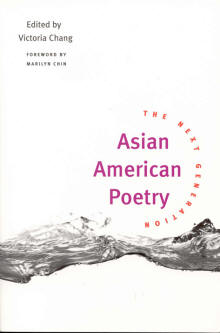
In her Foreword to Asian American Poetry: The Next Generation, Marilyn Chin says she is "pass[ing] the torch as a symbolic gesture" to a new collection of fresh voices whose identities are "multitudinous, multi-layered, and polyphonic."
It is this exciting diversity that sets the new anthology apart from earlier writings by Asian Americans who have eloquently recorded the struggle for assimilation, the deep veins of racism in the "New Land," and internal conflicts over identity. Many of these new poems actually transcend these themes to rampage or waltz across the boundaries of language, form, and internal landscapes as well as capture what it’s like to be ethnically tied to China, Japan, Korea, the Philippines, Vietnam, and Indochina.
In other, often startling, words, these "young Turks" are creating lively and lyrical poetry that doesn’t define them as Asian-American poets but as deft, flamboyant, evocative, and quirky explorers choosing their own pathways into the literary wilderness.
In the Introduction, Victoria Chang provides a historical perspective for this new cohort of scribblers. She reaches back to the 1890s when Sadachi Hartmann wrote Symbolist poetry and Yone Noguchi published Imagist poems in English. Chang then pays tribute to poets Lawson Inada, Jessica Hagedorn, and Joy Kagawa, who were publishing in the 1960s, and moves on to the first generation of Asian-American poets to receive widespread recognition. This group includes Li-Young Lee, Garrett Hongo, Ai, John Yau, and Marilyn Chin.
Four lines from Chin’s poem, "How I Got That Name" sums up the tenor and tone of Asian American poetry at that time:
She was neither black nor white,
neither cherished or vanquished,
just another squatter in her own bamboo grove
minding her poetry —.
Although the new generation continues to examine the themes of alienation and exile, it is also noted for its jubilant disregard of proper grammar or poetics. Chin explains that these new kids on the block use style "as a domain for innovation, experimenting with language, the line and white space, the stanza, rhyme, form and syntax." While continuing to honor their cultural legacy, they are not obsessed with sustaining a recognizable "Asian voice." Here are a few samples from this new generation —
Oliver de la Paz, born in Manila and raised in Ontario, Oregon, offers this comic, edgy prose poem:
The Boy’s Ears (from "Nine Secrets
the Recto Family Can’t Tell the Boy")
They think Fidelito gets them from great grandfather Carlos on Maria Elena’s side, the way they stick out like an awning. He was the talk of the barrio then. On hot days, people paid him to turn circles and circulate the air. Saturday nights, the people would say, "Meet you under Carlos," and huddle under his earlobe. Often, they used him to eavesdrop on conversations. At one point, he was the most hated man in Luzon.
Mong-Lan, who immigrated to the U.S. in 1975 to escape the political disorder of Saigon, has won numerous awards for shimmering poetry that resonates with the feverish surrealism of Arthur Rimbaud:
Field
Crows land like horse’s neighs
rush of rocks
how many buffaloes
does it take to plow a disaster?
how many women to clean
up the mess?
shoots of incense
hotly in her hands
she bows toward the tombstones
face of her son
how many revolutions for us to realize?
her windless grey hair
becomes her she knows this
there is no reason
to dye what she’s earned
rain quiet as wings
on her back
Lee Ann Roripaugh’s first volume of poetry, Beyond Hart Mountain, was a 1998 winner of the National Poetry Series. In the first segment of "Transplanting," a poem dedicated to "my mother, Yoshiko Horikoshi Roripaugh," she blends the haunting beauty of this life and the spooky regulations of a bureaucracy nervous about its border crossings:
1. X-Ray
My mother carried the chest x-ray
in her lap on the plane, inside
a manila envelope that read
Do Not Bend, and garnished
with leis at the Honolulu Airport
waited in line — this strange image
of ribcage, chain-link vertebrae,
pearled milk of lung and the murky
enigmatic chambers of her heart
in hand. Until it was her turn
and the immigration officer held
the black and white film up
to sun, light pierced clean through
her, and she was ushered from one
through the gate of another,
wreathed in the dubious and illusory
perfume of plucked orchids.
|