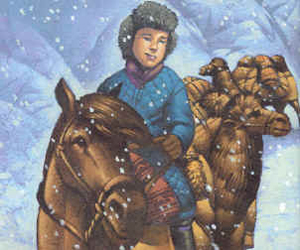
"My little sisters skip along beside me,
for it is the day I become a man,
and ride beside my father,
over the passes and through the snow,
in the caravan swaying back and forth,
where the mountains meet the sky,
and the trail leads ever on."
Caravan tells the story of a ten-year-old Kirghiz boy’s first journey from his family’s winter camp to the city where his nomadic people will trade their furs and felts for grain. Like the other drivers on horseback, Jura is entrusted with three camels. He hopes that someday he’ll be like his father, the caravan leader, "guiding the camels through the Pamirs." Caravan is both an exotic and a universal story, written in lilting free verse and enhanced by exquisite illustrations. It is a marvel.
Jura is a good storyteller because he’s a wonderful observer. Young readers and their parents — for this is a book for all ages — can imagine riding along with him "into the cold blue light" of the Hindu Kush. They can almost taste the melted cheese and bread the drivers eat as they spend the night in a cave, almost feel "the trembling of an avalanche," almost smell "the aroma of dates in the air" as the city appears below.
"Camels curl around a bend in the river.
I hear rapids frothing under crusts of ice.
Snowflakes settle upon my shoulders,
and I brush the snow from my mare’s ears.
Yearning to be running free in her pasture,
my mare’s gait lengthens under me.
My body is weary, but my heart is singing,
as I listen to her hooves carrying me home."
Jura’s mother and sisters are waiting as he pulls his camels into camp. They want to know all about the journey, but before he begins to tell them, he gives thanks that he has returned. Caravan ends here, at exactly the right moment, in exactly the right place, with gratitude, in the safe haven of home, with stories about to be told. This book is pure joy.
|