The old pond —
A straw sandal sunk to the bottom,
Sleet falling.
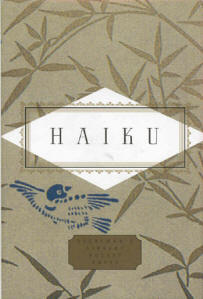
Buson’s vision of winter is only one of dozens of haiku collected here that give "old material a new twist," as Peter Washington characterizes this venerable and popular poetic form in his Foreword to this anthology. Included are not only R. H. Blyth’s "pioneering translations" of Japanese haiku from the fifteenth to the twentieth century, but also traditional and non-traditional Western haiku. Quite a few surprises wait between the covers of this little book, all of them pleasant.
Haiku is thematically arranged. The Japanese poems gravitate into chapters like "Happiness," "Phases of the Moon," and "Creatures." Ryuho writes:
Scooping up the moon
In the wash-basin,
And spilling it.
Animals are the subject of many of the haiku gathered here. This collection is especially rich in birds, several with Japanese names, which have a chapter all their own. Kikaku writes:
Its first note;
The uguisu
Is upside-down.
One of two poems about snakes that make an appearance here, Kyoshi’s haiku is a splendid little mystery:
The snake slid away,
But the eyes that stared at me
Remained in the grass.
R.H. Blythe believed that many haiku are "buried" in familiar English poems. Such Western haiku included in this collection are nothing short of astonishing. Wordsworth, Shelley, Keats, Thoreau, Coleridge, and Langston Hughes all provide fine examples, but Gerard Manley Hopkins and Walt Whitman wrote my favorites. Here’s Hopkins:
As a dare-gale skylark
Scanted in a dull cage
Man’s mounting spirit in his bone-house.
And here’s Whitman:
Far in the stillness,
A cat
Languishes loudly.
Non-traditional Western haiku by Pound, Rilke, Kerouac, Snyder, and a number of other poets new to me bring this collection to a close. William Carlos Williams’ poem "The Hurricane" is my current favorite:
The tree lay down
on the garage roof
and stretched, You
have your heaven,
it said, go to it.
Haiku has another treat in store for readers like me who miss those little ribbon bookmarks. And those whose New Years’ resolutions aren’t quite working out can commiserate with Matsuo:
New Year’s Day;
The desk and bits of paper —
Just as last year.
|