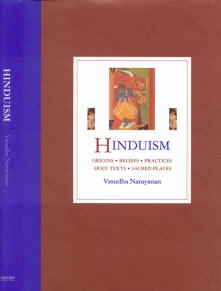
Hinduism has been portrayed in the past two centuries as being a more or less unified religion," writes Vasudha Narayanan in the introduction to this volume, yet "there are hundreds of internal divisions created by caste, community, language, and geography." Hinduism "has no single founder, creed, teacher, or prophet acknowledged by all Hindus as central to the religion." In fact, there are "few concepts that most ‘Hindus’ can be said to share." Hinduism is a visually stunning little book that explores and takes delight in the diversity of the flexible faith it describes.
Each of the nine chapters in Hinduism is illustrated with two photographs and followed by an extract from Hindu literature and commentary on the extract. Chapters are between only five and eleven pages long, with generous margins, and there is no extraneous verbiage here.
The first chapter, "Origins and Historical Development," begins with yet another unusual aspect of Hinduism: "There is no specific year or even century for the beginnings of the Hindu tradition." But the author is willing to "tentatively state that some features of the present-day Hindu religion may be nearly five thousand years old."
"Hindus may acknowledge many deities, but consider only one to be supreme; or they may consider all gods and goddesses equal, but worship one who is their favorite," we learn from the chapter "Aspects of the Divine." In a charming extract from the Brihadaranyaka Upanishad, a theologian is asked how many gods there are. He responds with six different answers including, "One and a half."
There is considerable flexibility in the "Ethical Principles" of Hinduism as well. "Some Hindus believe that through detached action, and knowledge, one may gain liberation. Others maintain that through devotion and surrender one can acquire the saving grace of the supreme being which stops the cycle of rebirth."
The chapter "Sacred Space" describes many natural and man-made places considered sacred by Hindus, and ends with a surprise: "Internet images of deities are taken seriously by devotees; some websites remind Internet surfers that it would be disrespectful to download such images. The Internet may therefore be seen as the last frontier of sacred space for many Hindus."
"Society and Religion," the final chapter, tackles the thorny matter of caste. Here, too, are diverse points of view. "The caste system was — and is — far more complex and flexible than the behavior the dharmashastras [treatises on righteousness, moral duty, and law] advocated, and historical evidence suggests that their prescriptions were probably not taken too seriously by many classes of society and apparently not followed at all in many areas." At the same time, even today "people continue to identify themselves by theirjati [birth group], and the entire Indian caste system is such a strong social force that non-Hindu communities such as Christians, Jains, and Sikhs have absorbed parts of it." A glossary, bibliography, and index conclude Hinduism.
From the rust and violet cover to the touches of that same rust at the top of each page, from the variously colored pages which begin and end each chapter to the quality of the paper of itself, Hinduism is a joy to hold and to behold. The photographs are magnificent, even when they are small. A picture of morning bathers at the Shivsagar tank, while measuring less than four by three inches, is vivid, luminous, suffused with the sacred.
Almost everything I know about Hinduism, I learned from this book, and I’d say that’s a lot.
|