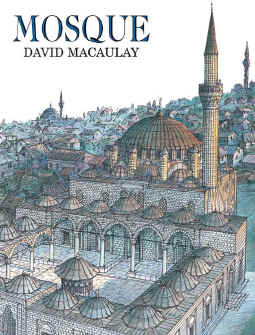
Every rare once in a while, I have the privilege of reading and writing about a book for which only the highest praise is adequate. A long-time admirer of David Macaulay, I have been devouring his words and drooling over his illustrations for years, but Mosque is the first of his books I’ve had the chance to review. It was worth the wait.
This book follows the planning and construction of a fictional mosque and associated buildings modeled after "existing examples built between 1540 and 1580 in and around Istanbul, Turkey, by Sinan, the most famous architect of the Ottoman Empire." Considerable challenges face Macaulay’s architect, Akif Agha. "How does one support a circular roof over a square room without filling the space with walls or columns?" How does one counteract the "self-destructive tendencies" of the resulting dome?
Macaulay’s mosque is much more than a building. The land chosen for it is located in a neighborhood "reduced to rubble" by fire ten years earlier. The author describes Christian craftsmen and artists, Muslim stonemasons, carpenters, roofers, and window makers, and Jewish merchants collaborating on this enormous project. Women may be mentioned only peripherally, but Macaulay makes it clear that this mosque is meant for women as well as men.
Of special interest is the description of the surrounding buildings and their functions, for example: "While the mosque would join the hearts and minds of the faithful through their devotion to God, the imaret would link the community within the kulliye to the community outside through their stomachs."
The illustrations are both sumptuous and instructive. Drawings from above and below give the reader the big picture of the structure-in-progress. Labeled diagrams of details such as stained glass windows show the reader the small intricacies of a magnificent building. Pictures of decorative tiles — "By tradition, all the decoration was to be drawn from three sources — the words of the Koran, natural vegetation, and the order and complexity of geometry" — hint at the beauty of faith made visible.
Perhaps it is a coincidence that David Macaulay gave us Mosque at this time in history, but I doubt it. Dedicated to his children and their children’s children, this book seems to me both a subtle plea for peace and evidence that peace is possible. "The greatest achievement of these buildings…" writes the author, "lies in their ability to impress and move even those whose personal beliefs they do not necessarily serve." Insh’allah.
|