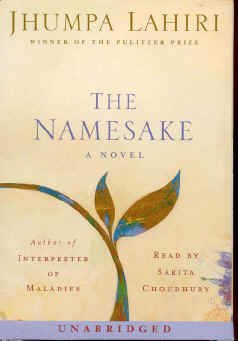
Jhumpa Lahiri’s Pulitzer-Prize-winning short-story collection Interpreter of Maladies is everything her judges and readers say it is. Her stories are brave and delicate. They go from lyric to cutting. Ms. Lahiri is among a recent pack of startling English-speaking Indian writers adored by critics and market alike. There’s not a soul not delighted with what these women have done to liven up our intermittently stale but always flexible English language. We are indebted to them.
It was with super expectations, indeed open-heartedness, that I poked Random House’s cassettes, one after another, into my blue Toyota’s tape player, two hours a day for my ride up the interstate, suburban Salem to downtown Portland.
Ms. Lahiri’s words, lilted dramatically by acclaimed screen actor Sarita Choudhury, were as disciplined as in her earlier work. She is easily precise inside her novel’s emotional terrain. As readers, now as listeners, we can be confident with her intimate handling of her characters’ inner lives. Ms. Choudhury’s sensual voice only adds to the spell. She is a master of suggestion, of tone, and of the thrumming pause.
But herein lies the trouble for me, as a recipient of their tale.
Ms. Lahiri’s latest effort is a good tale, again a string of immigrant jewels, strung into a big metaphor on traumatic dislocation. In short, The Namesake is about an America-raised boy of eager newcomer parents. From the day of his birth in a Cambridge, Massachusetts maternity ward, articulate and ancient Old World traditions are forsaken, at best in favor of Yank egalitarian notions, at worst as result of American impatience. The boy is named Gogol, after a Russian writer significant to Gogol’s father. It is an odd name by any standard.
Gogol hates his name. Gogol is, of course, embarrassed by his FOB (Fresh Off the Boat) family. It’s a theme that has long claimed main entrée at the literary table set more for middle-American consumption than as an expression of artistic exploration by immigrant writers. Immigrant work is typically not produced for Old Worlders.
Not surprisingly, Gogol grows up refusing and resenting his family’s suggested mates. Gogol goes for the white girls. All is well until he bumps into a childhood Indian friend, now a smart, beautiful brown woman. Now this could be interesting. Indeed, it is interesting in its charmingly nuanced then deliciously detailed way. Ms. Lahiri excels in riffing from nuance to detail to nuance. If only Gogol were a woman.
My problem with The Namesake — and I scurry to add that it’s my problem, neither Random House nor fans are troubled thus — is that I am an immigrant. The subject of the story. What’s more, I’m a guy. As a newcomer, as a typical spurned lover of American promises, I need more. I need it a bit more brutally. I need stories radically different from, dare I say it, what pleases that big demographic served by big publishers. You know whom I mean. Moreover, since this is a guy story, maybe about a muchacho like me rumbling and grumbling my way through America — well, I’ll need a male sensibility behind a male voice telling my tale.
When Gogol first scopes then gets innnterested in a girl on campus, he notices her freckles and her complexion. He likes the wave and swing of her hair. He gives details on her ensemble.
Hm.
Not my experience.
When Gogol and his roomies lay on elbows late at night, no one talks race, not one feels rage. Gogol’s buds want to know the (girlie) details of his date.
Oh.
The Namesake is a beautiful story, it is a beautiful telling. It’s just not for boys. Leastwise, not Raggedy Andys like me.
Jhumpa Lahiri won the 2000 Pen/ Hemingway Award and the 2000 Pulitzer Prize for fiction for her short story collection, Interpreter of Maladies. She was born to a Bengali Indian family in London and was raised in Rhode Island.
Sarita Choudhury is best known for her starring role in Mississippi Masala (1992), a film directed by Mira Nair about an interracial romance between Ms. Choudhury’s character and a southern Black played by Denzel Washington. Sarita Choudhury is also a London-born, British-educated Indian.
|