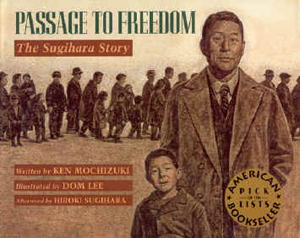
In 1940 Chiune Sugihara, the Japanese consul to Lithuania, repeatedly asked his government for permission to issue visas to hundreds of Jewish refugees from Poland. When his superiors refused for the third time, Sugihara told his wife, "I may have to disobey my government, but if I don’t, I will be disobeying God." Narrated by Sugihara’s five-year-old son Hiroki, Passage to Freedom is the astonishing story of the diplomat’s choice and its consequences.
Passage to Freedom begins with a one-page background story. When Chiune Sugihara gave money to a young Jewish boy who couldn’t afford to buy the food he wanted, the boy invited him to his home. "That is when my family and I went to a Hanukkah celebration for the first time," notes the narrator. In the accompanying sepia-toned illustration of the store, the expression on the Jewish boy’s face tells the reader all he or she needs to know about the motivation behind the diplomat’s tireless efforts on behalf of life.
Chiune Sugihara is portrayed not only as a hero to thousands of strangers, but also as a splendid family man. "My father always took the time to explain everything to me," the narrator tells us. "He said the refugees needed his help, that they needed permission from him to go to another part of the world where they would be safe." When he asks his family’s help in making his decision, everyone agrees that they really have no choice. Little Hiroki says, "If we don’t help them, won’t they die?"
Chiune Sugihara tried to write three hundred visas every day for a month. When his wife offered to help, he "insisted he be the only one, so no one else could get into trouble." When the Soviets took Lithuania, they ordered Sugihara to leave. The Japanese government reassigned him to Germany. Chiune Sugihara was handing permission papers out the window as his train pulled out of the station.
Hiroki Sugihara’s afterword describes the difficulty Chiune Sugihara and his family endured as a result of his heroic deed, and recounts the honors as well. "It is a story," he writes, "that proves that one person can make a difference."
Ken Mochizuki and Dom Lee are geniuses. Passage to Freedom is far more than a really good children’s book; it is a profound work of art. Study the words and the pictures. Let them change your life.
|