Strength, too much strength. You should have been born a man," a Chinese fortune teller shouts at Lakshmi. Angry. Behind his closed lids his eyes roll wild.
"You will have many children but never happiness. Beware your eldest son. He is your enemy from another life returned to punish you." This, from a stuffy little carnival tent, to which 16-year-old Lakshmi and her best friend Mui Tsai sneaked away on a sunny Saturday afternoon. And that is not the worst of it.
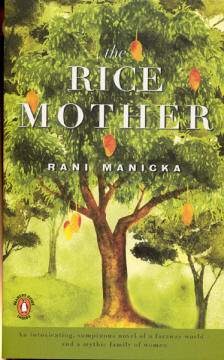
The Rice Mother is a story of four generations living through an awful and exhilarating century of Southeast Asian history. It is a litany familiar to many immigrants: men moving far to find back-breaking work; women entering marriage to improve their offsprings’ lives; maniacal enemy armies crushing your only home and nearly all your hopes; and hurt — deep, deep ancestral sorrow, each generation accumulating some more.
The Rice Mother is also beautiful. So much bitter loss, so much betrayal begs just as many lovely moments, just as much tender loyalty. Great dignity results from long sorrow.
The beauty is through the telling. Rani Manicka’s first novel is stunning. But her characters, telling their stories first-person, have never owned enough privilege to be stunned for very long. Self-indulgence is a luxury. Depression is not an option. When, for example, barely adolescent Lakshmi learns that she, her hopeful mother, and her carabao-like groom have been cleverly tricked, and now irrevocably trapped by their matrimonial matchmaker Aunty Pani, she stalls for barely a minute or two. "I closed my eyes and experienced profound defeat and the first flash of real anger that I had been so spectacularly used." She reels at the injustice of it all. She considers quickly her lack of options.
"Then the beauty of youth stepped in." Lakshmi gets practical. She gathers her meager personal assets, she sets on a plan. There are, as of yet, no limits to youthful optimism. She simply gets to work.
Indeed, when asked about the seed of her first novel, Ms. Manicka responds that it is her grandmother’s indominable energy, "the way she refused to give up, and the way she could turn her hand to anything she set her mind to do.
"If she had lived in my time," the author asserts, "she would surely be running a Fortune 500 company."
Ms. Manicka currently lives in London. Her family is Malaysian; more specifically, they are Indian ethnic minorities whose ancestors migrated as labor from Ceylon to Malaya during Imperial British rule. The Rice Mother won the 2003 Commonwealth Writers Prize.
|