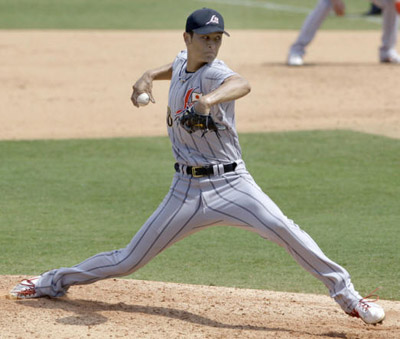
Despite some high-profile disappointments in the Japanese baseball import market, Major League Baseball (MLB) teams continue to look for Nippon Professional Baseball (NPB) players to bring across the Pacific. This year’s group includes the most-anticipated import since Daisuke Matsuzaka: Yu Darvish, who could singlehandedly shatter the perception that Japanese pitchers cannot excel in MLB.
In 2006, Matsuzaka’s final season in Japan, a 19-year-old Darvish pitched his first full season for the Hokkaido Nippon Ham Fighters. Finishing with a 12-5 record and a 2.89 ERA, Darvish led the Ham Fighters to the team’s first Japan Series win in 45 years. As strong as those numbers were, they represent one of Darvish’s weakest seasons. He never again registered an ERA over 1.88, and only once won fewer than 15 games.
NPB’s most dominant pitcher since Matsuzaka’s departure, Darvish possesses a broad repertoire of pitches, impeccable control, and a fastball in the high 90s. This combination is exceedingly rare among NPB pitchers and an excellent match for MLB, but Darvish continually dismissed any speculation that he would pitch in the United States.
But the choice is not his alone, and the cash-poor Ham Fighters posted Darvish this offseason, allowing American teams to bid for exclusive negotiating rights to him. The Texas Rangers, last year’s World Series runner-up, won the bidding with a $51.7 million figure, more than a half-million above Boston’s bid for Matsuzaka in 2006. This figure is even more impressive considering a weaker U.S. economy these days and the well-publicized struggles of Matsuzaka and other NPB imports in the U.S.
In part due to these struggles, teams bid less for other NPB players, like the Yankees’ $2.5 million winning bid for the rights to Seibu Lions’ shortstop Hiroyuki Nakajima. But this bid was surprising for other reasons. First, the Yankees already have an All-Star infield with 2011 Home Run Derby winner Robinson Cano at second base, team captain Derek Jeter at shortstop, and Alex Rodriguez and his 629 career home runs at third base. Next, the Yankees have been burned before on NPB players, shelling out $46 million for pitcher Kei Igawa and $12.8 million for the late Hideki Irabu, both high-priced failures.
New York will therefore either use Nakajima as a utility infielder or trade him to another team; the latter seems more likely for Nakajima, who could start in MLB. He spent 10 seasons with Seibu, hitting .302 with 134 stolen bases, 149 home runs, 664 RBI, and four Gold Gloves. In 2008, he led Seibu to the Japan Series title, winning MVP honors, and he was Japan’s top hitter when the team won the 2009 World Baseball Classic.
The Milwaukee Brewers entered this year’s import market when they also paid $2.5 million for the negotiating rights to Norichika Aoki, center fielder for the Yakult Swallows. In his eight NPB seasons, Aoki became the only player to ever have two 200-hit seasons, also scoring more than 100 runs three times, accumulating 164 stolen bases, and making seven All-Star teams.
As with the Yankees and Nakajima, the question with Aoki is where, and how often, he might play. The Brewers’ center field platoon of Carlos Gomez and Nyjer Morgan helped the team capture the NL Central, while 2011 MVP Ryan Braun plays in left field and All-Star Corey Hart plays in right. Braun is currently appealing a 50-game suspension for performance-enhancing drugs, so Aoki could fill in for Braun during that suspension or play occasionally as the Brewers’ fourth outfielder if Braun wins his appeal.
All of these players have yet to negotiate agreements with the teams, an outcome not guaranteed under the posting system. Last offseason, the Oakland Athletics failed to reach a deal with Hisashi Iwakuma after winning his posting rights. Texas will definitely sign Darvish, but Aoki and Nakajima could find themselves without an MLB contract if they cannot come to terms with the teams.
Because of this uncertainty, some MLB teams prefer to sign NPB players after they become free agents. One such free agent, the Fukuoka SoftBank Hawks’ Tsuyoshi Wada, signed a two-year deal with Baltimore worth $8.15 million. A reliable southpaw starter for nine seasons, Wada accumulated a 3.13 ERA and a 107-61 record, winning the Pacific League Rookie of the Year award in 2003, when he helped Fukuoka win the Japan Series. Wada should pitch at the back end of the Orioles’ rotation unless he can prove himself worthy of more frequent usage.
Other free agents seeking an MLB contract are Kensuke Tanaka of the Ham Fighters, Wei-Yin Chen of the Chunichi Dragons, and Hisashi Iwakuma. Iwakuma should get a deal this time around both because his value won’t be inflated by a hefty posting fee and because he can sign with any team. Tanaka, a decent second baseman, could provide infield depth but is unlikely to secure a starting job, while Chen, a left-handed starting pitcher, is rumored to be in discussions with Baltimore, where he would fit in nicely as a swingman.
The final free agent, speedy shortstop Munenori Kawasaki, played for 11 seasons with the Fukuoka Softbank Hawks, where he had a .294 batting average and 267 steals. He played with Ichiro Suzuki on two World Baseball Classic teams, and when Kawasaki declared free agency, he said he would only sign with Seattle because he wanted to play with Ichiro again. Kawasaki should sign a minor- league deal with the Mariners and get called up in 2012 if he doesn’t make the club as a utility infielder.
MLB fans have seen some disappointing imports in recent seasons, and most successes have been merely modest. Darvish has the best chance of reversing this trend, but if he doesn’t, many more players could do the same next season, boosting the flagging spirits of Asian sports fans everywhere. |