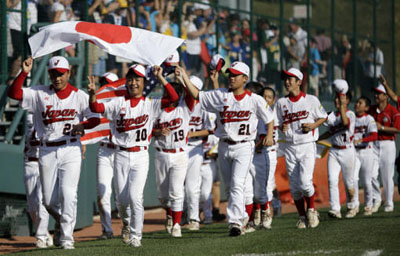
Asian fortunes have been waning lately in professional sports like basketball and baseball, but they’ve never been stronger in an international event for amateur athletes that draws worldwide attention: not the Olympics, the Little League World Series. We’re enjoying a renaissance of Japanese talent in this supposedly all-American sport, a resurgence that continued in this year’s tournament.
Between 1967 and 1974, the Far East dominated the Little League World Series, with Taiwan or Japan winning seven of eight championships. This led to the infamous 1975 rule excluding international teams from the tournament, a rule that was reversed the following year, when Japan won for the third time in nine years. This marked the last time Japan would reach the finals for more than 20 years, as other Asian teams dominated the international bracket. Taiwanese or Korean teams appeared in 16 of the next 21 Little League championships, winning 14, before Japan returned to the finals in 1998.
Japan has made up for lost time since then by appearing in nine of the next 14 finals, including four of the last six years, but they have struggled to win the championship. Of those nine appearances since 1998, they won just four, losing three of their last four appearances at Little League’s highest level, including 2011’s heartbreaking 1-2 loss to Huntington Beach, covered in one of last year’s sports columns.
This lack of success tempered the high expectations for Japan entering this year’s tournament. But Japan, represented by the team from Tokyo Kitasuna, erased any skepticism in their first game against Caribbean champion Curacao. Japan’s starting pitcher, Kotaro Kiyomiya, struck out the side in the first inning, his offense hung three runs on Curacao in the bottom of the frame, and the team never looked back. Kiyomiya struck out the next four batters without giving up a hit and, sitting on a six-run lead, Japan’s coach Yoichi Kubo brought Noriatsu Osaka in to finish the game and save his star pitcher’s arm. Japan won 7-0, yielding just two hits and one walk to their Caribbean counterparts.
In their next game, Japan faced Taiwan, the only non-U.S. country with more Little League World Series championships than Japan, in a matchup that would be Japan’s closest and most dramatic in the series. Both team’s starters threw six innings of scoreless baseball — a complete Little League game — striking out eleven, and the two pitching staffs combined to strike out 30 of the 66 hitters they faced.
In a battle of the bullpens, Taiwan’s cracked first. They had already saved the game twice in the seventh and eighth innings, when Japan had multiple runners in scoring position and Taiwanese relievers came on to erase the threat. But the third time was the charm for Japan, who won on a two-run walkoff home run by second baseman Hajime Motegi in the bottom of the ninth.
After such a low-scoring game, Japan wasted no time putting runs on the board in their next game against the Latin American team from Aguadulce, Panama. Back-to-back home runs in the first inning gave Japan three runs, more than enough for their pitchers to work with. Ryuji Osada and Noriatsu Osaka combined to strike out nine batters in six innings, giving up just four hits and walking two, while allowing only one run to Panama in the top of the fifth.
Japan faced Aguadulce again in the finals of the international bracket, a rematch with similar results. Japan again homered twice in the first inning and scored in every inning but the sixth, winning 10-2 and setting the stage for a championship showdown against the Southeast representative from Goodlettsville, Tennessee. Goodlettsville, an offensive juggernaut, had scored 49 runs in their first four games, 26 more than Japan, while showing an ability to win close games.
After winning its first game 12-1, Tennessee stayed neck-and-neck with Petaluma, California, through the fifth inning before scoring four to break open the game and secure the victory. In their third game, Goodlettsville repeatedly swapped leads with San Antonio, Texas, before rallying from a 2-3 deficit in the sixth inning for the win. Facing Petaluma again in the U.S. bracket championship, Tennessee saw their opponents rally from 10 runs down in the sixth inning to tie the score. But Tennessee responded with a dramatic rally of their own, scoring nine runs in the top of the seventh to advance to the final.
Beyond their tremendous offense, Tennessee lacked Japan’s shutdown pitching. In their first four games, the U.S. team gave up 26 runs, while Japan allowed just three, twice winning by shutout. This imbalance showed itself in the championship game, where Japan pitched and hit magnificently, while Tennessee could do neither.
Japan’s Kotaro Kiyomiya, his arm fresh after being pulled early in his first start, struck out eight of the 14 hitters he faced, giving up just one hit, a solo home run by Brock Myers, his fifth of the tournament. Tennessee teammate Lorenzo Butler also homered, a solo shot in the fifth off reliever Noriatsu Osaka, but it wasn’t enough to overcome Japan’s 12 runs. Four of those runs came from the bat of Osaka, who went 4-for-4 on the day with three home runs, including the two-run shot that won the game in the bottom of the fifth by invoking the Little League 10-run mercy rule.
After the game, Japan’s manager Yoichi Kubo said, "Our pitching and hitting is very balanced," an accurate assessment, considering that three of Osaka’s teammates drove in the other eight runs, two from home runs. This team effort typifies the Asian approach to baseball, a great sign that their dominance of Little League will continue for years to come.
|