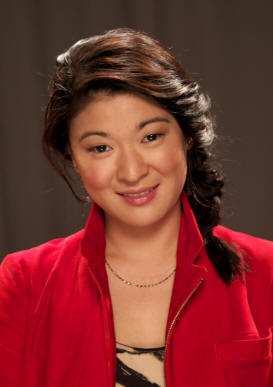
NEW YORK — Most stage actors toil for years in tiny, hard-to-find theaters, or in roaming national tours or at small regional companies before getting their shot on Broadway. Then there is Jennifer Lim.
Lim, 32, has amassed quite a few credits that can be considered really off-off-off Broadway: She has done a version of Medea at the International Adana State Theatre Festival in Turkey; Songs of the Dragons Flying to Heaven in Vienna; and she played Ophelia in a Mandarin-only production of Hamlet at the Grotowski International Theatre Festival in Poland.
Lim’s career, which has taken her to Broadway this fall in David Henry Hwang’s Ch’inglish, was more complex than most because she has had to qualify for an American work visa as a Hong Kong native.
"I had to work a little harder. But is it work when you love what you’re doing?" she asks with a broad smile. "For me, it’s a dream come true. I never imagined that I would be here."
Lim, who is half-Chinese and half-Korean and speaks both Mandarin and Cantonese, is attracting a lot of attention in Hwang’s new bilingual comedy. She plays an icy bureaucrat who later reveals herself to be a multifaceted, complex woman with her own agenda.
She first heard about the play in 2009 on Facebook. Hwang had written only the first act, and his team was casting for actors to do a reading. Lim jumped aboard and survived five rounds of readings and workshops before the finished play made it to the Goodman Theatre in Chicago a few months ago. Thankfully, her artist’s green card came in time for her to work on it professionally.
Ch’inglish is an east-meets-west collision of culture and communication, the story of a businessman from Ohio who goes to China to expand his business but struggles to be understood and falls in love with a Chinese woman played by Lim.
"Not only is he smart and brilliant, he so has his finger on the pulse," she says of Hwang. "He’s just so sharp and observant. I don’t know any other playwright who could have written this play quite in the same way. His understanding of the Chinese and his understanding of Americans and how they see each other is so spot on."
The play’s director, Leigh Silverman, who also directed Hwang’s play Yellow Face, says Lim has been a revelation. Finding a bilingual actress with the talent to convey all her character’s complexity was not terribly simple.
"She is fierce and funny and gorgeous and smart," Silverman says of Lim. "She understands who this woman is in a very deep way, and so I knew we would be able to tell the story of an ambitious, smart government official without falling into any kind of cliché, because Jennifer is too smart for that."
While Lim had not had a chance to see any of Hwang’s work onstage, including his Tony-winning M. Butterfly and FOB, once she heard about Ch’inglish she rushed to a bookstore and bought all his work, devouring it in two days.
"There’s so much in this play that resonates and I recognize," says Lim, who adds that the work has made her see the women in her life in a slightly different way. "He hasn’t written a single stereotype. They’re all fully fleshed out, complex characters."
Lim was reared in Hong Kong and studied dance, gymnastics, ice skating, and piano as a child. She continued her love of performing at Yale University, where she attended the Yale School of Drama after graduating from Bristol University in England with a bachelor’s degree.
She came to New York in 2004, but often found herself on the road, with acting jobs in Belgium, Germany, Norway, Spain, and the Edinburgh Fringe Festival in Scotland. While allowed to do television and film — her credits include the movie 27 Dresses and TV appearances on "The Good Wife," "Royal Pains," and "As the World Turns" — the union representing stage actors would not let her work in the theater until she amassed international credits, proof she was worthy.
The dues-paying has left her stronger and wiser and ready for the challenges of Broadway. "I would like to think that I won’t change too much," she says. "This whole experience: I feel like if I had to pick one word to kind of sum it up, it would be grateful."
Lim says Hwang’s play also has helped fuel a discussion in the Asian theater community about overcoming discrimination and pressing for more colorblind casting. She says many Asian-American actors are frustrated they aren’t often considered for American parts because they don’t have blond hair and cornflower blue eyes.
"When I walk into an audition room, I know that they have an idea of the character. It’s my job to go in there and say, ‘You may think you know what you want, but let me show you what you need,"’ she says. "I think that’s the only way to keep sane and keep working."
Lim hopes her positive reviews from Ch’inglish will open doors, and she’s not picky about what those open doors reveal. So if the next job is far from Broadway, she will not mind.
"If the work is good, I’d be as happy working out of storefront theater in Chicago as I would on Broadway, or doing an indie film in the middle of nowhere," she says. "The recognition is nice and the acknowledgement is nice, but that’s not why I do this." |