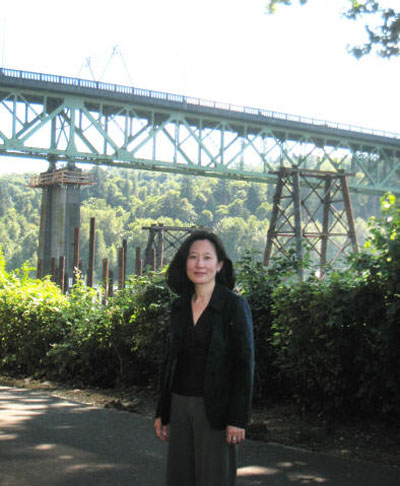
An old friend of Mikyoung Kim’s caught up with her recently and remembered visits to the artist’s home when she was a girl, growing up in a creative household where her mother was a ceramicist and her father an architect.
"We would listen to Mikyoung play the piano," the friend reminisced, "then eat dinner her mother cooked on plates her mother made, in a house her father built."
Kim herself describes her upbringing as "infused with creativity."
The child of Korean immigrants who travelled to the United States in search of education, Kim grew up in Hartford, Connecticut at a time when there weren’t many Asians.
"When I was younger," says the artist selected for the Sellwood Bridge public art project, "there was a struggle to figure out who I was. I was the only Asian in my school."
But Kim knows who she is now, and in a few years, everyone who crosses the Sellwood Bridge will know her by what she calls the "totem-like folded structures" she is designing to calm traffic and create "a sense of arrival" on the east side of the bridge.
Kim played the piano from the time she was five years old and looked forward to a career in music, but she developed tendinitis in her early 20s and had to find "a new pathway." She credits Athena Tacha, then a teacher at Oberlin College, with encouraging her along the journey to public art.
The artist has worked on a startling variety of projects, from the ChongGae Canal restoration in Seoul, Korea to Project Ripple, textured stone in a healing garden in Miami, Florida, to the Kaleidoscope Project, colored windows in an old bridge-tender’s room on the Potomac River in Washington, D.C.
Kim describes her plans for the Sellwood Bridge public art as "a preliminary proposal. I guarantee it’s going to change."
Likely elements include a collage of different media, including materials found locally, with imprints of regional significance: a bird’s feather, a butterfly’s wing, the scales of a fish.
Public art manager for the Regional Arts & Culture Council (RACC) Peggy Kendellen described the search for an artist capable of handling a $500,000 budget and a challenging site. A selection committee representing the neighborhood, the Sellwood Bridge Project, and the art community was formed last summer and reviewed the work of 40 qualified artists pulled from the Oregon Public Art roster. The committee narrowed the field to 12 artists, then to four finalists, and lastly to a unanimous selection of Kim.
Heather Koch, a selection committee member, Sellwood resident, and member of the Sellwood Bridge Citizens Advisory Committee, pointed out that, "public art is for everybody. It cannot be just a neighborhood-serving response, but must still be responsive to the neighborhood."
Kim’s art is "a good fit for the bridge project, the site, and the neighborhood. It was an extremely fitting proposal," Koch added.
Deborah Horrell, a selection committee member, sculptor, and Sellwood resident, calls Kim’s totems "simple in their elegance," and, like many Portlanders, appreciates the artist’s use of recycled materials, which offer "gradients of color and texture." Kim was "sensitive to all the conditions of the project — an incredible undertaking for an artist. Her work is lovely, has a sense of motion that integrates with the site, and doesn’t overwhelm the beauty of the bridge."
Mikyoung Kim’s artwork is scheduled to be in place on the new Sellwood Bridge in 2015 or 2016. It promises to be well worth the wait. |