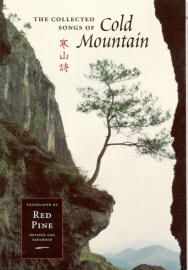
People ask the way to Cold Mountain
but roads don’t reach Cold Mountain
in summer the ice doesn’t melt
and the morning fog is too dense
how did someone like me arrive
our minds are not the same
if they were the same
you would be here
In his note discussing this poem, translator Red Pine says, "A road does reach Cold Mountain … But then, the poem is about a different mountain."
Born around 730, the mysterious Chinese poet and hermit who called himself Han-shan (Cold Mountain) ignored fame, fortune, and a government gig to live in a cave at the base of Hanyen, or Cold Cliff, in Chekiang Province, a two-day hike from the East China Sea.
A Zen mystic, cranky contrarian, and observer of human foibles, Cold Mountain wrote his pithy, humorous, at times luscious poems on rocky slabs or tree trunks, shared them with visitors, and thought little of his reputation. It took a thousand years for him to be recognized as one of China’s greatest poets, and by then only 300 of his poems survived. But the enduring, if tattered, body of his work was enough to secure his place in the literary canon of a nation that has long treasured its poets and reclusive philosophers.
Since I escaped to Cold Mountain
I’ve lived on mountain fruit
what worries does life hold
this time I’m following karma
days and months are like a stream
time is but a spark
Heaven and Earth can change
I am happy here in the cliffs
In his high-spirited preface, Red Pine reports that Cold Mountain would often take a long day’s hike to Kuoching Temple at the foot of Mount Tientai. He adds that Ko Hung, a Taoist writer of the fourth century, called Tientai "the perfect place for would-be immortals to carry out their alchemic and yogic transformations." The site would later become one of the foremost centers of Buddhist teaching and practice in all of China.
It was here that Cold Mountain met Big Stick (Feng-kan) and Pickup (Shih-te), two other eccentric fellows who joined the poet to become the Three Hermits of Tientai, still popular in China for their devotion to each other and cavalier attitude toward the rigidity of religious dogma.
At the end of this collection of poems by Cold Mountain, Red Pine includes a few by Big Stick:
Actually there isn’t a thing
much less any dust to wipe away
who can master this
doesn’t need to sit there stiff
And a few by Pickup:
Partial to pine cliffs and lonely trails
an old man laughs at himself when he falters
even now after all these years
trusting the current like an unmoored boat
Another highly readable segment of this volume is its introduction by author and sinophile John Blofield, who eloquently places Cold Mountain in his lonely setting, yet points out that he probably led an active social life amongst his fellow mountain men and nearby villagers. The key, of course, was access to physical as well as metaphysical solitude. This combination of isolation and observation of everyday life makes Cold Mountain’s poems so provocative and everlasting. Here’s a poem that hits close to home for this particular poet:
Disappointed impoverished scholars
know the limits of hunger and cold
unemployed they like to write poems
scribbling away with the strength of their hearts
but who collects a nobody’s words
may as well save your sighs
write them down on rice-flour cakes
even mongrels won’t touch them
Throughout the book, Red Pine’s succinct and informative notes for each poem are core samples of the cultural, political, and literary history of China. In reference to the last poem, he announces that among his favorite restaurants in Hangchou is Koupuli (Dogs Won’t Touch Them), famous for its steamed dumplings.
As my colleague, Doug Spangle, made clear in a review in The Asian Reporter, Asian poetry doesn’t have to be formal, somber, or lyrically stunning. It can also be a hoot. I’ll leave you with Cold Mountain doing stand-up:
All kinds of people exist under Heaven
different types of beauty prevail
Old Lady Chia had a husband of sorts
Huang-lao had no wife
the Wei sons all were handsome
Miss Chung-li was a fright
if she moved West
I’d head East
|