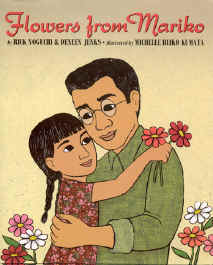
"Mariko had been waiting almost three years for this day, when she and her family were finally allowed to leave camp." In the heartbreaking picture accompanying the opening sentence of this book, the protagonist stands inside a barbed-wire fence, looking out, wishing she’d had a chance to explore the buttes nearby — but no one in Camp was allowed. When we ponder the shame of this country’s imprisonment of its own innocent citizens because of their ethnic heritage, we must also remember that many of those citizens were children. Flowers from Mariko is a book that will help today’s children, and the parents who read with them, never to forget.
Mariko’s father, who left a gardening business behind when his family was sent to an internment camp in the desert, grew flowers outside their barracks. Mariko and her father sang to the flowers together: "Haru-ga kita. Spring is coming." Now, living in a trailer park built for people returning from camp, Mariko notices that the trailers are "arranged in rows just as the barracks had been, with communal bathrooms in the center." Mariko’s father cannot find work. Her mother tells her that everything will be fine, but at night she can hear her parents whispering, "their words circling the dark rooms like birds without a safe place to land."
Although Mariko is embarrassed to see her father rummaging through trash barrels for gardening implements, she plants the two packets of seeds he has found and sings to them softly. When Mariko is disappointed because her father doesn’t notice the green shoots, her mother wisely tells her, "Your flowers hear the music. Father will, too."
Flowers from Mariko is a book not only about the hardships endured by those citizens of the United States who were imprisoned and in many cases returned to society to find their belongings gone and racial prejudice rampant. It is also a book about kindness, and the difference it can make. While children are often perceived as powerless, it is important to remember that their small acts of kindness can have an enormous impact on those they love.
This is Rick Noguchi and Deneen Jenks’ first children’s book, but the writing couldn’t be better. This is also Michelle Reiko Kumata’s first picture book, but her illustrations are absolutely right. We can only hope the future holds many more books by these wise and gifted collaborators.
|