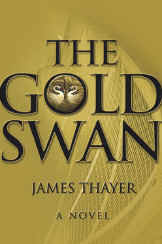
"I had just become an orphan, just that moment. Made an orphan in a terrible way, though I didn’t know it yet," confides James Thayer’s narrator at the beginning of The Gold Swan. It’s a stunner of an opening, tragic yet enticing, to this mystery with a message.
Protagonist Clay Williams is a senior security consultant for the Fifth Millennium China Tower, more commonly known around Hong Kong as the Gold Swan. A month away from completion as the narrative begins, the world’s tallest man-made structure is "one long, elegant curve … its bronze casing throwing back the gold of the sun, and also reflecting images of passing clouds and the restless water of the harbor, endlessly changing as the day unfolded." More than just a building, the tower is a vivid character, strangely linked to Williams’ father, a retired pear grower from Medford, Oregon, whose death in a fall from his son’s 20th-story balcony has been ruled a suicide.
Clay Williams does not believe that his father killed himself. Neither does Wen Quichin, the leader of 88K, "the largest criminal organization in Asia," whose grandson, Hsu Shui-ban, disappeared from his apartment down the hall from Williams’ apartment on the same night Williams’ father fell to his death. Neither does Soong Chan, Shui-ban’s friend and fellow amateur physicist, who has gone into hiding after witnessing the kidnapping and ensuing assault on Williams’ father. Neither does William’s friend Jay Lee, head of the police’s Organized Crime and Triad Bureau.
As these unlikely collaborators search for Hsu Shui-ban’s captors, presumed also to be killers, they discover one mystery after another surrounding the Gold Swan. Why has Williams’ supervisor warned him to ignore vessels approaching the tower or lose his job? Why does Anne Iverson, the architecture project manager for the tower and Williams’ friend, learn about the construction of a second ferry terminal on the tower’s island not from John Llewellyn, her lover and the building’s designer, but from the newspaper? Why has the Gold Swan’s respected chief geotech engineer been found guilty of graft and summarily executed? Why was the founder and CEO of the project’s principal fill contractor killed resisting a mugging in Singapore, of all unlikely places? And why are John Llewellyn’s hands shaking?
The Gold Swan is a first-rate mystery and a splendid portrait of contemporary Hong Kong. "Skinned rats, tail and all, hung from another vendor’s stand. A fortune-teller sat on the curb, his caged bird ready to lift a slip of paper from a tray whenever tempted with a seed." It is also an unnerving exploration of the lengths to which a government can go to cover up the truth. "CEOs and station managers and publishers had been taken into their offices, and the message given to them had been simple: any newspaper stories or broadcast reports regarding difficulties on construction of the Fifth Millennium China Tower would be considered as a breach of state security, a capital offense." It’s an effective strategy. As CIA agent Darrel Reese points out, "Most Chinese still do not know that men have landed on the moon."
James Thayer’s characters are consistently engaging. "You’d think that a culture that invented the abacus could’ve invented the fork," muses Williams as he wrestles with chopsticks. Jay Lee allows that, "Wen is a ruthless killer, but he’s a benign ruthless killer." Shao Long, 88K’s enforcer whose teeth glitter with emeralds, tells the policeman over a beer, "I was going to be a chef before I was led into a life of crime."
The tower from which The Gold Swan takes its name is something of a mirror, reflecting the best and the worst in the people who build it and admire it, and the land that surrounds it. Jay Lee speaks for this reviewer when he marvels, "It seems alive, doesn’t it?"
|