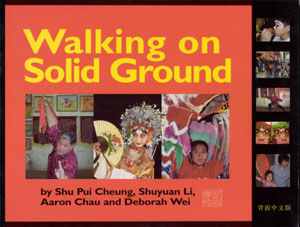
In Walking on Solid Ground, a Beijing Opera teacher and a kung fu teacher who have immigrated from China and Hong Kong to the United States, and their Chinese-American student who was born in Philadelphia, share their perspectives on the city’s Chinatown. Their words are printed in both Chinese and English and accompanied by lively photographs, but the organization of the book is peculiar and hard to follow. Walking on Solid Ground is a good idea that doesn’t quite work.
Opposite the title page is an interesting description of the history of Philadelphia’s Chinatown, but turn the page, and there’s a second account titled "History" that picks up around where the earlier description left off in the mid-1800s.
"Community" is the next section, in which the reader is introduced to the three community members who describe their Chinatown. Shuyuan Li, who arrived in the United States six years ago, says, "When I came here, I found people who like Beijing opera and wanted to learn. That made me very happy." Shu Pui "Sifu" Cheung compares his hard life as a young man in Hong Kong with the difficult lives of Chinese immigrants in the United States: "Some work 14 or 16 hours a day in jobs that don’t pay very well … The children, too, have it hard." Although there may be little time for art and culture, the kung fu teacher believes that "without the lion dancers or the dragon dancers, Chinatown would be a community filled with regrets." Aaron Jin Chau is troubled by people who come to Chinatown only for the Convention Center and "don’t even see that they’re walking through someone’s home," yet the boy is equally uncomfortable with tourists who stare: "It’s like they think we’re there to entertain them."
The longest section of this book is called "Struggle" and is divided into six sub-chapters from "Conquering Bitterness" to "Responsibility." It’s here that Walking on Solid Ground really falters. In "Conquering Bitterness," only Teacher Li addresses the topic; Sifu Cheung and Aaron Chau’s quotations seem haphazardly tacked on here. Sections on "Motivation," "Attentiveness," and "Respect" are more cohesive, but it’s still a slow read.
"Future" is a good summation, especially accompanied by a photograph of the three people whose words we have been reading standing together in Philadelphia’s Chinatown, but there’s also a sense of relief at this point that the book is finally at an end. Walking on Solid Ground is aimed at children in grades three through seven, but it’s going to take more than this to hold their interest.
|