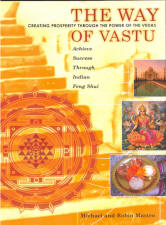
The Way of Vastu is a gorgeous book to flip through, but actually reading it — which is what you’ll need to do to put these ideas into practice — is another matter altogether. Even the book’s cover is jammed with too much information: a fine title, a lengthy but manageable subtitle, and "Achieve Success Through Indian Feng Shui," which sounds a lot more like an aggressive sales pitch than the philosophy of abundance the authors mean to convey. On the back cover the mood continues with testimonials in type so small you’ll need a magnifying glass and your best reading light to make out the letters.
Okay, so you can do without the testimonials, but the text of The Way of Vastu is also far from inviting. It’s printed in a larger type than the testimonials, but just barely, and there’s too much of it jammed onto each page. Faint, almost subliminal images of dollar bills, the outline of a human figure crouching in a square, and the lovely but dense letters of a language too faint to read lurk beneath some of the text, making it that much more vexing to puzzle out. Fortunately, this is confined to the first third of the book.
I’m getting around to the better aspects of The Way of Vastu, but I have one more serious grievance. Vastu, the authors write, "prescribes that to build in harmony with nature, the circumference of a building reduces in size as it grows in height." They go on to contrast the "tapered form of the pyramids and other structures such as the Petronas Twin Towers in Kuala Lumpur" with the "monolithic shape of the former Twin Towers in New York City," which "violated this natural law of design." The following paragraph states, "No matter how compromised your home or office may be by its irregular shape, however, it is possible to correct its imbalances and restore harmony by applying certain principles of Vastu." It’s an unnecessary reference at best, a creepy retrospective implication at worst.
Vastu, which means "building" is "yoga for the home or office," the authors write. There are some great quotations included, from Winston Churchill, who said, "We shape our buildings; thereafter they shape us," to Maharishi Mahesh Yogi, who said, "Where is the light of God? It is hidden within everyone. It has to be brought to human awareness. It is like a house that is wired for electricity, but if you don’t press the button, you remain in darkness."
There are also many fine photographs, most notable a stack of rocks with a red and yellow flower sitting atop it. Turn the page for the ultimate juxtaposition: a sweet little bungalow fades into the background behind a power pole with a streetlamp, wires running in four directions, and a yellow road caution sign.
Michael and Robin Mastro — who are also the authors of the award-winning Altars of Power and Grace: Create the Life You Desire — make their best points as The Way of Vastu draws to a conclusion. "To attract abundance, live with a grateful heart," they write, putting these wise words in italics so that they stand out. "In many parts of the world, service to others is considered essential in attracting abundance," they continue. While it would seem to me that service to others helps create abundance, I’m not going to quibble. I’m going to hope that whoever manages to read this book reads it all the way to the end.
|