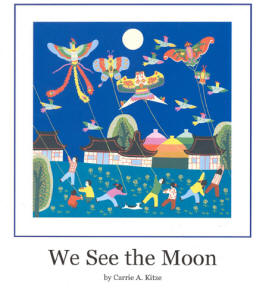
We See the Moon is a spare volume of great subtlety. The words, written from the perspective of an adopted child, are simple and poetic.
I was born
in a faraway land,
of parents
with faces in the shadows.
Opposite these lines is a bold yet tranquil painting of a mother cradling a baby. The colors aren’t exactly the primary red, blue, and yellow we know so well, and black, lavender, and turquoise add unexpected, but absolutely perfect, accents. This isn’t just an illustration; this is a work of art.
On the next page a neighborhood celebrates New Year’s Eve beneath a sky glittering with fireworks and a full moon. Facing this painting is the child’s question: "Where are you now?"
We See the Moon continues in this manner as the child wonders about the absent parents and describes the moon, eventually linking them:
I know you are always with me.
All I need is to look
at the moon in the night sky
and think of you.
The child has many questions — "Why did you leave me?" "Do you remember me?" — but We See the Moon ends not with a question, but with an affirmation of "warmth and love."
Author Carrie Kitze, who dedicated this book to her daughters’ birth parents, points out that in China, "during the Mid-Autumn Festival, the tradition is to look to the moon to connect with family and loved ones who can’t be together."
The astonishing illustrations are the work of various Chinese peasants, mostly older women, taught by painter Wu Tongzhang in the late 1970s.
As if the verbal and visual beauty of this book weren’t reason enough to buy it, a portion of the proceeds from We See the Moon helps children around the world who remain in orphanages. The author and the artists responsible for this book have already made the world a better place. Readers can do likewise.
|