"Everyone … was very poor, but we always had enough food because we raised our own. We were never hungry. As kids, no matter whose house we went to they always fed us. We played with our Japanese friends and their mothers gave us sushi. My grandma gave my friends Spanish food." -- La Senora, Sefa dela Torre
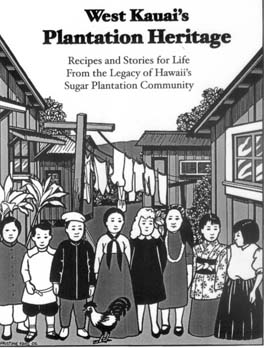
"They were young, most were poor, few owned much beyond dreams of a better life ... They loved their new country, America, and made their new island home, Hawaii, the fascinating blend of cultures that it is today," reads the dedication of West Kaua’i Community Development Corporation’s newest edition of West Kauai’s Plantation Heritage.
These opening words are important in understanding Hawai’i’s multicultural society; they are essential also for sustaining the strength of every cultural strand that could make the old American dream into our contemporary reality.
Hawaiian culture and cuisine have been evolving on the island of Kaua’i for about 1,500 years. The other families and foods featured in Kauai’s Heritage span only about 180. These later arrivals are: Scottish and English (beginning in the 1820s); Chinese (beginning 1850s); Japanese (beginning 1868); Okinawans (beginning 1884); Portuguese (beginning 1878); Germans (beginning 1880); Norwegians (beginning 1880); Puerto Ricans (beginning 1901); Koreans (beginning 1903); Spanish (beginning 1906); and Filipinos (beginning 1907). It is this mix — some inevitable blending, and a lot of cultural self-sufficiency — that makes Kaua’i’s kind society and Kaua’i’s famous cookbook as wonderful as they are.
Each immigrant group, the authors tell us, brought their own vegetable seeds. After all, what would Norwegians do without their potato soup (potetsuppe) or potato pancakes (lefse)? What about Germans without their rotkohl (red cabbage) or erter (green peas)? Imagine Pilipinos without paria (bitter melons) or utong (cowpeas). And so each ethnic American community keeps its promise to its own unique cultural heritage, and its own bright-eyed children. This is a big-hearted storybook and happy-tummied cookbook, generous with Hawai’i’s aloha tradition.
A Native Hawaiian recipe borrowed from Kauai’s Heritage, bound to be all the rage in our Pac Northwest:
Lomi Salmon
1 lb. salt salmon
5 large ripe fresh tomatoes
1 large onion
2 or 3 green onions
crushed ice
Remove skin and bones from salmon and soak, changing water till it isn’t too salty.
Pick apart or chop into pieces and put in bowl.
Dice tomatoes and onions.
Lomi (massage) ingredients with fingers until well mixed and in small pieces.
Serve ice cold, mixed with small amount of crushed ice.
Tastes best when accompanied by poi (mashed taro).
West Kauai’s Plantation Heritage can be purchased at Borders Books throughout Hawaii. Outside Hawaii, the book may be obtained for $20.00 (includes priority mail in the United States) by calling Lori or Liz at (808) 338-1900, or e-mailing <info@kikiaola.com>. It is also available online, at <www.waimea-plantation.com/shop>.
|