Special to The Asian Reporter
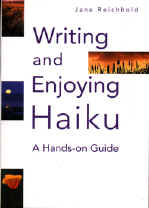
In an attempt to unveil the mysterious simplicity of Japan’s 400-year-old art of haiku, Jane Reichhold’s Writing and Enjoying Haikuseeks both to explain and challenge the precepts of this short-form poetry.
Informative, the book attempts to translate the essence of the Land of The Rising Sun’s contemplative poetry for today’s would-be Western practitioner: our view of nature, simplicity in scribing, and Anglicization.
"Let go of any preconceived ideas and simply do whatever brings you enjoyment," Reichhold begins. "This is your life. The book you are writing."
Perhaps her opening stanza about the world of subtle obviousness, which impregnates the pauses between a Haiku verse, is best voiced in what soon follows:
Silence
Between words
Stories
For Reichhold, Haiku is clearly a spiritual journey. The enthusiasm with which she encourages her readers to enjoy both reading and writing it blossoms. Her appreciation for its Zen-like mastery of seeing, contemplating, and expressing what she almost euphemistically calls "the here and now" is poignant — and poetic.
The text extols the virtues of awareness, openness, reverence, oneness, simplicity, and humility that the author asserts are essential for grasping the haiku mystery. But there is also an academic, if not contrasting, vein to the book.
As in profound poetry itself, there is a point where conflicting principles kiss. Sometimes they can even contradict. In Writing and Enjoying Haiku, it is where tradition and its translation converge.
Where does preserving the vehicle of haiku’s essence end, and formulaic dogmatism begin? When does the poetic translation and retranslation of a principle start to become something else?
If either the above virtues, or academic argument, are essential for grasping Haiku, is there adequate openness and humility — or scholarly inquiry — regarding the Japanese language in which it was derived?
Well-versed in classical Asian poetry or not, the discerning reader will find that Reichhold’s Writing and Enjoying Haiku leaves them pondering such questions.
In contrast to the art form’s regiment of three-line, 17-syllable poems — in syllabic rhythms of five, seven, and five — the book calls on contemporary times, language, and cultural differences as evidence that today’s haikuists should break from this and other aspects of tradition if they feel inclined.
Noting past "furious ink battles which have raged over haiku," Reichhold takes it upon herself to introduce haiku’s Magna Carta of a new age: replace syllable structure with three alternate long and short lines, include a fragment phrase, say something about nature, use the present tense, and avoid capitalizations and rhymes.
These revisions of a centuries-old Japanese art form — like the tea ceremony, flower arrangement, or the warrior Way of Budo, which are reputed to attune the practitioner to inner and outer realities beyond mere form — beg important questions.
Like the ripe silence between haiku verses, however, the reader must discern the answer from this, and perhaps other more traditional works on the topic, for her- or himself.
|