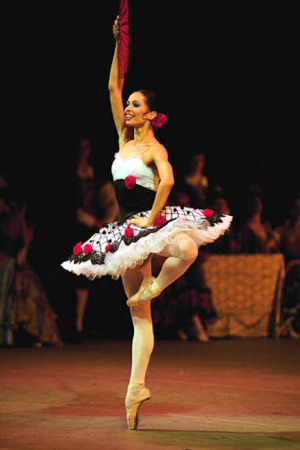
It turns out there is more to ballet than the annual run of Tchaikovsky’s The Nutcracker.
If that’s news to you, then Bertrand Normand’s documentary Ballerina is an excellent primer for the art form. It also provides a rare peek at the rigorous training and practice that lasts for hours and becomes decades.
A professional ballerina will start dancing as a little girl and by the time she’s 18 she’ll have danced for more than half her life. If it turns out she’s a huge success and avoids serious injury, her career may last until she’s 40.
The execution of the dance is so flush with transcendent beauty and elegance that it’s easy to forget that backstage it’s still show business, which is to say, business nearly as unflinchingly unsentimental in its application as a mafia operation or a life insurance company. The other thing about the art form, and the one on which Normand focuses (Mikhail Baryshnikov and the gents not withstanding), is its splendid femininity.
This isn’t to say it’s pleasant to see little girls picked out of a line based on their body type (tall and slender it turns out; the zaftig need not apply) and then trained with an intensity that had me longing for ibuprofen and Xanax.
Normand includes interviews with choreographers and coaches who are insightful but chilling in their calculations. Racehorses are treated with greater affection than are these young women.
But most of the choreographers and all the dancers are Russian, and Russians know better than most of us that life, like winter, is cold, dark, and very, very hard.
One of the Russian riddles wrapped in a mystery inside an enigma is how, under a brutal communist system, this delicate art form was conferred from the classes to the masses.
Normand conducts on-the-street interviews with women of all ages who relate the longing they had to become ballerinas. It could be compared to American boys wanting to play major league baseball, but not really — the yearning of the would-be dancers far surpasses that felt by frustrated centerfielders.
Ballet continues to enjoy broad and deep appeal in Russia, while in the Land of the Free there is Hannah Montana, "American Idol," and professional wrestling.
Ballerina follows five dancers who perform with the Kirov Ballet at the Mariinsky Theatre in St. Petersburg. Each woman is at a different stage on the arc of a dancer’s career.
They all seem to be likable enough people. To the extent that they enjoy certain material comforts, it is clear they have worked hard to achieve them. Though Normand gives us an intimate view, we don’t glimpse in any of them the spoiled, pampered diva one might expect to find in opera or professional tennis.
It is easy to make the comparison to athletics as much for the gruelling regimen and the toll taken on the body as for the confident gait with which they walk.
So there’s a physical artistry among the ballerinas that is not unlike the physical artistry possessed by John Elway or Muhammad Ali. However, the art of the ballerina requires more — as with acting, there is the conveyance of emotion.
There’s a reason my mother, in addition to scores of people in the audience at the Mariinsky, always finds it sad when the swan dies at the end of Swan Lake.
Valery Gergiev, artistic director of the Mariinsky Theatre, says, "The dancers are not interesting because … they’re traditionally taught and they go out and do what they were taught to do; they’re interesting because they bring their own tenderness, fire, depth, sensitivity, beauty."
Normand’s Ballerina is not life-changing stuff, though it is as pleasurable as it is instructive.
The readers of this newspaper know it’s a big world out there and we can learn a measure of appreciation through occasional peeks behind the curtain. Ballerinas, like flight attendants, can be lovely and they can be glamorous, but when you catch them checking into a hotel late at night on a work day that started 14 hours before, they are just regular, tired working folks.
Ballerina also impresses that the artistic hallmarks of other people can be important even if we don’t fully understand them. Normand gives us sequences from various performances. The technical significance of each exquisite footfall of every splendid pirouette is surely lost on the laity (as surely is Jackson Pollack’s dollop here and splatter there, or Michael Jordan’s instantaneous and tactically correct decision making while, apparently, flying.) What the layperson is left with is an overall emotional impression — a sense of wonder and awe at having seen something extraordinary for the very first time.
Tell Tchaikovsky the news: Bertrand Normand is here to show us there is more to ballet than The Nutcracker.
Ballerina is playing March 14, 15, 21, and 22 at the Hollywood Theatre, located at 4122 N.E. Sandy Boulevard in Portland. For more information, including showtimes, call (503) 281-4215 or visit <www.hollywoodtheatre.org>.
|