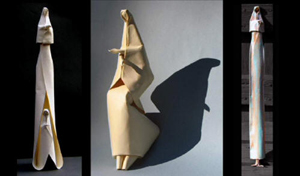
When material artist Chris K. Palmer folds paper, everything else becomes peripheral. He doesn’t notice the paper cuts on his knuckles. Nor the fact that he has been standing at his kitchen counter for four-and-a-half hours. All he sees is the intricate geometric shape that will emerge, a masterful work of origami that whirls across the table like an enormous top.
Palmer is one of several modern masters of origami, the art of paper folding (without cutting or gluing), featured in the Independent Lens documentary Between the Folds airing on Oregon Public Broadcasting. The film traces the history of the Japanese art form from its initial burst of popularity in the 1950s to the deconstructionist "one-fold" method and the practical scientific applications of the art today.
Though traditional Japanese origami has been practiced since the 17th century, paper folding wasn’t considered a form of art until Akira Yoshizawa, now considered the grandmaster of origami, became its champion during the 1950s. Yoshizawa, who quit his job and lived in poverty to devote his life to origami, developed the techniques that propelled paper folding from a child’s craft to an intricate art.
He developed a system for diagramming the folds of each design, as well as the wet-folding technique, which uses damp paper to create more sculpted pieces. Yoshizawa created an estimated 50,000 pieces in his lifetime, and he refused to sell any of them. But his books and exhibits drew attention from all over the world to the complex possibilities of origami.
People like Robert J. Lang and Eric Joisel were inspired. Lang, an American physicist, left his career to devote more time to origami. Joisel, a successful French sculptor, threw away every sculpture he had ever created except for his origami. Lang has designed and folded such pieces as a traditional German cuckoo clock, and Joisel creates whimsical figures such as fairies and elves as well as animals including the hedgehog and armadillo.
"Origami has within it all the possibilities we associate with creative art," Yoshizawa once said. Indeed, the artists in Between the Folds adjust color, texture, size, light, and movement in their works. The origami world has even experienced a movement from representational to abstract art, such as the "active" pieces created by Palmer or the crumpled works created by a French group known as Le Crimp.
In recent years, scientists and inventors have begun experimenting with the practical application of origami in fields such as aerospace engineering and medicine. Given the natural links between paper folding and geometry — origami diagrams can look like detailed mathematical blueprints — scientist-artists like Lang are keen on using origami to solve complex problems, like folding a giant telescope into a rocket to be launched into space.
Another scientist, Erik Demaine, who at age 20 became the Massachusetts Institute of Technology’s youngest tenured professor, is researching the way proteins fold and is pushing the boundaries of math with curved origami. Even here the lines between science and art blur — Demaine’s origami is permanently a part of the Museum of Modern Art’s collection in New York.
"When you see origami in a museum or in a gallery, you don’t get to see how beautiful the process is," Palmer says.
Yoshizawa treated the making of each origami like a spiritual mission. Another artist describes it like ballet. The makers of Between the Folds approach it the same way, as a beautiful process to unfurl for the viewer.
Between the Folds airs on Oregon Public Broadcasting December 22 from 11:00pm to midnight with a repeat scheduled for December 24 from 4:00 to 5:00am. To verify showtimes, call (503) 293-1982 or visit <www.opb.org>. To learn more about the film, to try a "Match the Folds" challenge, or to download Robert J. Lang’s "Peacock" design, visit <www.pbs.org/independentlens/between-the-folds>.
|