Special to The Asian Reporter
The first American film to deal with the delicate political situation between China and Taiwan, Formosa Betrayed is an exciting and thought-provoking political thriller that marks a new direction in Asian-American films. Playing with traditional portrayals of Asian countries, the movie combines a murder mystery with international political intrigue, stirring the blood even as it spurs contemplation.
When depicting Asian locales, most Hollywood films present them as inscrutably complex and corrupt places where gullible Americans lose their innocence. Produced by Taiwanese American Will Tiao, a former international economist who also has a supporting role in the film, Formosa subverts this convention to implicate western and eastern governments equally, a cynical but more realistic view of the situation.
The action in Formosa involves an investigation into a Taiwanese-American professor’s murder by Asian gangsters. James Van Der Beek of "Dawson’s Creek" stars as FBI agent Jake Kelly, who travels to Taiwan to assist in the investigation. Kelly soon finds himself confounded by corruption and entangled in an unimaginable political web that forces him to reassess his beliefs in his own country and his understanding of the world.
In some ways, this is a classic story of international intrigue, rehashed by films such as Matt Damon’s Bourne trilogy and virtually every James Bond movie ever made. In this formula, the protagonist stumbles over delicate political tripwires, creating a deeper layer of interest underneath the action-centered plot.
Formosa is different, in part because the action isn’t the focus of the film, and in part because of its political situation. The relationship between Taiwan and China at the heart of the film has been a long and contentious one, and Formosa brings its history — both recent and distant — to painful light. The title reflects the older western name for Taiwan, only appropriate for a film dealing with both past and present events.
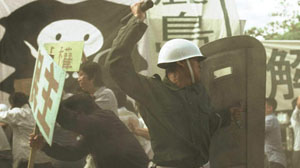
As Kelly steps outside the lines Taiwanese officials have carefully circumscribed around him, he finds himself embroiled in the historical controversy, presented in the form of the pro-democracy movement. At one of their forbidden protests, Kelly meets Ming, played by Tiao, who helps Kelly understand the complex history of modern Taiwan and China. Tiao is also speaking to the audience here, fulfilling one of his stated desires for the movie, to "help educate young Taiwanese and Chinese Americans on Taiwan’s unique political history and draw attention to the current global issues facing both nations."
During the Chinese Civil War, rebellious general Chiang Kai-shek retreated into Taiwan away from Communist Chinese forces, leading to martial law and repression of the native Taiwanese, a state of affairs that lingered for more than 30 years. During the time of Formosa, many Taiwanese were agitating for both democratic rule and a recognition of the brutality instituted by Kai-shek’s army.
Kelly soon finds the rotten core of his investigation in the coverups and repressive tactics of the regime, and he quickly discovers that the United States government has its own reasons for supporting this state of affairs. The complex, utilitarian relationship among America, China, and Taiwan is a revelation to him, just as it will be to American audiences today.
On a certain level, Formosa is reminiscent of Ridley Scott’s 1989 movie Black Rain, in which an American cop investigating a murder case in Japan must navigate an intricate, unfamiliar society and an uncooperative police hierarchy, ultimately seeing the world from an Asian perspective. Many other films in the 1980s grappled with understanding this unfamiliar Japanese way, fitting with American concerns at the time that everything from their cars to their office buildings would soon be owned or made by Japanese companies.
As that hysteria faded, Americans became interested in movies about other Asian countries, like Jackie Chan’s Hong Kong martial arts flicks or the elaborate Chinese costume dramas of Zhang Yimou. But these movies are more spectacle than commentary, andFormosa Betrayed is unique in its focus on today’s concerns about eastern encroachment. Just as Japan was an economic threat in the ’80s, our international debt today fairly demands that we coddle China, not confront it.
Despite taking place nearly 30 years ago, Kelly’s situation in Formosa becomes a metaphor for the contemporary dilemma of America’s relationship with China, as moral issues are hampered by political concerns. He deals with his frustration in a more dramatic Hollywood fashion than is allowed by countries on the international stage, but his emotions are certainly shared by many Americans in the audience, particularly those of Taiwanese descent.
Van Der Beek’s strong, understated performance breaks teen heartthrob stereotypes, reflecting the serious attempts of Tiao to portray the subtle political situation without the usual oversimplification of Hollywood good guy/bad guy polarization. Though it may not receive the publicity blitz usually accorded to big-budget international thrillers, Formosa Betrayed is an excellent mix of action and thoughtful themes that speaks particularly to the Asian-American community, and it should not be missed by anyone looking for a better understanding of the difficult political dance between East and West.
Formosa Betrayed will be released on DVD on Tuesday, July 13. To learn more, visit <www.formosathemovie.com>.
|