Special to The Asian Reporter
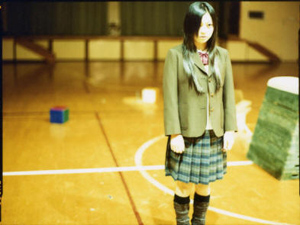
What would you do if you owed drug dealers 50 million yen? For Mitsuru (Tetsuji Tamayama) and Maki (Asami Mizukawa), the answer is simple: kidnap an innocent schoolgirl and hold her for ransom in an abandoned elementary school. But when they do, they receive a puzzling response to their demands — their kidnap victim has been dead for a year. In American urban legends, such a story might end with the kidnappers looking around to find their victim has disappeared, but Asian ghost stories are never quite so simple.
Soon after Maki relays the odd information about their captive to Mitsuru, strange things begin happening at their school hideout. Toilets gurgle mysteriously, objects appear or move suddenly, and Mitsuru is plagued by disturbing visions from his childhood. The little girl, played by Sanae Miyata, says little but evokes the kind of somber spookiness popularized by those creepy twin girls in Stanley Kubrick’s The Shining. She, too, suddenly appears and disappears, remains eerily silent, and is featured in many of the visions flashing through Mitsuru’s head.
In a parallel story, the parents of the girl — who, after a prolonged disappearance, turns out to be only presumed dead — visit a spiritualist who divines information about their daughter from a photograph. As Maki and Mitsuru discover more about the haunted schoolhouse and their captive, the parents learn more about their daughter’s fate and possible whereabouts. The storylines converge, not terribly neatly, soon after some of Mitsuru’s gang appear at the schoolhouse to further complicate the plot. Each new turn of events seems to spark yet another turn, so that the film will elicit occasional gasps of recognition or awareness as various mysteries are uncovered or resolved.
The result is a movie in the truest tradition of Asian ghost stories, where ghosts are indistinguishable from the living, and their presence, driven by unfinished business in the corporeal world, typically creates an epiphany in one of the characters. The little girl ghost is not all she appears (or disappears) to be, and Misturu must face up to his own painful past and deceptive present before the end of the film. Throw in a murderous specter stalking the cast members and layered subplots of betrayal, and there’s plenty for the viewer to keep track of in Pray.
The acting is generally strong, and the special effects are creepy without gouts of blood or unnecessarily graphic shots. Director Sato creates a creepy setting in the unlikeliest of locations, an elementary school that looks like it’s still being used, and not one abandoned for years. Unfortunately, he doesn’t seem to be up to the challenge of the rather sentimental plot, which manages to make us feel sorry for a little girl, as well as her grieving family, even as we’re horrified (and puzzled) by the chaos her ghost has wrought.
Amid all the twists and turns are some plot holes and loose ends, and — like ghost stories from the East or West — some healthy suspension of disbelief is required. Characters behave as characters in horror movies are supposed to, splitting up to explore strange noises, or running towards dead ends instead of exits, even though this irrational tendency is at odds with the intended emotional impact of the film. The title, too — mistranslated as "Prayer" in the subtitles — rings hollow, as characters do precious little praying, or discussion of praying, and religion or spirituality of any kind is only a minor concern.
There are good moments in Pray, both for fright and emotional revelation, but the result falls short of expectations, and befuddles more than reveals. Though we understand the back story of all the characters at the end, it doesn’t reveal much of anything connecting them to the events of the present, except for a common location. The little girl’s ghost and the marauding specter work at cross-purposes, eliciting their requisite screams or sighs, and seem a microcosm of the movie itself. Momentarily frightening or revealing, their impact quickly fades without clear connections to one another, and the dual plot of revenge and forgiveness similarly divides and confuses the audience.
Like many projects that try to do too many things at once, Pray doesn’t do a great job of either, and the ghost story and the sentimentally nostalgic counterplot undercut one another’s intentions. Ultimately, Pray doesn’t do much more than frighten, leaving the viewer to wonder if the intended prayer is for forgiveness, comeuppance, or simply clarity as to the intentions of the moviemaker. And though two out of three prayers answered isn’t bad, in this case, it isn’t really good, either.
Pray is now available on DVD. To learn more about Tartan’s Asian film offerings, visit <www.tartanfilmsusa.com>.
|