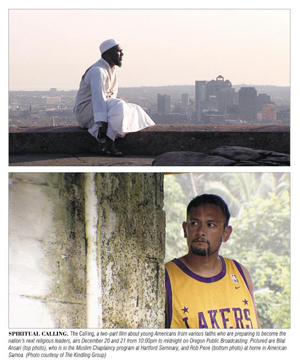
When I first found out that The Calling — a documentary that follows the lives of seven young seminary students — was four hours long, I was a little daunted. I sometimes have trouble sitting through a two-hour film. But when the final credits scrolled across the screen, I didn’t want it to end.
Series director and executive producer Danny Alpert, whose Oscar- and Emmy-nominated documentaries have explored systemic poverty and violence, has turned his lens on the next generation of religious leaders. The result is an absorbing and moving film that explores the gift and burden of being "called" to serve god.
"Doubt consumes faith as fire consumes wood," says Bilal, a Muslim chaplain at a prison, whose faith is tested by his crumbling marriage and the rise of anti-Muslim crimes. But he notes, that process "can be used as fuel."
That paradox captures the film’s essence, and The Calling is as much about doubt as it is about faith. It explores the sacrifices of service and the ongoing internal debates about identity and selfhood that are intrinsic to leading a life that is no longer one’s own.
There is the gifted seminary student Rob, who finds himself forced to choose between working with a predominantly white congregation or — in the wake of his father’s death — returning to Samoa to assume his father’s role as chief. Steven, one year away from becoming a Catholic priest, is still conflicted over his desire to one day have a family. To make ends meet, Jeneen, a single mom and former beauty queen, stars in TV commercials while awaiting a pastoral position to open up. As part of a dual-career couple, Yerachmiel tries to balance life as a new father and a newly minted rabbi.
The film is epic yet intimate. We meet the extended families of each person, and we see them as daughter, son, parent, friend, spouse, and community member. In giving space for each individual’s journey to unfold, the filmmakers deftly and imperceptibly weave the stories together to create a vivid and complex tableau of faith, identity, and the contradictions of contemporary society.
"The old model of being a rabbi," declares Shmuly, a first year rabbinical student, "of just sitting and teaching within the house of study … is not what I’m looking to do. It has to be about breaking boundaries … of where religion is relevant [sic], of breaking the boundaries of what a rabbi does."
For Shmuly, it means being on the front lines of social justice advocacy, of mobilizing Judaic ethics and values in service of social change. But his words are applicable to everyone featured in the film. Rob connects with young men of color at a southern California correctional facility through his raps about Christ, a modern-day version of a parable. Tahera, a Muslim chaplain at Mount Holyoke College, works with young women struggling to make sense of feminism and faith. In their personal lives as well as their public lives as religious leaders, how to make religion relevant to demands of contemporary life is an ongoing challenge.
At a time when mainstream media tends to highlight religions’ fanatical fringes, The Calling offers a powerful alternative. It undermines those representations by situating faith at the center of an ethical humanism. What the film emphasizes is not the doctrinal differences but their commonalities: to serve those who have been forgotten and marginalized in society, to help the needy and the sick, to lend an ear and to counsel those who are overwhelmed by their circumstances, and to celebrate the rituals and traditions that bring communities together.
Though the film is ostensibly about religion in contemporary life, it also speaks to larger questions of the human condition — Who am I and what is my purpose in life? Why am I here? What do I believe in and care about? For anyone who has struggled with these questions, The Calling offers an inspirational portrait of young men and women who grapple with the same questions everyday and have chosen to live by their convictions. In that sense, the film is not just about being called. It is about choosing to answer.
The Calling airs in two parts December 20 and 21 from 10:00pm to midnight on Oregon Public Broadcasting. A replay is scheduled for December 22 and 23 from 3:00 to 5:00am. For more information, call (503) 293-1982 or visit <www.opb.org>. To learn more, visit <www.itvs.org/films/calling>.
|