Special to The Asian Reporter
It sounds like the perfect fairy tale — a young architect learns that he has inherited a huge mansion from a relative, just in time for his return to Taipei from the U.K. Though it has been abandoned for years, the house holds plenty of architectural interest for James Yang (Jason Chang), who declines the real estate agent’s suggestion to sell it. "I like old houses," Jason says, and promptly moves in to the dusty mansion with his ballet dancer girlfriend, Yo (Terri Kwan). Now it’s beginning to sound more like a horror movie, and The Heirloom begins to take nasty turns from the moment James and Yo set foot in their new house.
The viewer is clued in to the sinister background of the house in the opening of the movie, which explains the (undoubtedly fictional) Chinese folk tradition of hsiao guei, which translates as "raising child ghosts." In this form of black magic, dead fetuses are kept in sacramental jars and fed with human blood in order to give the owner great power and fortune. Though the connection to the house is not initially explained, James and Yo begin to experience strange goings-on — specters, noises, and visions — that tell them that not all is well in their new home.
When their friends Yi-Chen (Chang Yu-Chen) and Cheng (Tender Huang) stay the night, things get worse. After several frights, both Yi and Cheng find themselves inexplicably returned to the house at midnight every night afterwards, frightened and disoriented, with no memory of having made the journey back. Yi-Chen uncovers an old story about a mass suicide at the mansion, and the family secret ofhsiao guei begins to come out. After Cheng is found dead, strangled by a rope that cannot be found, James and Yo realize that the house and its malevolent secrets are to blame, and they must face the full inheritance that the mansion represents.
Leste Chen, a hot young Taiwanese director, brings much mood and atmospherics to the film, and frightens mostly by implication — this is not a blood-soaked gore fest, but a movie that circumvents such indelicate horror clichés. The plot, however, is strictly B-grade, with holes wide enough to toss a mansion through and convenient rationalizations that move the plot towards its inevitable conclusion. One example of this happens when Yo is terrified at what has happened to Yi and Cheng, and James manages to convince her to stay in the house by saying that nothing horrible has yet happened to them. This is tantamount to a group of teenagers deciding to split up while exploring the creepy abandoned mine, the kind of decision that makes audience members scream their disagreement at such an abrogation of common sense.
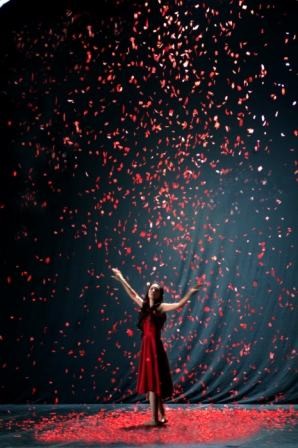
This is not to say that the movie is a failure, or even a B-grade horror film. Leste succeeds superbly in creating a spooky atmosphere, and scenes from Yi’s upcoming performance (as Eurydice in Orpheus and Eurydice) provide a haunting parallel to the events of the film. Yu-chen’s performance is superior to the somewhat wooden Chang, whose only chance to show real emotion comes in the film’s final anguished scenes. The promise of the premise, both in its metaphorical and plot-related implications, is also unexploited, as more is made of the mass suicide than the family’s macabre tradition.
There is much that shows promise in The Heirloom, and Chen is sure to improve his storytelling ability as he gets more films under his belt. His repertoire has largely consisted of music videos to this point, which is undoubtedly why this film works with style more than substance. It is also remarkable for being a high-quality horror film produced in Taiwan, which has become known more for derivative, second-tier Asian horror schlock. While it doesn’t work on all levels, and suggests far more about the plot and the potential of its creators than it delivers, The Heirloom is nonetheless a well-made movie with interesting moments and a highly stylized, eminently watchable aesthetic that bodes well for Leste Chen’s future in Asian cinema.
The Heirloom is now available on DVD. To learn more about Tartan’s Asian film offerings, visit <www.tartanfilmsusa.com>.
|