JAKARTA, Indonesia — Seismologists say last month’s powerful earthquake off western Indonesia increased pressure on the source of the devastating 2004 tsunami: a fault that could unleash another monster wave sometime in the next few decades.
"The spring was pushed a little bit tighter," said Kerry Sieh, director of the Earth Observatory of Singapore.
The timing of another megathrust temblor, if it’s on the way, "could have been advanced by a few years," he said.
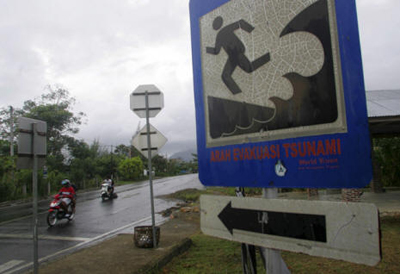
The mid-April 8.6-magnitude earthquake also showed that tsunami-ravaged Aceh province, close to the epicenter, remains unprepared for the next Big One. Though the quake caused little damage, the country’s disaster-management chief acknowledged that evacuation efforts were "a big mess."
Indonesia, located on the "Ring of Fire," an arc of volcanoes and fault lines encircling the Pacific Basin, has unleashed some of the deadliest seismic events of the past century. But the 9.1-magnitude quake that struck in 2004, triggering a 100-foot-high tsunami that killed 230,000 people, caught scientists off guard because its fault, west of Sumatra island, had long been quiet.
Since then scientists have conducted a flurry of research, looking at tsunami sand deposits, uplifted coral, and GPS data. By observing past patterns of quakes, which tend to be cyclical, they better understand what might happen next, though it’s impossible to make predictions with any certainty.
The two last behemoth quakes occurred around 1393 and 1450, and Sieh said the 2004 earthquake may be just the first part of a similar couplet.
Stresses loading up on the fault for centuries were relieved only about halfway eight years ago, Sieh said. And the recent tremor effectively squeezed the overlapping tectonic plates that form the fault.
"The next megathrust rupture could be in 50 years or in five," he said. "It’s impossible to know."
He said a separate section of the fault, hundreds of miles to the south, also could snap within the next 30 years, sending a tsunami slamming into Padang, a low-lying Sumatran city with a population of 1 million.
The recent quake was a "strike slip" quake, which means it thrust from side to side, not vertically, and therefore did not generate a large tsunami.
Danny Hilman Natawidjaja, a geologist with Indonesia’s Institute of Science, agreed that the mid-April quake piled a small amount of new stress onto the megathrust, and that "both Aceh and Padang need to be prepared."
"Authorities need to take a good look at what didn’t work well … and find a way to fix it," he said. "Hopefully, this is an opportunity to learn."
Countries along the Indian Ocean have spent millions of dollars installing buoys capable of detecting waves generated by seismic activity and building up a vast communications network, from alarms on beaches to systems that deliver warnings by television, radio, the internet, and mobile phone text message.
The quake shows that Aceh has a long way to go, even though there was almost no damage and the only deaths were from heart attacks.
Had it been the next Big One, sending waves crashing to shore within 30 minutes, tens of thousands of people could have died in Aceh, where about three-quarters of the 2004 deaths occurred.
Traffic was at a complete standstill as the provincial capital, Banda Aceh, emptied out, people screaming and crying as they piled into cars and motorbikes to try to get to high ground. Many said that after two hours they had only moved six miles. Some finally gave up, abandoning their vehicles and walking.
"It was a big mess," said Syamsul Maarif, head of the national disaster management agency.
"What we found out ... was that evacuations were nothing like the simulations," he said.
Among the proposals now being discussed are adding new evacuation routes and expanding existing roads to high ground out of Banda Aceh. Officials also are thinking about building more strong, tall structures along the way so that people unable to get out of town would have a better chance of surviving.
Only seven buildings, all built with the help of international aid that poured in after the 2004 disaster, have been set up as emergency shelters. Maarif said some buildings such as shopping malls, mosques, and schools should be added to the list of possible safe havens.
Associated Press writer Fakrurradzie Gade contributed to this report from Banda Aceh, Indonesia. |