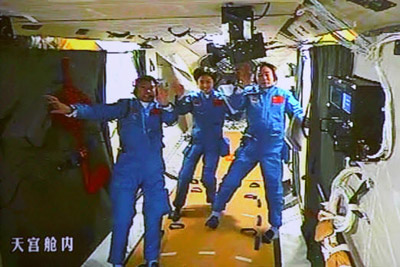
BEIJING (AP) — A Chinese spacecraft carrying three astronauts docked manually with an orbiting module last month, a first for the country as it strives to match American and Russian exploits in space.
The Shenzhou 9 capsule’s maneuver with the Tiangong 1 module was shown live on national television. It followed the docking, which was carried out by remote control from a ground base in China.
The Chinese astronauts lived and worked in the module for a week as part of preparations for manning a permanent space station. They returned to the Shenzhou 9 capsule June 24 and disconnected in preparation for the manual reconnection.
Wu Ping, spokeswoman for China’s manned space program, told reporters in Beijing that hand levers were used to control Shenzhou 9 and position it to dock with the orbiting module. The maneuver was "precise and perfect" and the three astronauts carried it out "calmly and skillfully," Wu said.
"This success in manual docking represents a major breakthrough in our space rendezvous and docking technologies," Wu said.
China’s next goals include another manned mission to the module later this year and replacing Tiangong 1, which was launched last year, with a permanent space station around 2020. Possible future missions could also include sending a man to the moon.
China’s permanent space station is to weigh about 60 tons, slightly smaller than NASA’s Skylab of the 1970s and about one-sixth the size of the 16-nation International Space Station.
The Shenzhou 9 crew included 33-year-old Liu Yang, an air force pilot and China’s first female space traveller. Liu was joined by mission commander and veteran astronaut Jing Haipeng, 45, and crewmate Liu Wang, 43.
Their mission, which lasted 13 days, is China’s fourth manned mission. Shenzhou 9 launched June 16 from the Jiuquan center on the edge of the Gobi desert in northern China.
The astronauts spent several more days in the module before returning to the capsule and manually separating from Tiangong 1. Once back in Shenzhou 9, they returned to Earth, landing in Inner Mongolia June 29.
China is hoping to join the United States and Russia as the only countries to send independently maintained space stations into orbit. It is already one of just three nations to have launched manned spacecraft on its own.
Wu said China spent $3.1 billion on its space program between 1992 and 2005. By the time the next Shenzhou mission is completed, Beijing will have spent an additional $3 billion, she said. |