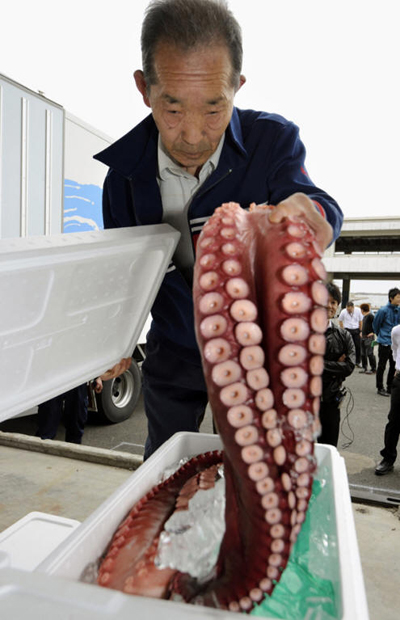
TOKYO — The first seafood caught off Japan’s Fukushima coastline since last year’s nuclear disaster went on sale June 25th, but the offerings were limited to octopus and marine snails because of persisting fears about radiation.
Octopus and whelk, a kind of marine snail, were chosen for the initial shipments because testing for radioactive cesium consistently measured no detectable amounts, according to the Fukushima Prefectural (state) fishing cooperative. Before they could be sold, they were boiled so they would last longer while being tested for radiation.
Flounder, sea bass, and other fish from Fukushima can’t be sold yet because of contamination. It was unclear when they would be approved for sale as they measure above the limit in radiation set by the government. The government is testing for radioactive iodine as well, but its half-life is shorter than cesium and thus is less worrisome.
"It was crisp when I bit into it, and it tasted so good," said Yasuhiro Yoshida, who oversees the seafood section at York Benimaru supermarket in Soma, which sold out of about 65 pounds of the snails and 90 pounds of the octopus that had been shipped to the store.
The March 11, 2011 earthquake and tsunami left the coastlines of northeastern Japan devastated and displaced tens of thousands of people. Entire towns were contaminated by the radiation leaking from the Fukushima Dai-ichi nuclear plant, where three reactors went into meltdown.
"I was filled with both uncertainty and hope today, but I was so happy when I found out the local supermarket had sold out by 3:00pm," said Hirofumi Konno, an official in charge of sales at the fishing cooperative in Soma city in coastal Fukushima.
He said he hoped crabs would be next to go on sale as radiation had not been detected in them, but he acknowledged things will take time, perhaps years, especially for other kinds of fish. Radiation amounts have been decreasing, but cesium lasts years.
The octopus and snail sold at almost half of what they fetched before the disaster, he said. But he said people were buying Fukushima seafood to show support for local fishermen. The items were available locally, but not in the whole prefecture or the Tokyo area.
Nobuyuki Yagi, a University of Tokyo professor studying the fisheries industry after the disaster, said serious concerns remain over whether anyone would buy Fukushima fish, and the key lay in finding the types of fish that don’t store radioactive elements.
"Fishing cannot survive unless people buy the fish. That may seem obvious, but Fukushima is facing up to this," he said in a statement.
Farmlands have also been contaminated, and every grain of rice will be tested at harvest in some areas before they can be sold. The image of Fukushima produce has been seriously tarnished, and worried consumers, especially those with children, are shunning Fukushima-grown food. |