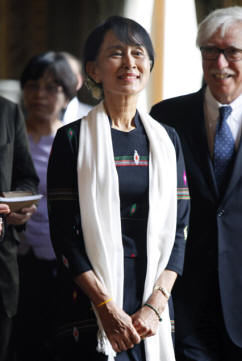
PARIS — Opposition leader Aung San Suu Kyi says she holds no grudges against the military regime that kept her under house arrest for some 15 years and, instead, views it as a group she can work with as the country moves toward democracy.
Her focus is on practical matters, Suu Kyi said at a news conference, not "abstract ideas of justice."
Suu Kyi talked to the press after a meeting with French President François Hollande during her four-day visit to France that closed out a European tour that took her to Switzerland, Norway, Ireland, and Britain.
The Nobel Peace Prize winner has been a world symbol of courage and hope for facing down Myanmar’s military regime, which ruled for 49 years until last year. She is now helping the country usher in what many hope is a transition to democracy. And pragmatism seems to be her watchword.
"I certainly do not bear any grudges against the military regime," she said. "I never think of them as those people who placed me under house arrest for so many years. This is not the way we bring about national reconciliation.
"I think of them as people with whom I would like to work in order to bring reform to our country."
Hollande, at her side, said France intends to support all those involved in the democratic transition so Myanmar achieves a "full and complete democracy."
He cautioned that France will keep a vigilant eye on financial transactions and industrial projects that a more open Myanmar will likely attract.
It was unclear whether he was making reference to the French oil giant Total, which has been present in Myanmar for decades under military rule there, and became the object of criticism.
Suu Kyi said she wants "democracy-friendly, human rights-friendly" investments that protect the environment of her country, which she refers to by its colonial name, Burma. However, she added, "I do not want to be shackled by the past."
She said that "we must go forward to the future," and that Total has compensated people displaced by a gas pipeline. She also said investment in technology would be welcome from France and others.
"We would like to give everybody an opportunity to engage in business that actually strengthens the process of democratization," she added.
Suu Kyi, who turned 67 last month during her trip, emphasized youth during her visit to France and, during her news conference, the word "future" constantly found its way into her remarks.
Among her activities in France was a conference-debate with some 1,400 students at Sorbonne University. Education is vital so that the new generation can carry the ball, and anchor the hoped-for democracy once people like herself retreat from the foreground, she said.
Youth make up 32 percent of Myanmar’s population and play an important role in Suu Kyi’s party, which was the big winner in partial parliamentary elections in April.
Suu Kyi also met with foreign minister Laurent Fabius to plant a "tree of liberty" in the ministry garden.
She has been collecting honors during her travels conferred on her many years ago while she was trapped at home, including the Nobel Peace Prize in Oslo and an honorary degree from Oxford, which she once attended.
In Paris, she picked up an award granted in 2004 that made her an honorary citizen of the city of Paris.
During her European travels, Suu Kyi has been accorded the attention of a diva. Asked at the news conference if she sees herself as the icon she embodies for many in the world, she scoffed, calling it unsettling, even if she understands the human need to put a face on everything.
"I represent the human face of the movement for democracy in Burma, and I think that is where it should remain," she said. "I’m always very disturbed when people speak of me as an icon. Icons just seem to sit there doing nothing at all — and I work very, very hard, I assure you." |