PHNOM PENH, Cambodia — The body of Cambodia’s late King Norodom Sihanouk returned to his homeland, welcomed by hundreds of thousands of mourners who packed tree-lined roads in the Southeast Asian nation’s capital ahead of the royal funeral.
Sihanouk, 89, died October 15 of a heart attack in Beijing, where he had been receiving medical treatment since January.
The former monarch was the last surviving Southeast Asian leader who guided his nation through post-war independence. He served as prime minister and twice as king before abdicating the throne for good in 2004.
A Boeing 747 arranged by the government of China — a steadfast friend of the late monarch for decades — brought back the body, which was accompanied by Sihanouk’s widow, Queen Mother Monineath.
Also on the plane was Sihanouk’s son and successor, King Sihamoni, and Cambodian Prime Minister Hun Sen, who had travelled to Beijing to retrieve the body.
The casket was carried on an elaborate motorized float from the airport to the Royal Palace, where Sihanouk will lie in state for three months. During that time, the public is able to pay respects before the body is cremated according to Buddhist ritual.
Monks and soldiers rode the float, designed to represent a giant golden phoenix-like bird.
Crowds had gathered since morning along the five-mile route, many wearing white, a color of mourning in Buddhist tradition. Officials estimated the crowd at more than 200,000, while state television broadcaster TVK later said about 500,000 people turned out.
When the float passed by, wailing grew louder among the onlookers. Many, especially the elderly, bowed low with hands pressed together above their heads in a mark of respect. Some tossed flowers.
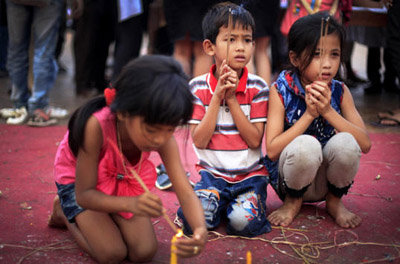
Thousands of people, some with tears in their eyes, gathered outside the palace in swelteringly hot weather, many of them kneeling before a huge portrait of the late monarch on the main wall, which was also adorned with lights. They carried flowers, lit candles, burned incense, and prayed.
"I needed to come here today to pray and see the body of the king because he dies only one time, not twice," said Khy Sokhan, a 73-year-old woman in a wheelchair outside the palace.
While older people seemed more emotionally affected, younger people also came to grieve.
A young woman who travelled with her family from Kampong Cham province in eastern Cambodia described mixed emotions.
"I am happy because I have a chance to come to Phnom Penh, see the coffin of the grandfather-king with own eyes, but I feel so sad to see him passing away," said 20-year-old Kay Savath.
Sihanouk played many roles in the Cambodia he helped navigate through half a century of war and genocide. He was known as a revered independence hero, communist collaborator, eccentric playboy, and a cunning and sometimes ruthless monarch and prime minister.
First crowned king in 1941, he stepped down in 1953 to pursue a political career. He became head of state, and during the Cold War tried to steer his country on a neutralist course.
Eventually, however, his country became enmeshed in the conflict in neighboring Vietnam, leading to his first fall from power and culminating in the murderous rule of the communist Khmer Rouge in the late 1970s, during which about 1.7 million of his countrymen perished.
His legacy became tainted because in an effort to regain his political influence, he made common cause with the Khmer Rouge, though the regime never yielded power to him and killed five of his children.
After the Khmer Rouge were ousted and Sihanouk regained the throne in 1993, he rebuilt his reputation as the conscience of his country. But Hun Sen, a tough and canny politician who had defected from the Khmer Rouge, undercut his influence, and a discouraged Sihanouk gave up the throne eight years ago. Sihanouk spent much of the rest of his life in China.
The passage of time and Sihanouk’s retreat into quiet retirement in China made the once-dynamic monarch more of a historical figure than a contemporary statesman, but his passing was noted internationally. |