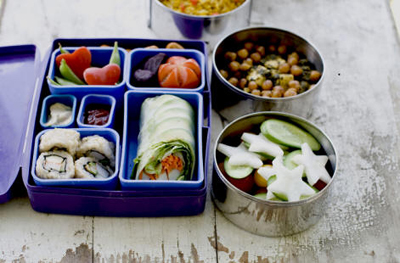
If you — or your kid — are blanching at the thought of yet another year of day-after-day brown bagged PB&J, perhaps this is the year to mix up the lunchbox offerings a bit.
Of course, that’s an easy thing to say. It’s a lot harder to execute when the morning rush hits and getting the family out of bed and out the door has all the ease of a multinational military maneuver. And that is why the typical parent is unlikely ever to fully abandon that all-American sandwich.
But that doesn’t mean you can’t mix things up now and then. The trick is to have something from which to draw inspiration — and we don’t mean staring blankly into the refrigerator at 7:00am.
Our advice? Look elsewhere in the world. Wherever you look, parents every day must figure out fun and healthy ways to feed the little ones. Their answers sometimes are startlingly different than our own, but often are easily adapted. It’s a simple way to get inspired, as well as to expose kids to new cultures.
You might even turn it into a family research project. Once a week (or if that’s too much, try once a month), let the kids pick a new country and read up on what children there eat for lunch. Start at the library; there have been plenty of child-friendly books published on this very subject.
To help you start the year off right, we’ve summed up a few easy ideas.
Bento Boxes
Japanese farm workers once carried their lunches into the fields wrapped in bamboo leaves, and later in simple wooden boxes. Today, these bento boxes have evolved into edible works of art, with Japanese parents — and a growing number of Americans — shaping rice balls into hearts and stars, making meatballs into faces, and cutting vegetables into flowers. But even ordinary lunch food takes on a special quality in a bento.
"It’s not so much the type of food, but what I call ‘a bento state of mind,"’ Debra Samuels, author of My Japanese Table, said via e-mail. "I see the concept of bento as basically a food sampler, a colorful culinary puzzle. The benefits of the bento are smaller portions and greater variety of food."
Think about it — there’s a reason Lunchables are popular with kids. They get a bunch of colorful foods packed into a box. It’s like a private mini buffet. But using a bento box.
To assemble a bento box, Samuels suggests thinking in terms of five colors or five types of food. Kid-sized vegetables such as mini-summer squash, cherry tomatoes, and Persian cucumbers make great dippers for dressing. Wraps with meat and vegetables, as well as cheese quesadillas studded with red peppers also are festive.
And part of the bento philosophy is to present the items attractively, Samuels says. For instance, cut sandwiches into triangles and set them on end. Fill mini-muffin cups with favorite shaped pastas or strawberries. Spear finger foods with fun toothpicks.
"Opening a bento box is like opening a gift," Samuels says. "When you lift the lid, there is a big ‘Ooh!’ factor."
Tiffin
In India, lunch is all about the tiffin, a lunchbox made from stackable metal containers that usually are filled, then clamped together. And Anupy Singla’s tiffins are the envy of the other kids in her children’s Chicago area school. Singla, author of the recently released Vegan Indian Cooking, may send her children off with rice and lentils, rotis and sabzi (a dry vegetable curry), or a potato-stuffed flat bread.
"Those are the things that stay fresher during the day," she says. Vegetables like kohlrabi and daikon (Asian radish) hold up well and complement the other flavors. Sometimes lunch is packed in a tiffin, but often Singla just puts the items in a freezable lunchbox available in many stores or online.
More Indian kid favorites include papardam, lentil wafers that can be crisped in the microwave and substituted for chips, and what Singla calls "chickpea poppers," cooked or canned chickpeas sprinkled with salt, garam masala, and oil, then roasted at 325º Fahrenheit for 25 minutes. Salads can take on an Indian flavor by topping them with whole beans or lentils, then dressing them with oil, lemon, and a little toasted cumin seed.
The good news? Many of these items are available pre-made at Indian grocers. Even Trader Joe’s carries packaged Indian meals.
Fiambrera
The Filipino fiambrera is similar to a tiffin, says Amy Besa, author of Memories of Philippine Kitchens and co-owner of the Purple Yam restaurant in Brooklyn, New York. It’s simply a stacked, stainless steel container.
Vinegary chicken adobo, the signature dish of the Philippines, holds wide appeal for children, Besa says, possibly because it often has a hint of soy sauce. "The most fervent people at the restaurant for chicken adobo are the children," she says. "I have parents who say it’s the six-year-old who’s insisting that we eat here."
Adobo, usually a saucy dish of chicken or pork braised in vinegar, garlic, soy sauce, bay leaves, and black peppercorns, is easily adapted for the lunchbox as a dry version, Besa says.
Braise the meat in the mixture, making sure to go light on the soy sauce. Remove the meat, then simmer the sauce until reduced and thick. Spoon a dollop of the thickened sauce over the meat and stick it under the broiler until it’s caramelized. Send it to school on a bed of fluffy white rice paired with a cold tomato and cucumber salad sprinkled with vinegar.
Hand Pies
Nearly every culture has a savory hand pie that works as a quick and tasty lunch, says Rebecca Federman, culinary librarian at the New York Public Library and co-curator of its current exhibit, "Lunch Hour NYC."
An influx to New York of Asians, Latin Americans, and other immigrants during the 1960s raised the profile of their lunch staples, Federman says. Today, spiced Jamaican beef patties and flaky chicken-filled Latin-American empanadas feed hungry New Yorkers. Indian samosas stuffed with peas and potatoes, meat-filled Cornish pasties from England, and sweet-spicy, beef-filled Bolivian saltenas are among the many lunchbox-friendly choices. And of course there are Italian calzones and Jewish knishes.
Best yet, they all taste delicious hot or at room temperature.
To make hand pies at home, fold a stuffing of your choice into pre-made empanada wrappers (sold frozen at most grocers), wonton skins, or even refrigerated American pie crust. Or, make it even easier: Pick them up at your local ethnic bakery or grocer, or even in the frozen food section of many grocers. |