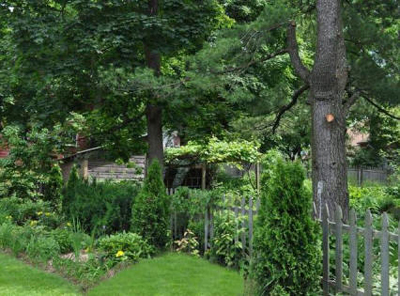
If your garden or yard is feeling too small, expand your horizons without buying another square inch of property or doing much work. Just borrow some landscape.
"Borrowed landscape" is a technique frequently used in designing Japanese gardens, where it is called shakkei, but it can be employed in any garden style. The idea is to incorporate distant elements of the surrounding landscape into your own, creating the feeling of greater space.
You could reap a feeling of infinite space if that distant element is a mountain or ocean that stretches all the way to the horizon. Or you could just borrow a bit of scenery from your neighbor’s yard — an attractive clump of birch or larch trees, a grape arbor or a pergola dripping with wisteria blooms, for example.
Begin your borrowing
First, look around to see what you’d like to borrow. Ideally, this should be done before you plan or plant anything, even before you’ve moved any dirt or stones around in your own garden. But it’s usually not difficult to borrow landscape even into an existing garden.
No need to borrow a whole scene. A view of a lumbering meadow that breaks into a range of mountains might create too expansive a feeling if on view from everywhere in your garden. Part of the art in gardening is balancing a sense of coziness and enclosure, which gives us the word "garden" (from the same root as the words guard, yard, and girth), with a feeling for the infinite, for limitless horizons.
A window of some expansive scene — through an opening in a fence or hedge, for example — might make such a view all the more precious. As for your neighbor’s pergola clothed in wisteria: You might not want to also see the red sports car he always parks nearby.
Bring focus on what you want to borrow
Once you’ve decided which surrounding scenery you might like to borrow, bring it on home to your garden. This might entail nothing more than planting or building something to obstruct part of a view, thus lending focus to what remains. Or it might require removing some obstruction, such as a pine tree in the wrong place or a fence that’s too tall.
Most borrowed scenery represents just a slice of what is out there, so bringing it home might just mean selectively trimming that pine tree or making just a hole in the fence. A cut in the fence in itself contributes to the look of the garden. Popular in both oriental and occidental gardens are fences or walls with "moon windows," circular openings that allow a chosen view.
By screening out much of the landscape beyond, a small opening begs viewing of it; a relatively narrow rectangular opening in a fence or wall can bring attention to a distant view. A pair of prominent evergreens and a nonfunctional gate could provide a psychological entryway into your borrowed landscape.
Mimic to bring the outside in
Another way to borrow landscape is to echo elements in the distant landscape with similar elements in your garden.
A grouping of rocks in your space might show kinship with a similarly shaped distant mountain. A small but upright tree might form a connection to stately, spired conifers in the distance. A trickle of water — even rounded stones representing a dry streambed — might form a visual association with a majestic waterway far away.
In most cases, borrowing a landscape entails less muscle than creating one. |